

Norin the Wary
 Commander
Norin the Wary turns every flurry of spells and attacks into repeated enter-the-battlefield value, disruptive board states, and incremental table-wide damage.
Public decks: 26Bracket: 4

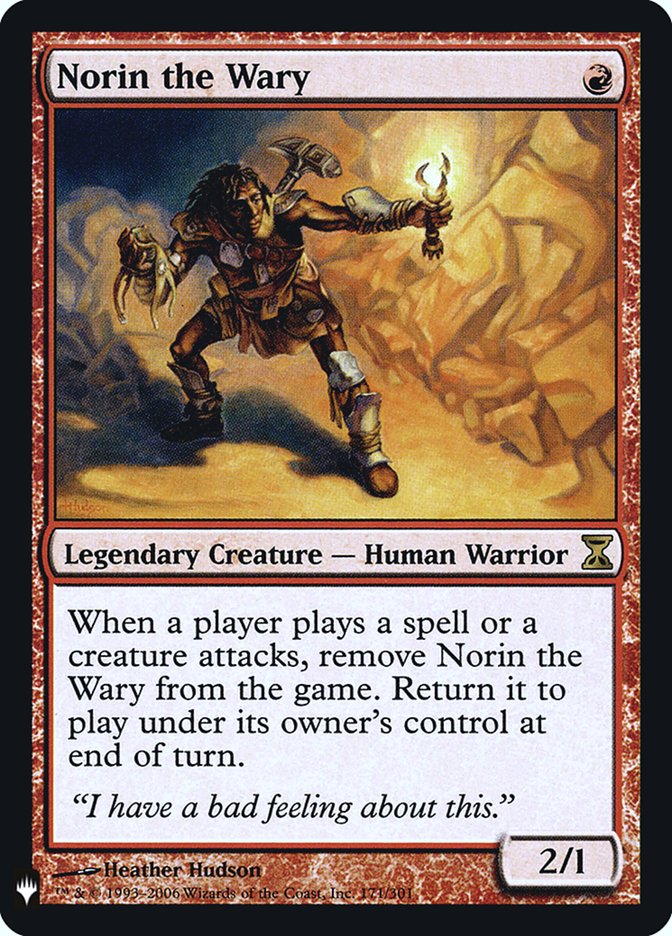
Card text
Legendary Creature — Human Warrior
When a player casts a spell or a creature attacks, exile Norin. Return it to the battlefield under its owner's control at the beginning of the next end step.
Building around this commander?
Use MTG Master to build or analyze a Commander deck around this card, check consistency, and find weak spots before your next game.
Overview
- Cast Norin early, then let spells and combat repeatedly exile and return him at end step.
- The central plan is to convert Norin's recurring return to the battlefield into damage and creature-entry value.
- The available signals point toward a high-powered mono-red shell with fast mana, selection, targeted interaction, and broad reset buttons.
- Blood Moon and Magus of the Moon can pressure multicolor mana bases while Norin continues his evasive routine.
- Games often close through accumulated enter-the-battlefield damage rather than commander damage.
Common lines
- Deploy Norin, establish a creature-entry payoff, then use normal spellcasting and combat to generate repeated end-step triggers.
- Use fast mana or cost reduction to develop several permanents before opponents can stabilize.
- Apply mana pressure with Blood Moon or Magus of the Moon, then leverage the resulting tempo window to advance your board.
- Clear crowded boards with Blasphemous Act or punish artifact-heavy development with Vandalblast before rebuilding around Norin.
- Use a wheel effect or card selection to find a payoff, interaction piece, or pressure card when the first plan is disrupted.
Strengths
- Norin costs only one mana and repeatedly returns without needing to be recast.
- Every player can help trigger his exile ability by casting spells or attacking, making the commander naturally active in multiplayer.
- Repeated creature entries can translate into persistent damage through cards such as Impact Tremors, Purphoros, God of the Forge, and Witty Roastmaster.
- The deck can attack mana bases with Blood Moon and Magus of the Moon.
- It has access to efficient red interaction, including Chaos Warp, Vandalblast, and Blasphemous Act.
- Norin's tendency to leave the battlefield before spells resolve can make him awkward to remove with ordinary sorcery-speed interaction.
Weaknesses
- The payoff permanents are often more important than Norin himself, so removing them can significantly slow the deck.
- Norin does little on his own beyond repeatedly leaving and returning, making setup hands less threatening without supporting cards.
- His exile trigger makes him unreliable as a blocker during combat.
- Mana-denial and chaotic exchange effects can draw immediate attention from the table.
- A board built around artifacts and enchantments can be vulnerable to broad permanent interaction.
- The deck's damage plan may need multiple end steps to finish the table if its entry payoffs are not amplified.
Rule zero notes
- Disclose the presence of Blood Moon and Magus of the Moon, as they can substantially restrict multicolor mana bases.
- Mention that the list includes fast mana such as Sol Ring, Mana Vault, Chrome Mox, and Mox Amber.
- Flag Confusion in the Ranks as a potentially chaotic permanent-exchange effect that can make games harder to track.
- Set expectations for a high-powered game; the snapshot's bracket mode is 4.
- Let the table know whether your build is focused on incremental damage, mana denial, or both.
Matchups
Best into
- Multicolor decks that lean heavily on nonbasic lands.
- Creature-heavy midrange pods where Blasphemous Act can reset a developed board.
- Tables that cast many spells and attack frequently, giving Norin more opportunities to cycle through exile and return.
- Artifact-heavy boards that are exposed to Vandalblast.
Struggles against
- Pods with abundant enchantment and artifact removal for creature-entry payoffs and mana pieces.
- Fast, proactive decks that can win before incremental damage engines are established.
- Low-board games where opponents offer few attacks and the table gives Norin fewer incidental triggers.
- Tables prepared to immediately remove mana-denial permanents or punish a player for deploying them.
Recent public decks
New Deck
Aug 26, 2026
P
Play1272...
Bracket 4Deck Power 7.3
Norin masterworksss
Aug 20, 2026
P
Play1272...
Bracket 4Deck Power 7.4
Norin grandiose
Aug 17, 2026

Play5882...
Bracket 4Deck Power 7.4
New Deck
Apr 8, 2026
Play5882...
Bracket 4Deck Power 7.8
New Deck
Apr 8, 2026
Play5882...
Bracket 4Deck Power 7.6
New Deck
Apr 8, 2026
Play5882...
Bracket 4Deck Power 7.8
Norin
Apr 30, 2026

Neurosis
Bracket 4
New Deck
Apr 3, 2026
Play5882...
Bracket 4Deck Power 7.8
T
Apr 3, 2026
Play5882...
Bracket 4
Hiiii
Apr 3, 2026
Play5882...
Bracket 4
New Deck
Apr 3, 2026
Play5882...
Bracket 4
Test norin max
Apr 1, 2026
P
Play3814...
Bracket 5Deck Power 5.2
Page 1 of 3
Staples
Browse all public decksFAQ
What does Norin the Wary actually do for the deck?
Norin repeatedly leaves and returns whenever a player casts a spell or a creature attacks. That repeatable return supports permanents that reward creatures entering the battlefield.
How does this deck usually win?
It typically accumulates damage from creature-entry payoffs such as Impact Tremors, Purphoros, God of the Forge, and Witty Roastmaster. A developed board can turn each of Norin's end-step returns into table-wide pressure.
Why is Norin difficult to interact with?
When a spell is cast, Norin's trigger can exile him before that spell resolves. He returns at the beginning of the next end step, though the supporting permanents remain important targets.
Can Norin reliably block?
Usually not. A creature attacking triggers Norin, and he will normally exile before blockers are declared.
How disruptive is the mana-denial plan?
Blood Moon and Magus of the Moon can be very restrictive against multicolor mana bases. They are worth discussing before the game, especially at tables expecting less mana denial.
Is this a high-powered commander deck?
The snapshot places its bracket mode at 4 and shows fast mana, efficient interaction, mana pressure, and compact damage engines. The exact power level still depends on how heavily an individual list emphasizes those elements.