
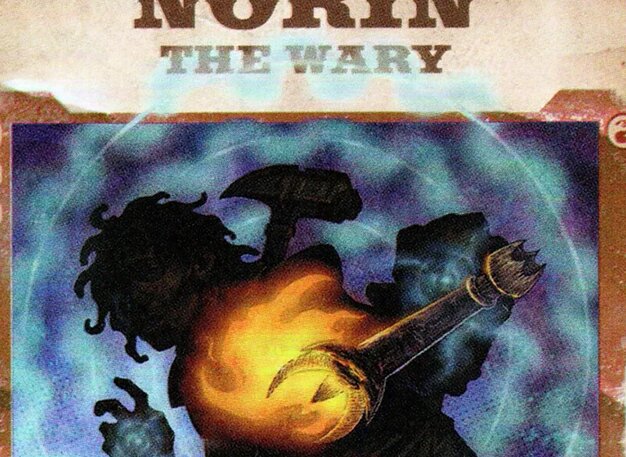
Norin the Wary // Norin the Wary
 Commander
A one-mana commander that weaponizes constant blinking into steady chip damage, token pressure, and chaos-infused board control.
Public decks: 4Bracket: Varies

Card text
Legendary Creature — Human Warrior
When a player casts a spell or a creature attacks, exile Norin. Return it to the battlefield under its owner's control at the beginning of the next end step.
//
When a player casts a spell or a creature attacks, exile Norin. Return it to the battlefield under its owner's control at the beginning of the next end step.
Building around this commander?
Use MTG Master to build or analyze a Commander deck around this card, check consistency, and find weak spots before your next game.
Overview
- Norin the Wary naturally flickers on most turns, repeatedly triggering “enter the battlefield” payoffs without needing extra setup.
- The deck often leans on ping engines like Impact Tremors, Witty Roastmaster, Molten Gatekeeper, and Agate Instigator to turn each return into damage.
- Genesis Chamber style play patterns can snowball the board with tokens, giving you both offense and fodder while Norin stays hard to interact with.
- Red disruption and pressure pieces (Blood Moon, Magus of the Moon, Manabarbs) can slow the table long enough for your incremental damage to matter.
- Sweeper-heavy control lines are common, using Blasphemous Act and Chain Reaction to reset creatures while your engine rebuilds quickly.
Common lines
- Land Norin early, then spend the midgame layering a damage payoff plus a token maker so every end step advances your clock.
- Use sweepers to clear opposing boards, then immediately re-establish pressure because Norin returns automatically and your engines keep ticking.
- Deploy “chaos” pivots like Confusion in the Ranks to scramble board development and punish opponents for committing permanents.
- Leverage burst mana and card access (Jeska's Will, Chandra, Torch of Defiance, Outpost Siege) to keep deploying threats through interaction.
Strengths
- Commander resilience: Norin dodges many conventional removal patterns by exiling itself repeatedly.
- Reliable inevitability via repeated small damage triggers that add up across a full pod.
- Strong into creature-centric tables thanks to Blasphemous Act and Chain Reaction lines.
- Can attack mana bases and pacing with Blood Moon, Magus of the Moon, and Manabarbs.
- Capable of playing a “messy” table where Confusion in the Ranks makes clean game plans difficult.
Weaknesses
- Often relies on key permanents sticking; removing your damage engines can dramatically slow your clock.
- Mono-red constraints can make it harder to answer certain permanent types cleanly outside of effects like Chaos Warp and Wild Magic Surge.
- Chaos and prison-style pieces can generate table friction and may draw early focus.
- Incremental damage plans can be slower to close if opponents gain life or stabilize behind noncreature defenses.
- Fast combo tables can outrun you if your disruptive pieces don’t line up early.
Rule zero notes
- This build can include land-denial pressure via Blood Moon and Magus of the Moon.
- Manabarbs can heavily punish spellcasting and may function like a soft prison piece.
- Confusion in the Ranks creates high-variance board states and can be frustrating for some pods.
- Fast mana like Chrome Mox and Mana Vault can speed up early setup and change table expectations.
Matchups
Best into
- Creature-heavy midrange pods that overcommit to the battlefield
- Greedy multicolor mana bases that struggle under Blood Moon effects
- Tables that play lots of small spells and combat steps, naturally triggering Norin repeatedly
Struggles against
- Decks that can consistently remove or lock down your key noncreature engines
- Very fast combo pods where incremental damage doesn’t race without early disruption
- Strategies that ignore the red zone and don’t care about board wipes
Recent public decks
No public decks are available yet.
Staples
Browse all public decksFAQ
How does Norin actually win games?
Most wins come from stacking repeated ETB-based damage (like Impact Tremors, Witty Roastmaster, Molten Gatekeeper, or Agate Instigator) until the table is in burn range.
Is this a combo deck or a grindy deck?
It tends to be grindy and inevitability-based, but fast mana and strong engines can create explosive turns that feel combo-adjacent.
Why run so many board wipes?
Blasphemous Act and Chain Reaction reset creature boards while your commander effectively survives the churn and your engines rebuild quickly.
What’s the role of Confusion in the Ranks?
It can act as a disruptive pivot that turns every new permanent into a liability, making it hard for opponents to assemble clean board states.
Do Blood Moon and Magus of the Moon belong at casual tables?
They can be fine if your group is comfortable with mana denial pressure, but they’re worth a Rule Zero mention because they disproportionately punish some decks.