
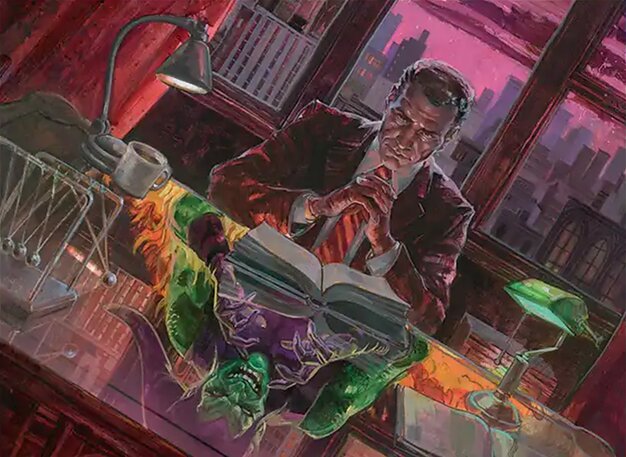
Norman Osborn // Green Goblin Commander Deck Guide

 Commander8
An evasive Grixis looter that pivots into a graveyard-casting engine once you transform into Green Goblin.

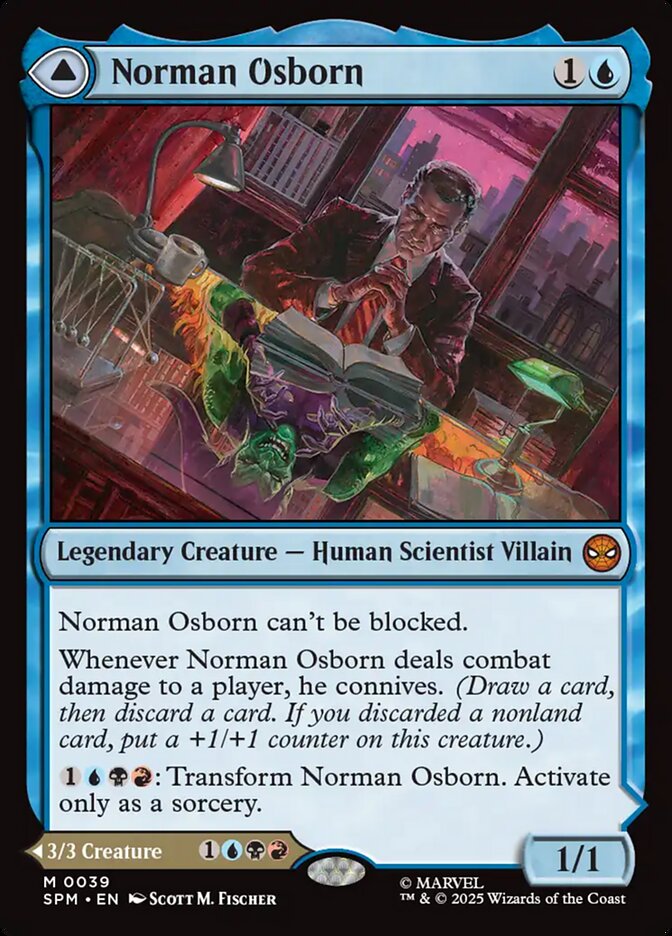
Card text
Norman Osborn can't be blocked.
Whenever Norman Osborn deals combat damage to a player, he connives. (Draw a card, then discard a card. If you discarded a nonland card, put a +1/+1 counter on this creature.)

 : Transform Norman Osborn. Activate only as a sorcery.
//
Flying, menace
Spells you cast from your graveyard cost  less to cast.
Goblin Formula — Each nonland card in your graveyard has mayhem. The mayhem cost is equal to its mana cost. (You may cast a card from your graveyard for its mayhem cost if you discarded it this turn. Timing rules still apply.)
Building around this commander?
Use MTG Master to build or analyze a Commander deck around this card, check consistency, and find weak spots before your next game.
Overview
- Deploy Norman early, chip in safely thanks to unblockable, and use connive to sculpt your hand while stocking the graveyard.
- Time the sorcery-speed transform when you can immediately capitalize on the back side's graveyard discounts and discard-to-cast play patterns.
- Plays well as a tempo/value deck: keep hitting players, keep filtering, and turn your graveyard into a second hand.
- Often closes by snowballing card quality into a dominant midgame, then converting repeated combat steps and spell velocity into lethal damage or overwhelming advantage.
- Build decisions tend to revolve around how hard you lean into discard/graveyard casting versus staying a lean evasive threat with interaction.
Common lines
- Cast Norman, attack the least-likely-to-block (or the most vulnerable) player, connive to pitch a nonland and grow Norman while improving your next turns.
- Use connive and other looting effects to set up a turn where the card you discarded can be cast from the graveyard the same turn.
- Transform on a turn where you have spare mana and a stocked graveyard, then immediately follow up by replaying key spells at a discount.
- Leverage cheap interaction to protect your engine long enough to take over, then keep pressure up in the air once transformed.
Strengths
- Very reliable combat connection on the front side, turning attacks into steady card selection.
- Natural synergy between looting/connive and graveyard-based casting on the back side.
- Can pivot between aggression (growing evasive threat) and grind (recasting spells) depending on table speed.
- Grixis color identity supports a flexible mix of removal, countermagic, and card draw to keep plans coherent.
Weaknesses
- Highly sensitive to graveyard hate; shutting off the yard blunts the transformed side's biggest payoff.
- Needs combat damage triggers early to feel like a true engine; repeated fogs, removal, or taxation can slow momentum.
- Transform is sorcery-speed and mana-intensive, so tapping out at the wrong time can be punished.
- Can accumulate lots of resources without immediately ending the game, inviting the table to gang up once the engine is online.
- Mana can be tight: early blue for Norman, then consistent access to U/B/R to transform and double-spell.
Rule zero notes
- This commander can generate a lot of card velocity and long turns once transformed, especially if the deck leans into casting from the graveyard.
- The transform is sorcery-speed but can still create swingy turns; clarify whether the list is aiming for grindy value or explosive spell chains.
- Expect some focus on discard/looting and graveyard recursion; mention how much the deck depends on the graveyard so opponents can calibrate hate and expectations.
- If you include heavy permission (for example, Counterspell) or a high density of efficient removal (for example, Bitter Triumph), call out the interaction level up front.
Matchups
Best into
- Midrange pods that want to develop boards and trade resources over several turns
- Creature-light control tables where a small evasive threat can connect repeatedly
- Decks that rely on incremental value rather than fast, deterministic wins
Struggles against
- Graveyard-hate-heavy tables that can repeatedly exile or lock down yards
- Fast combo pods that can win before repeated combat/connive matters
- Decks that pressure life totals quickly while also keeping up interaction for the transform turn