
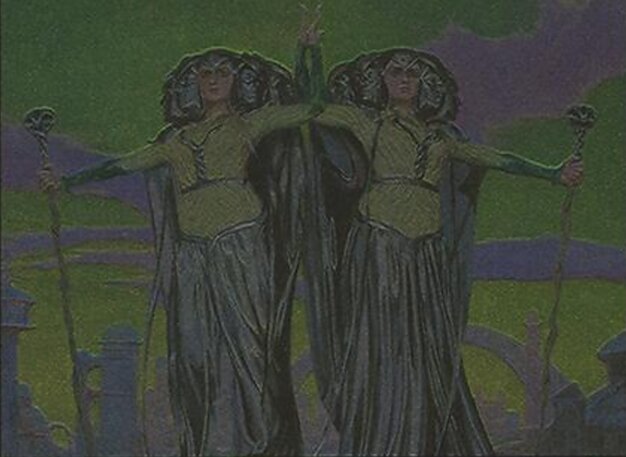
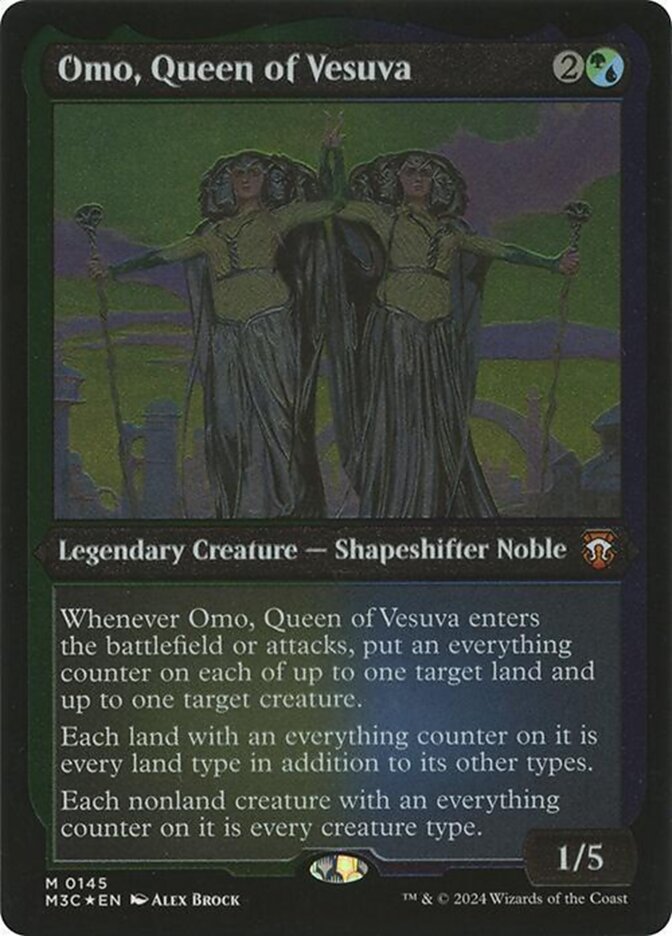
Omo, Queen of Vesuva

 Commander
A Simic shapeshifter commander that turns your key land and creature into “everything” as it enters and attacks, enabling flexible tribal and land-type payoffs.
Public decks: 0Bracket: Varies
Card text
Legendary Creature — Shapeshifter Noble
Whenever Omo enters or attacks, put an everything counter on each of up to one target land and up to one target creature.
Each land with an everything counter on it is every land type in addition to its other types.
Each nonland creature with an everything counter on it is every creature type.
Overview
- Omo triggers on ETB and on attack, letting you steadily add everything counters to a land and/or a creature over time.
- Everything-counter lands become all land types, which can unlock domain-style effects, land-type checks, and flexible mana patterns if your deck cares about types.
- Everything-counter creatures become all creature types, supporting tribal-cross-synergies and letting one threat count for multiple typal payoffs.
- Typical games revolve around keeping Omo on board, attacking safely to re-trigger, and choosing the best land/creature each turn to “upgrade.”
- Because the effect is incremental, the deck often plays like value-midrange that pivots into a synergy finish once your board is set.
Common lines
- Cast Omo, immediately mark a key land and/or creature with an everything counter, then plan to attack to repeat the effect.
- Prioritize placing counters on permanents that are hard to replace or easy to protect, since repeated triggers are where Omo’s advantage comes from.
- Use the creature-type flexibility to turn a single attacker or engine creature into the right “tribe” for whatever payoff you draw.
- Use the land-type flexibility to turn one land into the land-type glue your deck needs, then keep attacking to expand the package.
Strengths
- Repeatable value engine from the command zone that scales with combat steps.
- Highly flexible: the same commander supports both land-type and creature-type synergies.
- Low color requirements (Simic) tend to make it easy to protect and recast Omo as needed.
- Can adapt to different tables by choosing different counter targets each game.
Weaknesses
- Relies on Omo sticking and safely attacking; removal or fog effects can slow the plan significantly.
- Incremental advantage can be too slow if the table is racing with fast combo.
- Targeting means you can get set back by spot removal on the marked creature or land disruption on the marked land.
- If your deck’s payoffs are narrow, you can draw the wrong half (type enablers without payoffs, or vice versa).
Rule zero notes
- How quickly your list can convert everything counters into a deterministic win (if at all).
- Whether your build is primarily typal synergy, land-type synergy, or a split plan.
- How combat-focused the deck is (Omo wants to attack) versus a more defensive value plan.
- Any unusually high density of protection/countermagic intended to keep Omo on board.
Matchups
Best into
- Creature-heavy midrange pods where combat steps happen and you can attack to accrue triggers.
- Longer, value-oriented tables where incremental setup is rewarded.
- Decks that don’t pressure commanders heavily, letting Omo remain on board.
Struggles against
- Fast combo tables that end games before repeated attack triggers matter.
- High-removal pods that routinely clear commanders or punish attacking.
- Land-hate or land-denial strategies if your plan leans on upgrading a specific land.
Recent public decks
No public decks are available yet.
FAQ
Do I have to attack with Omo to get value?
You get one trigger on entering, but the commander really shines when you can attack repeatedly to keep placing everything counters.
Should I usually put the counter on a land or a creature?
It depends on what your hand is doing; lands support land-type payoffs and mana flexibility, while creatures support typal payoffs and combat pressure.
Is this a tribal commander?
It can be, but it’s more accurate to say Omo enables typal synergies by making one creature count as every creature type rather than committing you to a single tribe.
How does the deck typically close games?
Most builds will try to turn the accumulated type flexibility into a big advantage—either overwhelming combat damage or a synergy-based finish once the board is established.
What should I protect first: Omo or the counter targets?
Usually Omo, because the repeated triggers are the engine; if Omo is stable, you can rebuild or re-mark targets over time.