

Quintorius, History Chaser


 Commander
A Boros planeswalker commander that turns graveyard churn into a growing Spirit army and threatens a sudden double-strike finish.
Public decks: 1Bracket: Varies

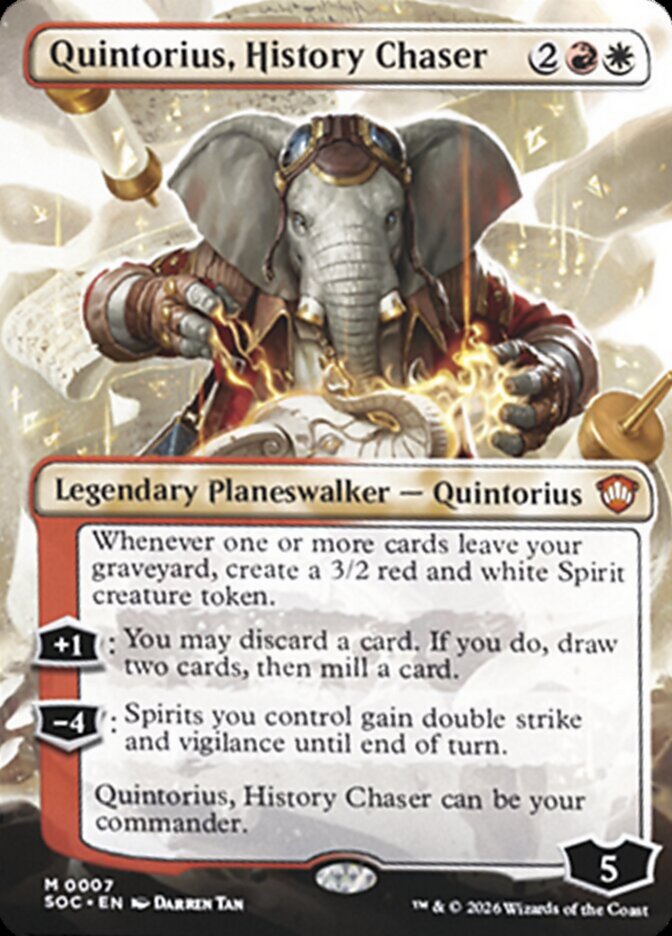
Card text
Legendary Planeswalker — Quintorius
Whenever one or more cards leave your graveyard, create a 3/2 red and white Spirit creature token.
+1: You may discard a card. If you do, draw two cards, then mill a card.
−4: Spirits you control gain double strike and vigilance until end of turn.
Quintorius, History Chaser can be your commander.
Building around this commander?
Use MTG Master to build or analyze a Commander deck around this card, check consistency, and find weak spots before your next game.
Overview
- Leans on moving cards out of your graveyard to repeatedly make 3/2 red-white Spirit tokens.
- Uses the +1 to filter your hand, dig for action, and stock the graveyard to keep triggers flowing.
- Often plays like a token-midrange deck: stabilize early, build a board, then convert width into lethal damage.
- The −4 is a clean closing tool, turning a modest Spirit board into a big combat swing with double strike and vigilance.
- As a planeswalker commander, it tends to prioritize protection and board presence to keep Quintorius on the table.
Common lines
- Land Quintorius, immediately +1 to discard a less useful card and reload, setting up future graveyard movement.
- Create Spirits incidentally while you loop cards out of the graveyard, then pivot into attacks once you have a critical mass.
- Hold up interaction or protection when Quintorius is exposed, since losing the commander can slow token production.
- Set up a turn where you make multiple Spirits, then −4 for a single explosive combat step.
Strengths
- Built-in card selection and velocity from the +1, helping you find payoffs and keep your hand moving.
- Scales well with repeated graveyard movement, letting you produce meaningful bodies without spending cards on tokens directly.
- Strong at turning the corner: the −4 can end games quickly when you already have a board.
- Tokens provide resilience against single-target removal and give you good defensive posture while you set up.
Weaknesses
- Can be vulnerable to pressure on the commander, since the engine and finisher are both on Quintorius.
- Graveyard disruption can reduce how often you trigger token creation and may force you into a fairer beatdown plan.
- Board wipes can undo a lot of your progress if you rely heavily on Spirit density to close.
- Often needs time and some setup to generate multiple triggers, so very fast decks can get under you.
Rule zero notes
- This is a planeswalker commander; clarify if your table has any house expectations around attacking or answering planeswalkers.
- Primary win plan is combat via Spirit tokens, often with a big −4 double-strike swing to close.
- Game pace tends to be midgame-focused rather than turbo-fast, but it can still produce sudden lethal damage with a developed board.
Matchups
Best into
- Creature-based midrange pods where a growing token board can block profitably and win combat.
- Removal-heavy tables where repeated token generation helps you rebuild.
- Longer games where incremental filtering and engine turns can compound value.
Struggles against
- Fast combo tables that end the game before you can establish board and protection.
- Frequent sweepers plus graveyard hate, which attack both your board and your token engine.
- Decks that can reliably pressure planeswalkers in combat early.
FAQ
What does Quintorius actually want from the graveyard?
Anything that makes cards leave your graveyard will do the job; you typically aim to enable repeated, reliable graveyard movement to keep making Spirits.
How do games usually end?
Most wins come from building a wide Spirit board and then using the −4 to turn one combat step into a lethal burst of double-strike damage.
Is the +1 mostly for card advantage or setup?
It tends to do both: you trade a discard for deeper digging while also putting cards into the graveyard to fuel future token triggers.
Do I need to protect Quintorius heavily?
Usually yes; since Quintorius is both your engine and finisher, keeping it on the battlefield often translates directly into pressure and inevitability.
What should I expect from tables that pack graveyard hate?
You can still play a functional token-combat game, but you may get fewer free Spirits and will need to choose your setup turns more carefully.