

Rubinia Soulsinger Commander Deck Guide



 Commander1
A Bant control commander that turns the best creature on the table into yours by keeping Rubinia tapped and protected.
Public decks: 0Bracket: Varies

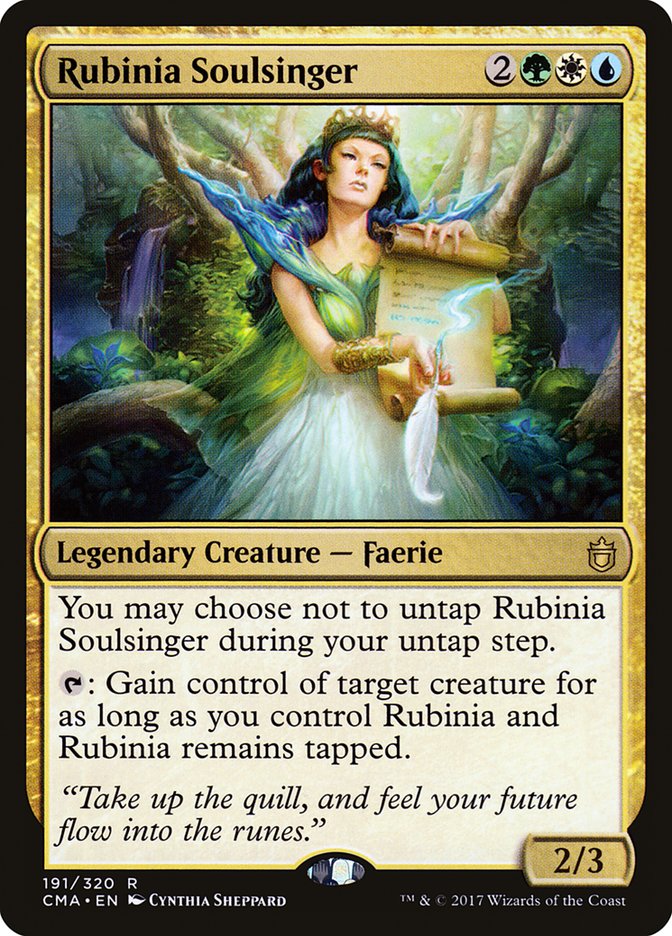
Card text
Legendary Creature — Faerie
You may choose not to untap Rubinia Soulsinger during your untap step.
 : Gain control of target creature for as long as you control Rubinia Soulsinger and Rubinia Soulsinger remains tapped.
Building around this commander?
Use MTG Master to build or analyze a Commander deck around this card, check consistency, and find weak spots before your next game.
Overview
- Plays a slower, interactive game where Rubinia’s tap ability acts like repeatable creature theft as long as she stays tapped and under your control.
- Often prioritizes mana, protection, and ways to keep Rubinia relevant over racing, since the deck’s power scales with what opponents present.
- Typically aims to stabilize the board by stealing key attackers, blockers, or combo creatures and using them to pivot into a win.
- Because the control effect is tied to Rubinia staying tapped and alive, timing and table politics matter as much as raw card advantage.
- Closes games by converting stolen creatures into pressure, leveraging superior board position, and denying opponents their best threats.
Common lines
- Deploy Rubinia once you can reasonably keep her from being removed immediately, then start taking the most impactful creature each turn cycle you can maintain.
- Choose not to untap Rubinia to keep control of a high-value creature, and only “release” it when a better target appears or you need the tap again.
- Use stolen creatures defensively first to survive swings, then turn the corner by attacking with the best bodies on the table.
- Hold up interaction to protect Rubinia at the moment removal would otherwise undo your board control.
Strengths
- Scales well in creature-centric pods by turning opponents’ threats into your resources.
- Strong at breaking parity in midrange board stalls by stealing the single best creature.
- Naturally political: you can answer a table problem without committing your own threats.
- Can function as soft removal that also advances your board presence.
Weaknesses
- Highly commander-dependent; removing or untapping-stopping Rubinia can collapse the control plan.
- Struggles more when opponents don’t rely on creatures as primary win conditions.
- Tapping/untapping constraints mean you can’t always change targets or defend as flexibly as traditional removal.
- Vulnerable to instant-speed interaction that removes Rubinia after you invest a turn in tapping her.
Rule zero notes
- Rubinia’s plan centers on repeatedly taking control of opposing creatures; confirm the table is okay with ongoing theft effects.
- Games can slow down as you hold up protection and interact to keep Rubinia tapped and in play.
- Expect some feel-bad moments when a key creature gets taken for multiple turns; set expectations on playstyle and pace.
Matchups
Best into
- Creature-heavy midrange pods with high-impact single threats
- Voltron and tall-creature strategies that lean on one attacker
- Battlecruiser tables where big creatures decide combat
Struggles against
- Spell-based combo and control pods with low creature density
- Token swarms where stealing one body doesn’t meaningfully reduce pressure
- Decks that can repeatedly remove commanders or punish tap-out turns
Recent public decks
No public decks are available yet.
FAQ
How does Rubinia’s control effect actually end?
You keep the creature as long as you control Rubinia and she remains tapped; if she untaps or you lose control of her, the creature returns to its owner.
Do I have to skip untapping Rubinia every turn?
No; you may choose not to untap her, which is usually how you “hold” a stolen creature, but you can also untap normally if you want to use the tap ability again.
What should I steal first in most games?
Often it’s the creature that either generates the most ongoing value or is most likely to kill you soon; the best target is frequently a role-player rather than the biggest beater.
How does this deck usually win if it’s mostly reactive?
It typically turns the corner by attacking with stolen creatures and whatever board you’ve assembled while opponents struggle to rebuild without their best threats.