

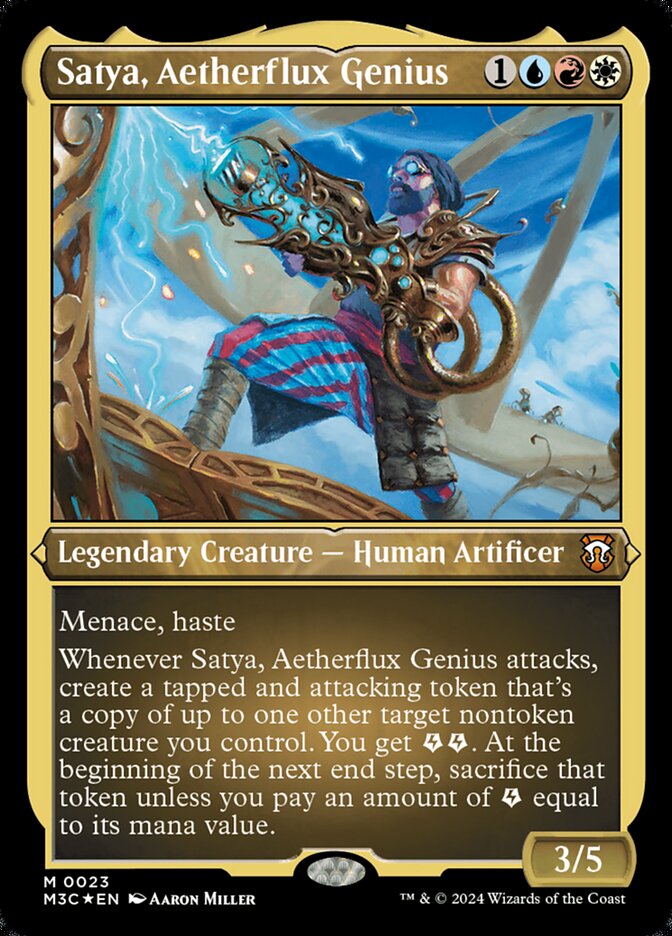
Satya, Aetherflux Genius



 Commander
A Jeskai attack-trigger commander that turns your best creature into a temporary extra attacker and asks you to manage energy if you want to keep the copy around.
Public decks: 1Bracket: Varies
Card text
Legendary Creature — Human Artificer
Menace, haste
Whenever Satya attacks, create a tapped and attacking token that's a copy of up to one other target nontoken creature you control. You get  (two energy counters). At the beginning of the next end step, sacrifice that token unless you pay an amount of equal to its mana value.
Overview
- Play Satya as an aggressive value engine: attack early thanks to haste and menace to start cloning your own nontoken creatures.
- Each attack can effectively double up an on-board creature for combat and for any attack/damage/ETB-style pressure that creature provides.
- Energy is the limiter: you stockpile {E}{E} on attacks, then decide at end step whether the copied token is worth paying to keep.
- Typically wants a creature suite where a copied attacker meaningfully swings the game even if it only lives for the turn.
- Leans proactive and board-centric; it can grind with repeated attacks, but it’s still fundamentally combat-driven.
Common lines
- Curve out creatures, land Satya, then immediately attack to generate a copied attacker and energy.
- Use the copy as a one-turn burst (no payment) when you just need extra damage or an extra trigger, then let it go at end step.
- Bank energy over multiple attacks, then start keeping higher-impact copies when the table can’t easily punish the tempo loss.
- Force awkward blocks with menace while the extra attacker increases pressure and shortens the clock.
Strengths
- Immediate impact: haste means Satya often generates value the turn it enters.
- High ceiling with the right board: copying your strongest creature scales with the game without needing many cards in hand.
- Flexible resource management: energy lets you choose between tempo bursts and longer-term board development.
- Combat pressure backed by menace makes it easier to keep the attack trigger flowing.
Weaknesses
- Board-dependent: without another nontoken creature worth copying, Satya’s attack trigger is low impact.
- Needs to attack: fog effects, pillowforts, or getting brick-walled can shut off the engine.
- Energy tax can be awkward: keeping expensive copies may be unrealistic without time to build {E}.
- Vulnerable to instant-speed removal in combat: losing either Satya or the target can fizzle or diminish the attack payoff.
Rule zero notes
- This commander plays to the battlefield and wins primarily through combat pressure plus repeated attack triggers.
- Power level tends to hinge on how explosive your creature suite is and how quickly you can convert attacks into a winning board.
- Expect frequent combat steps and on-board decision points around energy payments at end step.
- If your list includes any non-combat infinite combos or hard locks, call them out up front (not implied by the commander itself).
Matchups
Best into
- Midrange creature pods where repeated combat steps are a realistic plan
- Tables that give you time to build a board and start snowballing incremental attacks
- Slower decks that rely on sorcery-speed interaction
Struggles against
- Heavy control pods with lots of instant-speed interaction and sweepers
- Pillowfort or combat-denial strategies that make attacking unprofitable
- Very fast combo tables where combat value engines don’t have time to matter
FAQ
Do I have to copy a creature when Satya attacks?
No. The trigger lets you copy up to one other target nontoken creature you control, so you can choose not to make a token.
Does the token enter tapped and attacking?
Yes. It’s created tapped and attacking, so it contributes to combat immediately without needing haste.
When do I decide whether to keep the token?
At the beginning of the next end step, you either pay energy equal to its mana value or you sacrifice it.
How does energy shape the game plan?
Early on you often treat the copy as a temporary burst, then later you can bank energy from repeated attacks and start keeping key tokens.
What kind of creatures pair well with Satya?
Creatures that are impactful as extra attackers or that create meaningful value when duplicated tend to shine, especially if they’re good even when the copy only lasts one turn.