

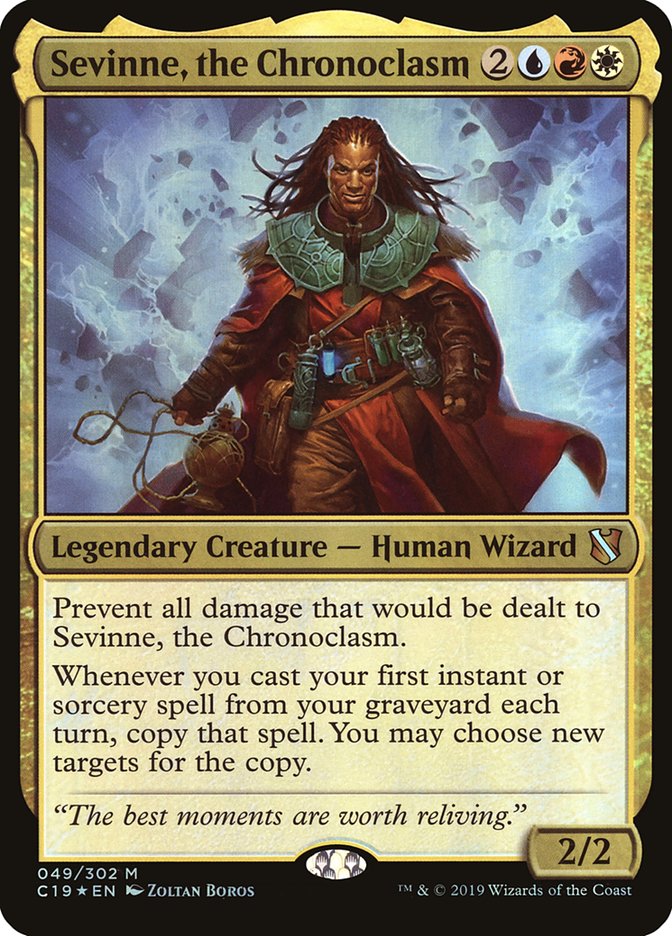
Sevinne, the Chronoclasm



 Commander
A Jeskai spells-from-the-graveyard commander that rewards you once per turn with an extra copy.
Public decks: 0Bracket: Varies
Card text
Legendary Creature — Human Wizard
Prevent all damage that would be dealt to Sevinne.
Whenever you cast your first instant or sorcery spell from your graveyard each turn, copy that spell. You may choose new targets for the copy.
Overview
- Build around casting instants and sorceries from your graveyard to trigger a once-per-turn copy effect.
- Sevinne’s damage prevention makes it hard to remove via combat damage, letting you keep your engine commander on board.
- Games often revolve around setting up repeatable graveyard access and timing your “first-from-graveyard” spell on multiple turns.
- Plays well as a value-control shell that turns recursion into card advantage and extra interaction.
- Win conditions typically come from overwhelming spell value over time or assembling a late-game spell-based finisher.
Common lines
- Spend early turns trading resources and setting up a stocked graveyard, then land Sevinne to start doubling key casts.
- Hold up interaction and try to make your first-from-graveyard cast happen on opponents’ turns to maximize triggers per round.
- Use the copied spell either to scale up removal/counterplay or to double up on whatever advances your endgame.
Strengths
- Generates incremental advantage by copying your first graveyard-cast instant/sorcery each turn.
- Naturally supports a reactive game plan: you can progress while keeping mana up for interaction.
- Commander is resilient to combat-based pressure thanks to preventing all damage to it.
- Can pivot between controlling the table and turning the corner with spell-based payoff turns.
Weaknesses
- Once-per-turn restriction means you don’t automatically “storm off” without additional setup.
- Relies on the graveyard; graveyard hate and exile-based interaction can shut down the core engine.
- Four-mana, three-color commander can be tempo-negative if removed repeatedly.
- If you can’t reliably cast from the graveyard, Sevinne is mostly a defensive body with limited payoff.
Rule zero notes
- This commander tends to play as a reactive spells deck with a grindy game plan; confirm your expected pace and win conditions.
- Let the table know if your list is aiming for long, control-heavy games with lots of instant-speed interaction.
- Mention how dependent the deck is on the graveyard so opponents can calibrate expectations around hate pieces.
Matchups
Best into
- Creature-centric midrange pods where repeated removal and value trading matters.
- Slower, grindy tables where you can take time to set up graveyard access and play on multiple turns.
- Decks that struggle to pressure life totals quickly, giving you time to turn recursion into inevitability.
Struggles against
- Graveyard-hate-heavy pods that can consistently exile your yard or stop casting from it.
- Very fast combo tables where a slower value engine may not come online in time.
- Decks with lots of exile-based removal that sidestep Sevinne’s damage prevention and disrupt your key pieces.
Recent public decks
No public decks are available yet.
FAQ
What does Sevinne want you to do each turn?
Set up a way to cast an instant or sorcery from your graveyard and make sure the first one you cast each turn is impactful so the copy matters.
Do I need to cast from my graveyard on opponents’ turns?
You don’t have to, but doing so often increases how many times you can trigger Sevinne across a full table rotation.
How does Sevinne usually win?
Typically by out-valuing the table with repeated graveyard casts and copies until you can leverage a big spell turn or a closing finisher backed by interaction.
Is Sevinne hard to kill?
It’s hard to take down with combat damage, but exile removal, sacrifice effects, and being countered or repeatedly removed can still keep it in check.
What’s the biggest thing that stops this plan?
Consistent graveyard hate or effects that prevent you from casting from the graveyard will usually turn off the main payoff and force a slower, fairer control plan.