
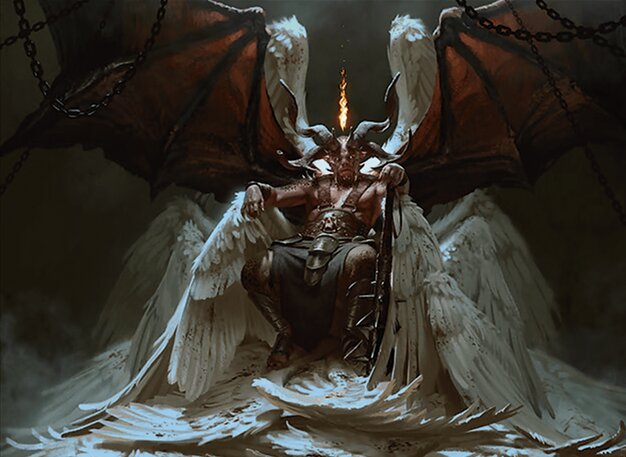
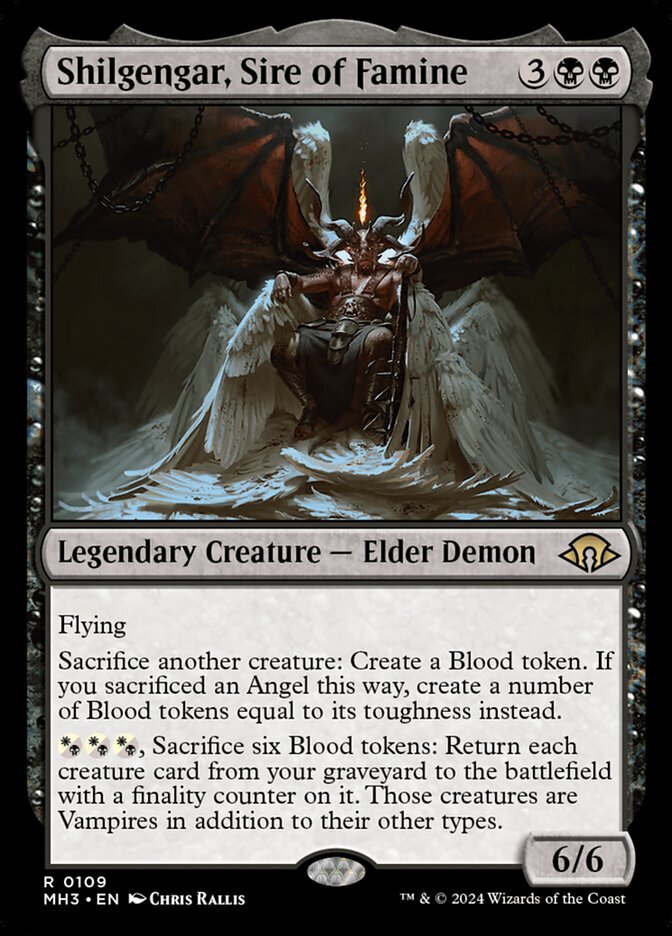
Shilgengar, Sire of Famine


A sacrifice-and-graveyard commander that turns spare creatures into Blood, then cashes in six tokens for a one-shot mass reanimation swing.
Public decks: 1Bracket: 1
Overview
- Uses a steady stream of creatures (often including Angels) as fodder to convert board presence into Blood tokens.
- Leans into self-mill/looting and trading creatures off to stock the graveyard for a big reanimation turn.
- Plays a midrange control game early, then pivots into a decisive rebuild after a wipe or combat-heavy turn cycle.
- The six-Blood activation tends to be the centerpiece: one big return that immediately threatens lethal damage or massive value.
- Finality counters mean the deck usually wants that reanimation to be backbreaking, not incremental.
Common lines
- Deploy a few creatures, then sacrifice extras to build up Blood while controlling the board with spot removal.
- Intentionally put key creatures into the graveyard, keeping enough fodder around to keep Blood production flowing.
- Stabilize with a sweeper effect, then rebuild faster than the table by turning Blood into a mass reanimation.
- Time the six-Blood activation for a turn where reanimated attackers can immediately pressure life totals or generate follow-up value.
Strengths
- Excellent grind potential: sacrificing creatures converts into a tangible resource (Blood) while filling the graveyard.
- Strong post-wrath positioning: you can often be the first player to present a real board again.
- Threatens sudden, table-warping turns once six Blood are assembled.
- Naturally supports aristocrats-style pressure when creatures are dying frequently (for example, with Blood Artist as a payoff).
- Can play both defense and offense thanks to access to removal and a commander that stabilizes via recursion.
Weaknesses
- Relies on having creatures to sacrifice; if you’re light on fodder, Blood production slows dramatically.
- Graveyard hate can shut off the biggest payoff turn and force you into a fairer, slower game.
- The reanimation is not infinitely repeatable as-is; finality counters make sequencing and timing very punishing if you fire too early.
- Token-hate or artifact-hate can incidentally disrupt the Blood stockpile.
- Commander-centric: removing Shilgengar repeatedly can strand the deck with enablers but no conversion engine.
Rule zero notes
- This deck can produce a large, sudden board swing via mass reanimation once six Blood tokens are available.
- Games may feature frequent creature deaths and sacrifice loops for value (not necessarily infinite).
- It may include sweepers and strong spot removal (for example, Damnation or Bitter Triumph), depending on the build.
- Finality counters mean the big reanimation is intended as a closer or major pivot, not a repetitive lock.
Matchups
Best into
- Creature-heavy midrange pods where trading resources is normal and graveyards fill naturally
- Board-wipe-heavy tables where rebuilding quickly matters
- Slower value decks that give you time to assemble six Blood
Struggles against
- Graveyard-focused hate packages and repeatable exile effects
- Fast combo tables that end the game before your Blood engine matters
- Decks that can consistently prevent sacrificing or keep your creature count low
FAQ
What is Shilgengar actually trying to do each game?
Turn creatures into Blood tokens, fill the graveyard along the way, and then convert six Blood into a mass reanimation that swings the game.
Do I need to be an Angel deck?
Not strictly, but Angels have extra upside because sacrificing an Angel can generate a lot of Blood at once based on its toughness.
How do you usually win after the six-Blood activation?
Often by immediately presenting overwhelming combat damage from a rebuilt board, or by leveraging death triggers if the table tries to answer it.
What does the 'finality counter' clause change about deckbuilding and play?
It pushes you toward making the reanimation turn count, since those creatures won’t be able to return again if they die with finality counters.
What kinds of cards support the plan without being all-in?
Cheap creatures to sacrifice, ways to put cards into the graveyard, and interaction to survive until you can assemble six Blood and safely activate.