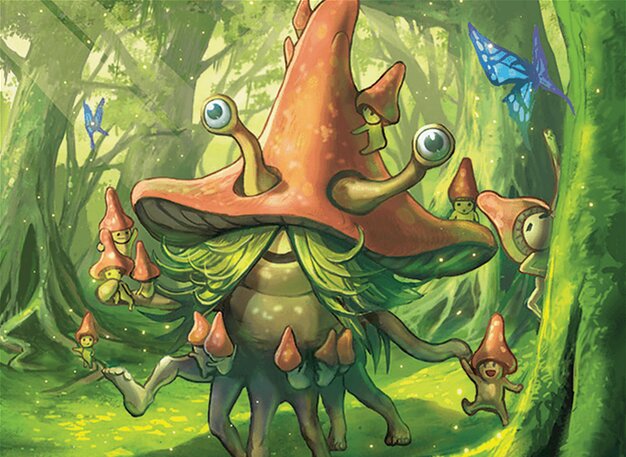
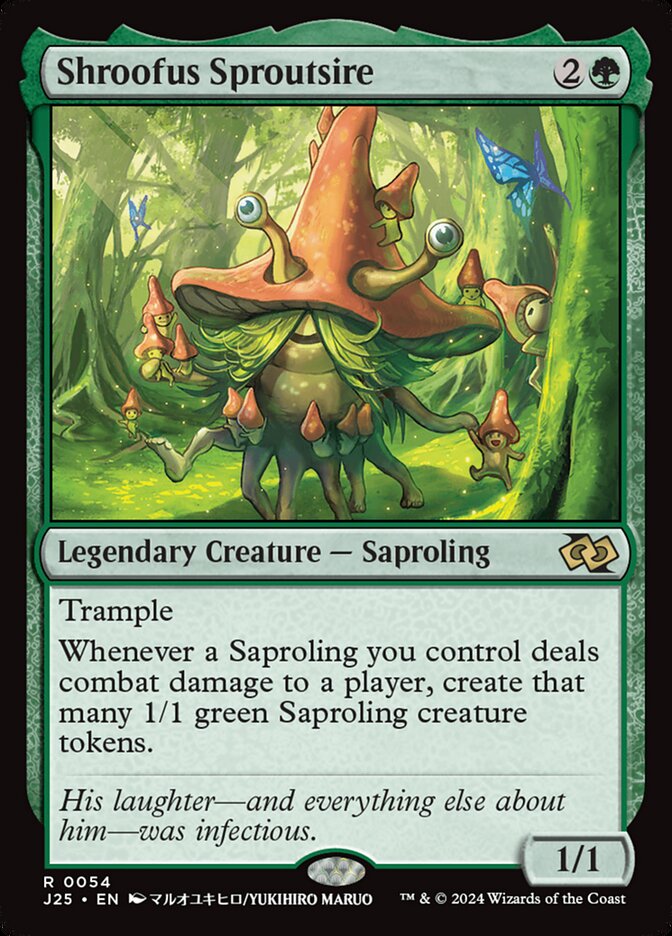
Shroofus Sproutsire

 Commander
Shroofus Sproutsire is a mono-green combat snowball commander that turns every connecting Saproling into a rapidly multiplying token army.
Public decks: 1Bracket: 3
Card text
Legendary Creature — Saproling
Trample
Whenever a Saproling you control deals combat damage to a player, create that many 1/1 green Saproling creature tokens.
Building around this commander?
Use MTG Master to build or analyze a Commander deck around this card, check consistency, and find weak spots before your next game.
Overview
- Game plan is simple: make Saprolings, attack, and let Shroofus turn combat damage into even more Saprolings.
- You typically want to set up safe attacks (evasion/trample, protection, or favorable blocks) so at least a few tokens connect each turn.
- Once you’ve connected once, the deck can start scaling fast: more bodies means more chances to hit players, which means even more tokens.
- Most wins come from go-wide combat math, often backed by a single big pump/anthem effect to end the table in one or two swings.
- As a mono-color deck, you lean on green ramp to deploy Shroofus early and keep recasting through removal.
Common lines
- Early mana acceleration into Shroofus, then start sending 1/1s at the most open player to get the first token-doubling turn.
- Develop a wide board, then pivot from chip damage to a decisive alpha strike once you can profitably attack multiple players.
- Hold up protection during key turns so a wipe or removal spell doesn’t reset your board right before you swing.
- Use a burst-finisher turn where tokens connect, you create a second wave mid-combat, and the table suddenly faces lethal on the crackback.
Strengths
- Explosive scaling once your tokens start connecting; the engine rewards even small early hits.
- Go-wide pressure that can punish players who durdle or rely on a few big blockers.
- Mono-green ramp helps you re-establish quickly after interaction and keeps your top-end finishers live.
- Naturally strong at spreading damage across multiple opponents rather than needing to focus a single target.
- Can play a resilient posture with protective effects (for example, Heroic Intervention or Asceticism).
Weaknesses
- Heavily combat-dependent; fogs, pillow-fort, and gummed-up boards can shut off your token engine.
- Board wipes are a major setback, especially if you overextend without protection.
- Token armies can struggle into repeated mass removal or repeatable sweep effects.
- Mono-green interaction is narrower, so some problematic permanents can be hard to answer cleanly.
- Your commander draws attention once opponents realize how quickly a single hit can spiral.
Rule zero notes
- This is a combat-focused token-snowball deck that can grow from a few 1/1s to a lethal board quickly if attacks connect.
- If you run big one-shot finishers (for example, Craterhoof Behemoth or Beastmaster Ascension), mention that up front.
- Let the table know whether you’re built more like go-wide aggro or more like Voltron/protected commander damage (for example, Commander's Plate or Bear Umbra).
- Call out how many protection effects you’re on (for example, Heroic Intervention, Asceticism) since that changes how interactable you are.
- Expect to generate very large token counts; confirm the table is okay with that pace and board complexity.
Matchups
Best into
- Slower midrange pods that take time to stabilize their boards
- Decks light on sweepers that rely on spot removal
- Tables where combat damage is a common axis and players tap out proactively
Struggles against
- Control or stax shells that restrict combat steps or punish attacking
- Metas with frequent board wipes and repeatable mass removal
- Decks that can consistently produce big, efficient blockers early
FAQ
Do I need Shroofus to win, or is it just a value engine?
Shroofus is usually the primary engine, but the deck can still win by going wide and pumping the team even if Shroofus is answered a few times.
How do games usually end?
Most games end through a big alpha strike after you’ve built a wide Saproling board, often with a single finisher pump (for example, Beastmaster Ascension or Craterhoof Behemoth).
Should I attack early with 1/1s even if they might die?
Often yes, as long as you can reasonably connect with at least one Saproling; the first successful hit is what starts the snowball.
What’s the biggest mistake pilots make with Shroofus?
Overextending into obvious sweepers; you typically want to time your all-in turn when you can also protect your board (for example, Heroic Intervention).
Is this more of a go-wide tokens deck or a Voltron deck?
It can lean either way, but Shroofus’s trigger pushes you toward go-wide Saprolings; Voltron elements mainly help ensure combat damage keeps happening.