

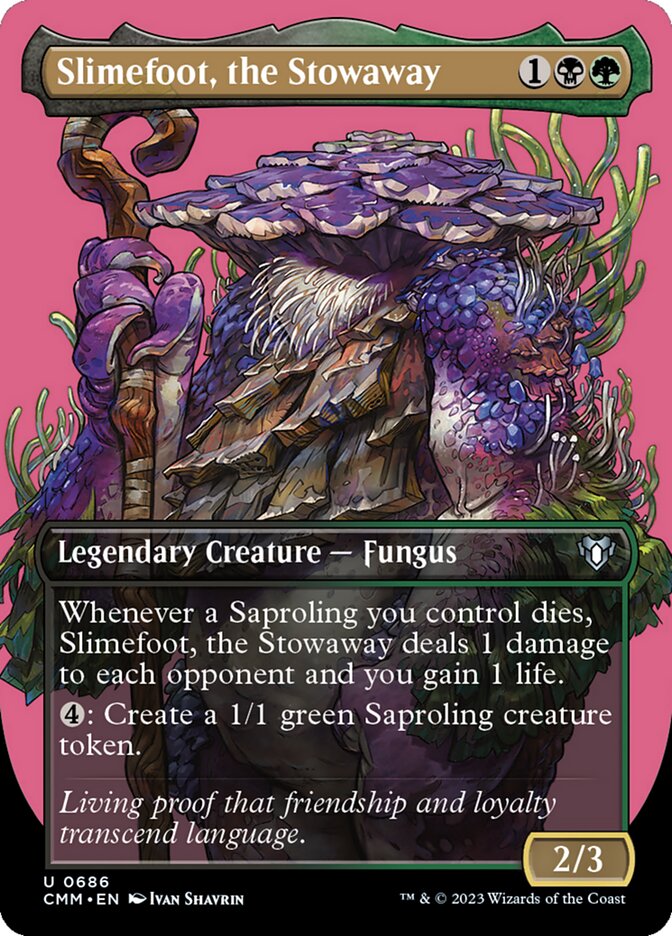
Slimefoot, the Stowaway


 CommanderPauper Commander
A Golgari Saproling engine that turns token deaths into steady table drain while padding your life total.
Public decks: 3Bracket: 1
Card text
Legendary Creature — Fungus
Whenever a Saproling you control dies, Slimefoot deals 1 damage to each opponent and you gain 1 life.
 : Create a 1/1 green Saproling creature token.
Building around this commander?
Use MTG Master to build or analyze a Commander deck around this card, check consistency, and find weak spots before your next game.
Overview
- Plays a grindy aristocrats-style game where Saprolings dying slowly chips every opponent.
- Builds incremental board presence with token makers, then converts bodies into cards, mana, or damage.
- Often leans on death triggers and sacrifice outlets to control when tokens die and to survive wipes profitably.
- Wins by accumulating enough token churn that Slimefoot’s drain (and similar effects) becomes unavoidable.
- Prefers longer games where repeated value loops outpace single big plays.
Common lines
- Ramp early, land Slimefoot, then start making Saprolings when you have spare mana or need fodder.
- Set up one or two death-payoff permanents, then repeatedly sacrifice/lose tokens to drain and draw through the deck.
- Use flexible Golgari interaction to answer key permanents while your engine keeps ticking.
- After a sweeper, rebuild quickly by turning leftover resources into more tokens and re-establishing drain pieces.
Strengths
- Reliable inevitability: every Saproling death advances your win and stabilizes your life total.
- Strong grind game with sacrifice/value engines (e.g., Moldervine Reclamation, Deathreap Ritual, Deadly Dispute).
- Can punish board wipes by turning mass death into damage and extra resources.
- Solid spot and permanent-based interaction (e.g., Abrupt Decay, Binding the Old Gods, Feed the Swarm).
- Multiple overlapping payoffs for tokens entering/dying (e.g., Bastion of Remembrance, Mirkwood Bats).
Weaknesses
- Can be slow to close without a dedicated engine; incremental drains may take time to add up.
- Token plans are vulnerable to exile-based removal and effects that shut off death triggers.
- Commander-centric pacing: if Slimefoot is removed repeatedly, the deck may be forced into a pure value plan.
- Wide boards can get clogged, making combat less effective and forcing you to rely on drain lines.
- Needs careful resource management; overcommitting to the board can still get punished by repeated sweepers.
Rule zero notes
- This tends to play as a slow-drain aristocrats deck rather than a quick combo deck, but it can still end games without combat.
- Expect lots of death triggers and sacrifice-based gameplay; turns can involve stacking multiple triggers.
- Board wipes don’t always reset the game equally because token deaths translate into damage and value.
Matchups
Best into
- Creature-heavy midrange pods where bodies trade often and removal is mostly damage/destroy-based.
- Long, grindy games where incremental life drain and recursion-style value engines shine.
- Tables light on graveyard hate and exile interaction.
Struggles against
- Fast combo tables that end the game before your token churn matters.
- Decks packed with exile sweepers or effects that prevent/ignore death triggers.
- Heavy stax/lock pieces that restrict activations, mana development, or sacrifice patterns.
Recent public decks
Staples
Browse all public decksFAQ
How does this deck usually win?
By repeatedly creating and sacrificing/losing Saprolings so Slimefoot’s trigger drains the table, often backed up by extra drain pieces like Bastion of Remembrance or Mirkwood Bats.
Do I need to attack to win?
Not typically; combat can help, but the primary plan is to make token deaths inevitable and let the drain finish the job.
What kind of game pace does Slimefoot prefer?
Usually a midrange-to-grindy pace where you can assemble a token-and-death engine and accrue value over multiple turns.
What are the key things to protect?
Your repeatable token production and your death-payoff engines; losing either side of the loop slows your clock dramatically.
What interaction profile fits the plan?
Flexible Golgari answers that keep engines online while disrupting problem permanents, like Abrupt Decay, Binding the Old Gods, and Feed the Swarm.