

Tergrid, God of Fright // Tergrid's Lantern


A mono-black commander that turns opponents’ sacrifice and discard into your own board by stealing the permanents they lose.
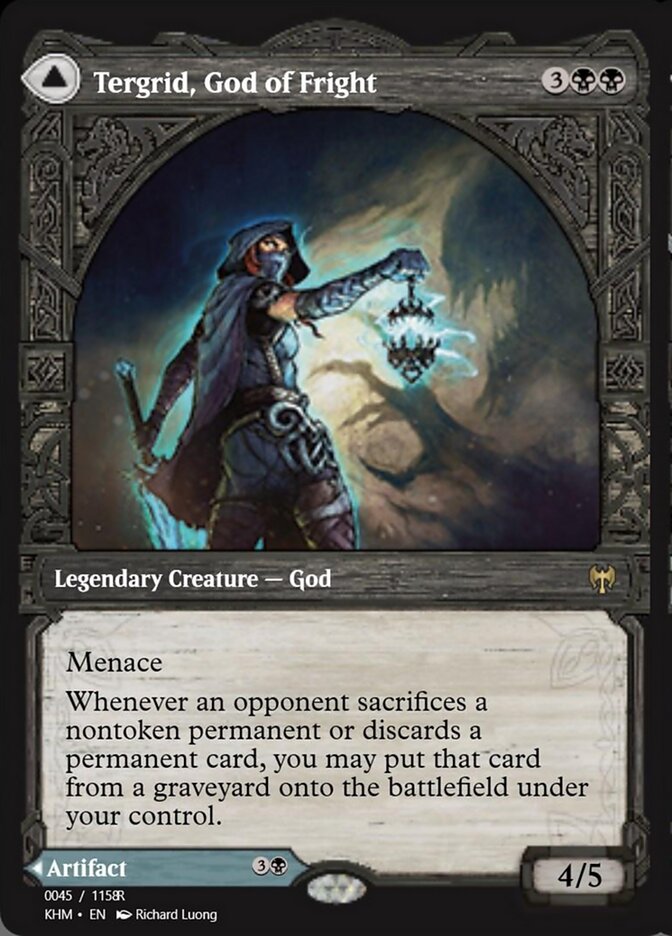
Public decks: 1Bracket: 4
Overview
- Game plan is to pressure hands and boards with discard and forced sacrifices, then convert those losses into free permanents under your control.
- Tergrid tends to play like a snowball engine: once opponents start losing permanents, your battlefield grows while theirs shrinks.
- The Lantern side gives you a repeatable way to tax a single player each turn cycle, pushing them toward discarding or sacrificing to feed Tergrid.
- You often win by overwhelming the table with stolen resources and leveraging the tempo advantage of turning interaction into your threats.
- Because the effect is high-impact and targeted at opponents’ resources, table politics and threat perception matter a lot from turn one.
Common lines
- Deploy Tergrid, then follow up with effects that make multiple opponents discard or sacrifice to immediately swing the board in your favor.
- Use the Lantern mode early if you can’t safely stick the creature, then transition into Tergrid once opponents are low on cards/permanents.
- Pick on the player who’s most vulnerable (or most ahead) with Lantern activations to force awkward choices and open windows for your engine.
- After you steal a few key permanents, pivot from attrition to closing the game by attacking with a widened board and denying rebuilds.
Strengths
- Explosive snowball potential once opponents are made to discard or sacrifice repeatedly.
- Turns common resource-denial lines into actual win material by converting losses into your permanents.
- Naturally punishes greedy keeps and low-redundancy decks that rely on a few key permanents.
- Lantern side provides a built-in, repeatable pressure tool that doesn’t require additional cards to function.
Weaknesses
- High table threat: opponents often prioritize removing Tergrid or preventing you from sticking it.
- Relies on opponents having permanents worth taking; token-heavy boards and low-permanent strategies can reduce payoff.
- Can be vulnerable to instant-speed removal or countermagic on the turn you try to land Tergrid and immediately convert value.
- Resource-denial plans can stall the game if you don’t also include reliable ways to actually close.
Rule zero notes
- Disclose that the deck’s core gameplay revolves around discard and forced sacrifice (resource denial).
- Call out whether you’re aiming for hard-lock patterns or just attrition into a win.
- Mention how aggressively you plan to target individual players with the Lantern side.
- Clarify expected game length and whether you have fast finishes or mostly grindy closes.
Matchups
Best into
- Midrange creature-and-permanent decks that commit a lot to the battlefield
- Voltron or engine decks that hinge on a few specific nonland permanents
- Slower pods where repeated discard/sacrifice effects have time to accrue advantage
Struggles against
- Token-centric strategies that can sacrifice expendable pieces without losing real material
- Spell-heavy combo/control decks that keep their critical pieces off the battlefield until they win
- Pods with abundant instant-speed interaction that can answer Tergrid on sight

FAQ
Do I need to cast the creature side for the deck to work?
Typically yes if you want the signature payoff, but the Lantern mode can buy time and pressure hands when Tergrid isn’t safe to deploy.
How does this deck usually win?
It often wins by snowballing stolen permanents into an overwhelming board state, then closing via combat while opponents struggle to rebuild.
Will this commander draw a lot of hate?
Usually, yes—discard and sacrifice effects plus stealing opponents’ cards tend to raise threat perception quickly.
Is this more of a control deck or a combo deck?
It tends to play like an attrition/control engine focused on resource denial, with wins coming from the advantage generated rather than a single scripted combo.
What should I mulligan for?
Hands that can develop mana and present early pressure on resources tend to be better than hands that only plan to cast Tergrid and hope it lives.