

Terra, Herald of Hope


 Commander
A combat-driven Mardu graveyard value commander that mills steadily and reanimates small creatures when Terra connects.
Public decks: 1Bracket: 1

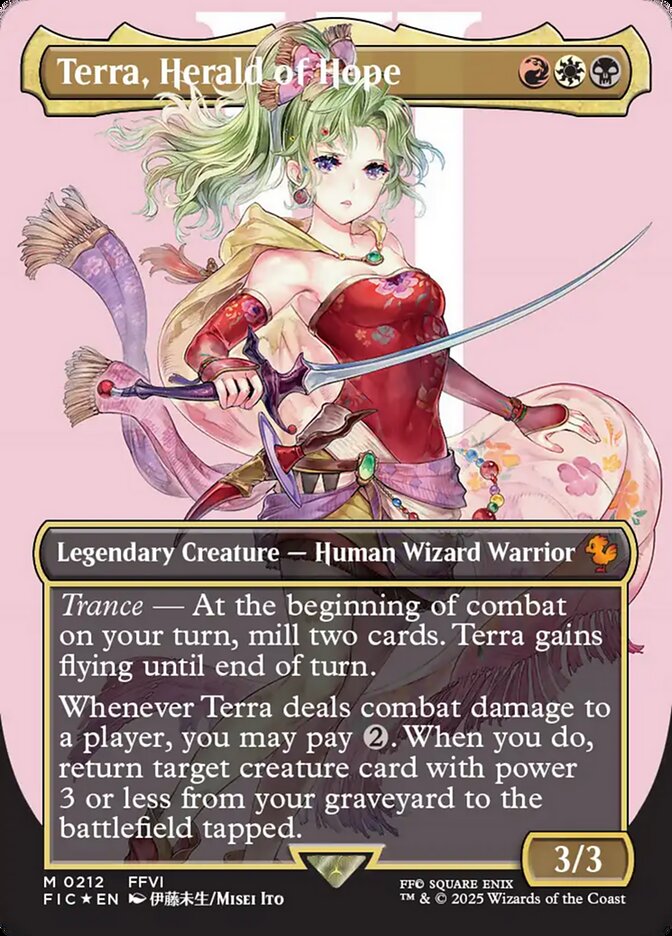
Card text
Legendary Creature — Human Wizard Warrior
Trance — At the beginning of combat on your turn, mill two cards. Terra gains flying until end of turn.
Whenever Terra deals combat damage to a player, you may pay  . When you do, return target creature card with power 3 or less from your graveyard to the battlefield tapped.
Building around this commander?
Use MTG Master to build or analyze a Commander deck around this card, check consistency, and find weak spots before your next game.
Overview
- Wants to attack every turn: Terra gets flying at the beginning of combat, helping you consistently push damage through.
- Uses built-in self-mill to stock the graveyard without spending extra cards.
- Turns combat damage into repeatable reanimation for creatures with power 3 or less, creating a steady stream of bodies and ETB/death value.
- Often plays like an aggressive-midrange deck that refuels from the graveyard instead of from the hand.
- Closing usually comes from accumulating board advantage via repeated reanimation, then converting that into overwhelming combat pressure.
Common lines
- Curve out with early creatures and support pieces, then start attacking with Terra to begin the mill-and-connect loop.
- Connect with Terra, pay {2}, and bring back a small creature tapped to rebuild after trades or to extend your board.
- Use sacrifice/trade patterns in combat to keep the graveyard stocked, then reanimate back the best small threat or value creature each turn.
- When the table stabilizes, leverage flying-enabled chip damage plus repeated reanimation to stay ahead through removal-heavy turns.
Strengths
- Consistent plan: Terra’s combat trigger naturally enables both evasion and graveyard setup.
- Resilient to spot removal and creature attrition thanks to repeatable reanimation.
- Excellent at grinding value with small creatures that trade well and come back.
- Can pivot between aggression and midrange depending on how contested combat is.
Weaknesses
- Heavily dependent on connecting in combat; fogs, pillow-fort effects, and lots of blockers can slow the engine.
- Graveyard hate can shut off the reanimation line and reduce the value of the self-mill.
- Mana-hungry: repeatedly paying {2} can constrain development or interaction in the same turn cycle.
- Returning creatures tapped can make it harder to immediately defend after a big reanimation turn.
Rule zero notes
- This commander typically wins through combat and repeated reanimation value rather than instant wins, but power level depends on how hard you lean into recursion engines.
- Self-mill and graveyard recursion are central; confirm the table’s expectations around graveyard hate and repeated reanimation loops.
- Because the reanimation is tied to combat damage, the deck can feel swingy based on how interactive the pod is with combat and commanders.
- If you include many sacrifice outlets or death-trigger packages, mention it up front since turns can involve multiple graveyard actions.
Matchups
Best into
- Creature-heavy midrange pods where combat trades fill graveyards and incremental advantage matters.
- Removal-heavy tables where recurring small creatures can outlast one-for-one interaction.
- Slower pods that give you time to establish repeated attack steps.
Struggles against
- Decks with frequent graveyard hate or exile-based removal that invalidates your recursion.
- Pillow-fort, fog, or heavy-blocker strategies that prevent Terra from dealing combat damage.
- Fast combo tables where combat-based value engines don’t get enough turns to matter.
FAQ
Do I need to build around power 3 or less creatures?
You generally want a high density of good targets so Terra’s combat trigger is live most turns. That said, you can still play a few bigger threats as finishers.
Is this more aggro or midrange?
It tends to play as aggressive-midrange: you’re incentivized to attack, but your real edge is out-grinding the table with recurring small creatures.
How do I protect the engine if Terra keeps getting answered?
Plan to generate value from your supporting creatures even without Terra, and prioritize lines that let you recast Terra and immediately threaten a connect.
What’s the biggest gameplay bottleneck?
Getting clean combat damage triggers while keeping {2} up. If combat stalls, you may need to shift to setting up favorable attacks rather than forcing them.
How does the deck usually close games?
Most games end with a wide, repeatedly refueled board that overwhelms blockers, sometimes supplemented by steady commander chip damage from flying attacks.