

Teval, the Balanced Scale



 Commander
A Sultai graveyard-value commander that turns attacking, self-mill, and land recursion into a steady stream of Zombie Druid tokens.
Public decks: 5Bracket: Varies

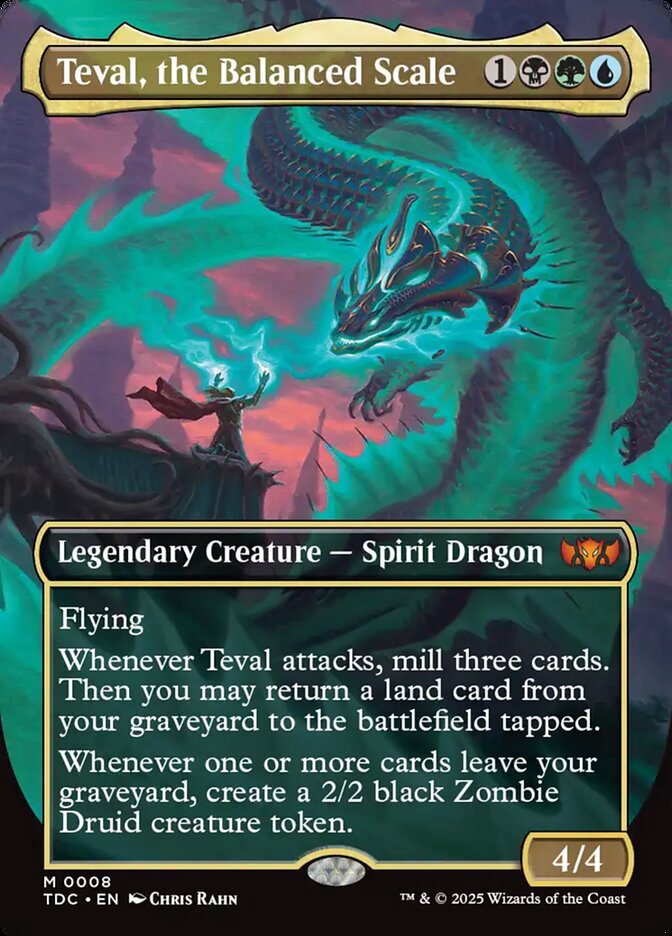
Card text
Legendary Creature — Spirit Dragon
Flying
Whenever Teval attacks, mill three cards. Then you may return a land card from your graveyard to the battlefield tapped.
Whenever one or more cards leave your graveyard, create a 2/2 black Zombie Druid creature token.
Building around this commander?
Use MTG Master to build or analyze a Commander deck around this card, check consistency, and find weak spots before your next game.
Overview
- Attacks to mill three, stocking your graveyard while setting up land recursion each combat.
- Rebuys lands from your graveyard tapped, helping you hit land drops and grind through longer games.
- Rewards any cards leaving your graveyard by making 2/2 Zombie Druid tokens, turning recursion into board presence.
- Often plays as a midrange/value engine that snowballs over multiple turns rather than winning immediately.
- Tends to like repeatable graveyard interaction and ways to safely attack with a flyer to keep triggers flowing.
Common lines
- Deploy Teval, then attack to start self-milling and converting a milled land into an extra land drop.
- Use graveyard recursion effects; each time cards leave your graveyard, Teval converts that movement into more bodies.
- Build a token board incidentally while advancing mana, then pivot from value to pressure with a wide battlefield.
Strengths
- Reliable, repeatable engine from the command zone that generates value just by attacking.
- Natural resilience to attrition: self-mill plus recursion can keep resources flowing after trades and wipes.
- Token production scales with how much you can repeatedly move cards out of your graveyard.
- Mana development from recurring lands can help you keep pace in grindy pods.
Weaknesses
- Graveyard hate can shut off both the land recursion and token engine.
- Needs combat to start the primary loop; fogs, pillow-fort effects, or grounded board stalls can slow you down.
- Tokens are incremental; without payoff support, closing the game can take time.
- Lands return tapped, so the ramp is steady rather than explosive.
Rule zero notes
- This commander naturally cares about self-mill and recurring cards from the graveyard; confirm how much graveyard interaction your table is comfortable with.
- The deck can generate a lot of tokens over time; clarify whether your build is more midrange pressure or combo-adjacent recursion loops.
- If you include deterministic loops that repeatedly move cards out of the graveyard to farm tokens, mention that up front.
- Expect longer turns in some builds due to graveyard management and multiple triggers; set expectations if your list leans that way.
Matchups
Best into
- Creature-based midrange tables where incremental tokens and value trades matter.
- Grindy pods that go long and give you time to compound recursion and board presence.
- Removal-heavy metas where a commander-based value engine helps you recover.
Struggles against
- Pods with frequent graveyard exile effects or repeatable graveyard suppression.
- Fast combo tables where incremental combat-based value may not race effectively.
- Decks that prevent profitable attacks or punish combat heavily.
Recent public decks
Staples
Browse all public decksFAQ
What is Teval trying to do each game?
Attack to self-mill and recur lands, then leverage cards leaving your graveyard to steadily build a Zombie Druid army.
Do I need lots of lands in the graveyard for Teval to work?
You only get one land back per attack, but having lands hit the graveyard regularly makes the attack trigger consistently productive.
What counts as cards leaving my graveyard?
Any time one or more cards move from your graveyard to another zone (like returning to hand or battlefield), Teval can reward that movement with a token.
How does the deck usually win?
Often by turning sustained token production into overwhelming board presence and pressuring life totals over multiple combat steps.
What are the biggest risks to plan for?
Graveyard exile effects and game states where you can’t profitably attack are the main ways Teval’s engine gets slowed or turned off.