
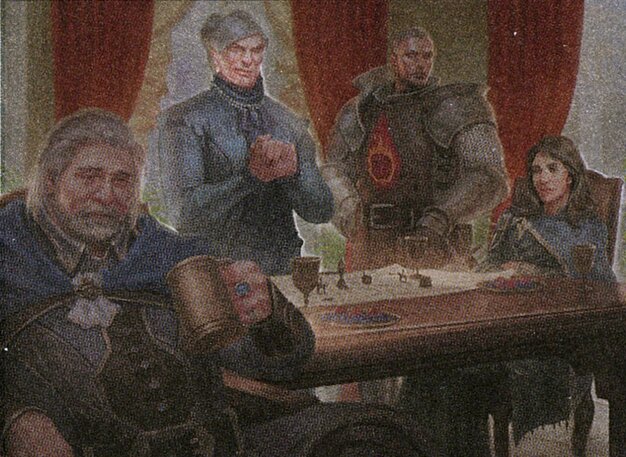
The Council of Four


 Commander
The Council of Four is an Azorius value engine that turns the table’s extra draws and double-spell turns into your own cards and a growing Knight army.
Public decks: 1Bracket: 3
Card text
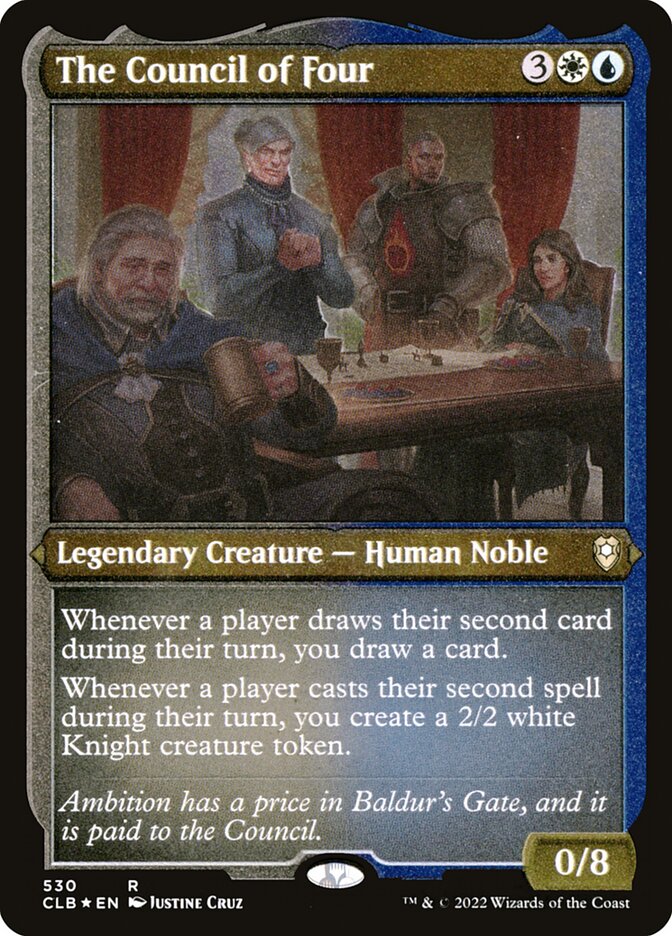
Legendary Creature — Human Noble
Whenever a player draws their second card during their turn, you draw a card.
Whenever a player casts their second spell during their turn, you create a 2/2 white Knight creature token.
Overview
- Plays a reactive, on-board engine game: stick your commander, then let opponents’ turns fuel you.
- Rewards pods where people naturally cantrip, draw extra cards, or cast multiple spells per turn.
- Often wants to keep mana up on other players’ turns while quietly accruing cards and tokens.
- Transitions from “harmless value” into a real clock once the Knight count gets high.
- Typically closes with a big inevitability play (for example, a dedicated wincon spell) or by turning tokens sideways with protection.
Common lines
- Develop mana early, deploy The Council of Four, then pass with interaction up to convert opponents’ second spell into Knights.
- Encourage or allow extra draw to happen, turning “everyone draws” turns into your own steady refuel.
- Use counterspells to protect your engine and to stop sweepers right before your token board becomes lethal.
- When ahead on cards, pivot to a finisher plan rather than trying to grind forever.
Strengths
- Consistent card flow without spending mana on your own turn, especially in spell-heavy pods.
- Produces a wide board incidentally, giving you defense against attacks and a real endgame plan.
- Naturally supports a draw-go posture with lots of instant-speed interaction.
- Scales well in multiplayer since it triggers off any player.
Weaknesses
- Relies heavily on keeping the commander in play; repeated removal can stall your whole plan.
- Token plan can be set back hard by sweepers, especially if you overcommit.
- Can struggle to end games quickly without a clear finisher line.
- Table perception can flip fast once the value snowball is obvious, drawing coordinated pressure.
Rule zero notes
- Disclose whether you’re running a dedicated alternate-win finisher (e.g., Approach of the Second Sun) versus mainly winning through combat.
- Let the table know if you’re playing lots of “group draw” effects (e.g., Dictate of Kruphix, Font of Mythos) since that changes threat assessment.
- Mention the density of free/cheap counterplay if your build is very interaction-forward (e.g., Force of Negation, Flusterstorm).
- Call out if you intend to play a slow, draw-go control game that can extend turn cycles.
Matchups
Best into
- Spell-slinger and cantrip-heavy pods that regularly draw extra cards and double-spell
- Midrange tables where games go longer and incremental advantage matters
- Decks that try to win with a few key spells you can answer while building resources
Struggles against
- Fast combo tables where the game can end before your engine matters
- Heavy board-wipe metas that repeatedly reset token armies
- Decks that can repeatedly remove commanders or keep them off the table
FAQ
Do I need to force opponents to draw extra cards for this commander to work?
Not necessarily; many pods naturally produce second draws and double-spell turns. Dedicated “everyone draws” effects can accelerate your engine, but they also feed opponents.
How does The Council of Four usually win?
It often wins by building a large Knight board and converting it into a lethal combat step, or by leaning on a standalone finisher like Approach of the Second Sun.
Should I play more on my own turn or hold up mana?
The commander rewards passing with mana up, since the token trigger cares about opponents casting their second spell. You can still advance your board, but the deck tends to like a draw-go cadence.
Why include symmetrical draw effects if they help everyone?
They can be worth it because your commander turns opponents’ extra draw into your own card advantage while also setting up more double-spell turns. The risk is giving combo or control opponents more raw resources than you can police.
What’s the biggest thing to play around when piloting this deck?
Board wipes and commander removal. Try to avoid overextending tokens into a reset, and prioritize protecting The Council of Four when it’s generating multiple triggers per round.