
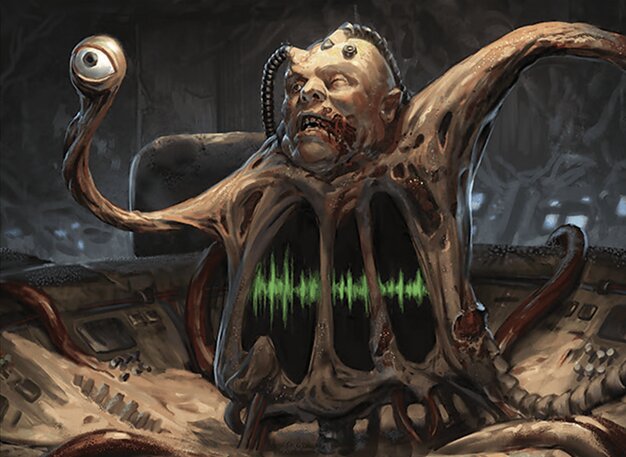
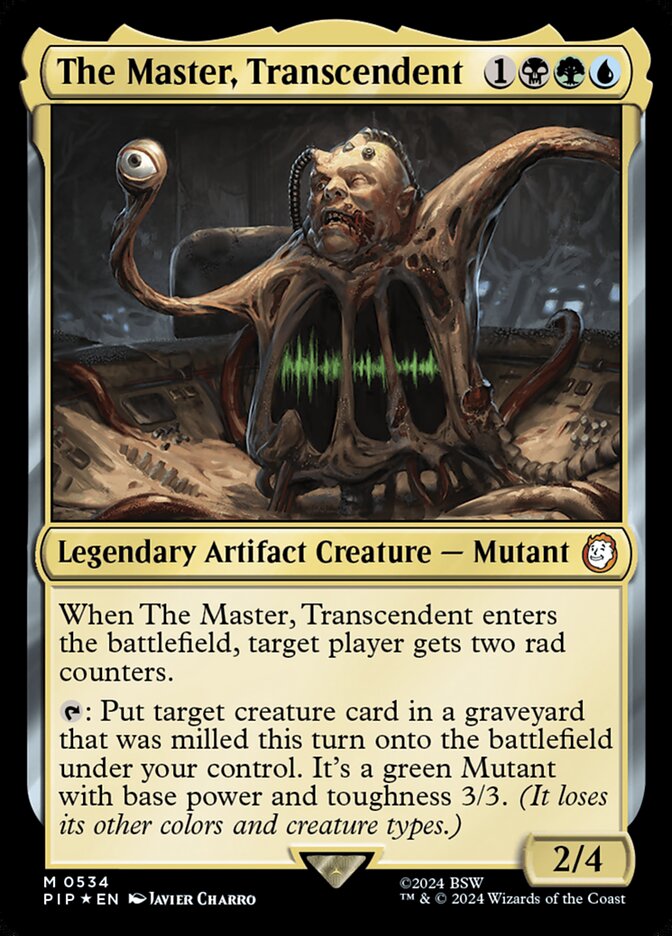
The Master, Transcendent



 Commander
A Sultai graveyard hijacker that turns milling (including rad counters) into on-board threats by reanimating creatures milled that turn.
Public decks: 1Bracket: Varies
Card text
Legendary Artifact Creature — Mutant
When The Master enters, target player gets two rad counters.
 : Put target creature card in a graveyard that was milled this turn onto the battlefield under your control. It's a green Mutant with base power and toughness 3/3. (It loses its other colors and creature types.)
Overview
- Leans on self-mill and/or opponent-mill to create a steady stream of creature hits each turn cycle.
- The Master’s tap ability is timing-sensitive: you typically plan to mill first, then immediately convert the best creature milled that turn into a 3/3 Mutant under your control.
- Can play like value reanimator early, then pivot into grinding table resources by stealing the best creatures out of any graveyard that got milled that turn.
- Often wants cheap acceleration to land the commander and keep mana up for interaction while setting up mills.
- Wins tend to come from snowballing board presence via repeated reanimation, sometimes backed by big reset turns that re-stock battlefields from graveyards.
Common lines
- Ramp early, deploy The Master, Transcendent, then start sequencing “mill first, activate second” each turn.
- Give rad counters to yourself when you need fuel, or to an opponent when you want to pressure life totals and incidentally stock their graveyard for later turns.
- Use selective removal and counterspells to protect the commander and keep the best reanimation target available.
- Set up a graveyard with tutors-to-graveyard effects, then reanimate key creatures through your commander or traditional reanimation spells.
- In some builds, a sacrifice outlet can turn your own creatures into additional mill triggers to keep the commander online.
Strengths
- Turns incidental milling into immediate board impact, which can outpace fair midrange pods if unanswered.
- Flexible target selection: can reanimate from any graveyard as long as the creature was milled that turn.
- Naturally supports a strong interaction suite in Sultai colors (e.g., Counterspell, Arcane Denial, Abrupt Decay, Assassin's Trophy as examples).
- Good at rebuilding after trading resources, since the plan is centered on graveyards rather than hand size.
- Can threaten multiple angles: value reanimator, theft-style gameplay, and occasional mass-graveyard swing turns (e.g., Living Death as an example).
Weaknesses
- Graveyard hate and replacement effects can shut off large parts of the plan.
- Commander is tap-gated and timing-restricted to “milled this turn,” so you can get stranded without a mill enabler or without good hits.
- Reanimated creatures become base 3/3 green Mutants, which can reduce the ceiling of certain theft targets and makes raw stats matter more.
- Can draw table attention quickly once you start taking opponents’ best creatures.
- Vulnerable to repeated commander removal if you can’t stick the engine long enough to profit.
Rule zero notes
- Disclose how much of the plan is creature-theft via graveyards (it can feel like a steal deck once it’s rolling).
- Call out if you’re using rad counters primarily as self-mill fuel versus as a pressure tool on opponents.
- If you run repeatable mill + sacrifice lines (e.g., Altar of Dementia as an example), clarify whether you have deterministic loops or just value.
- Mention if your list includes mass reanimation swings (e.g., Living Death as an example), since those can flip games abruptly.
- Let the table know whether you’re aiming for a fair reanimator game or a faster tutor-heavy setup (e.g., Entomb, Buried Alive as examples).
Matchups
Best into
- Creature-heavy midrange pods where lots of high-impact creatures can get milled and reused
- Slow, grindy tables where repeated value engines are rewarded
- Pods light on graveyard interaction
Struggles against
- Decks packing strong graveyard hate or graveyard lock pieces
- Fast combo tables where milling/value lines are too slow to matter
- Very removal-dense pods that can keep your commander off the table

FAQ
Who should get the rad counters?
It often depends on whether you need fuel or pressure: giving them to yourself can reliably stock your own graveyard, while giving them to an opponent can set up “steal your best hit” turns.
Do I need dedicated reanimation spells if my commander reanimates?
Many builds still want backup reanimation so the deck functions through commander tax and removal (e.g., Animate Dead, Dance of the Dead, Exhume as examples).
Why does it matter that the reanimated creature becomes a 3/3 green Mutant?
You keep the card’s abilities, but you lose its original colors and creature types and it’s locked into base 3/3 stats, so your plan values ETB/triggered abilities and utility bodies more than raw power/toughness.
How does the deck usually close games?
Typically by accumulating enough on-board value from repeated reanimation to overwhelm combat, or by swinging momentum with a big graveyard reset turn (e.g., Living Death as an example).
What kind of interaction fits best here?
Cheap, flexible answers help you protect the commander and stop hate pieces (e.g., Abrupt Decay, Assassin's Trophy, Counterspell, Arcane Denial, Cyclonic Rift as examples).