

The Thirteenth Doctor Commander Deck Guide


 Commander7
A Simic value commander that rewards casting spells from unusual zones while turning counters into pseudo-vigilance through end-step untaps.
Public decks: 0Bracket: Varies

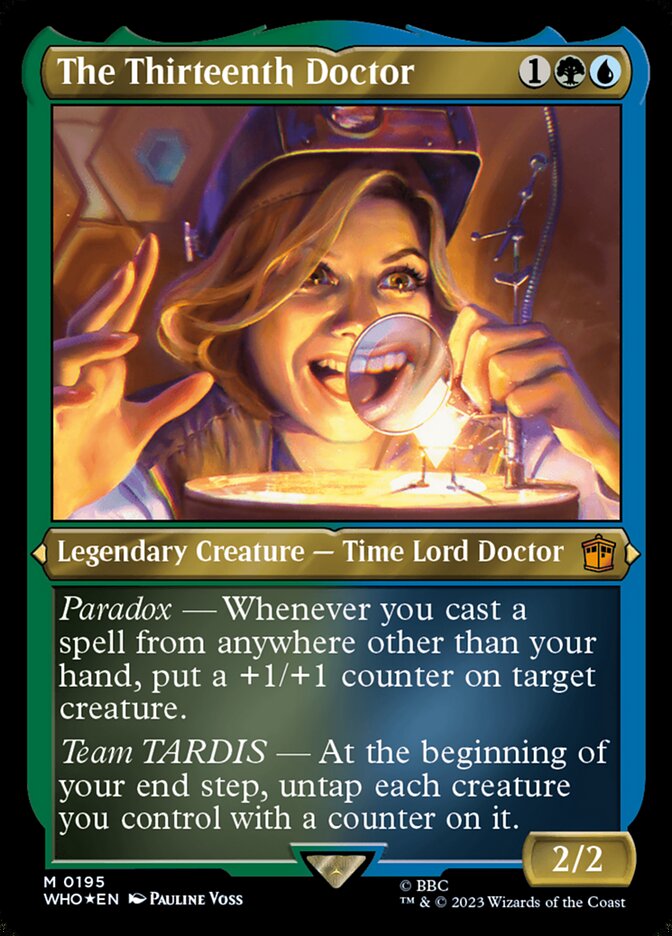
Card text
Legendary Creature — Time Lord Doctor
Paradox — Whenever you cast a spell from anywhere other than your hand, put a +1/+1 counter on target creature.
Team TARDIS — At the beginning of your end step, untap each creature you control with a counter on it.
Building around this commander?
Use MTG Master to build or analyze a Commander deck around this card, check consistency, and find weak spots before your next game.
Overview
- Plays like a counters-and-tempo deck: grow key creatures with +1/+1 counters while keeping mana up.
- Wants a steady stream of spells cast from anywhere other than your hand to repeatedly trigger Paradox.
- Uses Team TARDIS to untap your countered creatures each end step, enabling safer attacks and holding up interaction.
- Often shifts between developing a board of countered threats and playing at instant speed to stay flexible.
- Typically closes by snowballing a wide board of countered creatures that can attack and still be available on defense.
Common lines
- Deploy early creatures that scale well with +1/+1 counters, then start triggering Paradox to spread counters across your board.
- Attack with creatures that already have counters, then get them back untapped at end step to discourage crack-backs.
- Use the end-step untap to represent interaction after committing to combat.
- Stack counters on one or two high-impact creatures to turn them into fast clocks while the rest of your team stays relevant.
Strengths
- Excellent at converting repeated triggers into board presence and combat leverage.
- End-step untaps make racing and blocking math awkward for opponents.
- Naturally supports a flexible, play-with-mana-up game plan.
- Scales well in longer games as counters accumulate across multiple creatures.
Weaknesses
- Relies on maintaining creatures with counters; board wipes can reset a lot of progress.
- Needs consistent access to non-hand casting lines to maximize Paradox; otherwise it can feel like a fair counters deck.
- Can struggle if opponents repeatedly remove the commander and choke off the engine.
- Combat-focused closing plans can be slow into heavy pillowfort or repeated fog-style defenses.
Rule zero notes
- How consistently your deck can cast spells from zones other than your hand (this determines how explosive Paradox will feel).
- Whether your build is primarily combat/value or includes any fast, deterministic combo finishes.
- How interactive your list is (lots of mana-up play can read as control at some tables).
- Whether you lean into counter-synergy as a theme or just use counters incidentally for the untap engine.
Matchups
Best into
- Creature-heavy midrange pods where combat positioning matters.
- Slower value tables that give you time to build a countered board.
- Decks that win via incremental chip damage and board stalls (you untap through them).
Struggles against
- Fast combo pods that end the game before counters and combat pressure matter.
- Frequent sweepers and mass-bounce strategies that repeatedly clear your countered creatures.
- Hard stax that restricts casting or keeps the commander from sticking.
Recent public decks
No public decks are available yet.
FAQ
What does this commander most want to enable?
It wants you to regularly cast spells from somewhere other than your hand so Paradox can keep distributing +1/+1 counters.
How does Team TARDIS change combat?
Creatures with counters can attack more freely because they untap at your end step, letting you pressure life totals without giving up defense.
Do I need to focus on +1/+1 counters to make it work?
You typically want enough creatures that benefit from counters, but the main payoff is also the end-step untap, which can make even modest threats play above rate.
What are the most common ways this deck wins?
It often wins by building a board of increasingly large creatures and leveraging repeated untaps to keep attacking while staying protected.
What should I prioritize when piloting it?
Prioritize keeping a few creatures on board that can hold counters, and time your turns to attack while still representing interaction after the end-step untap.