
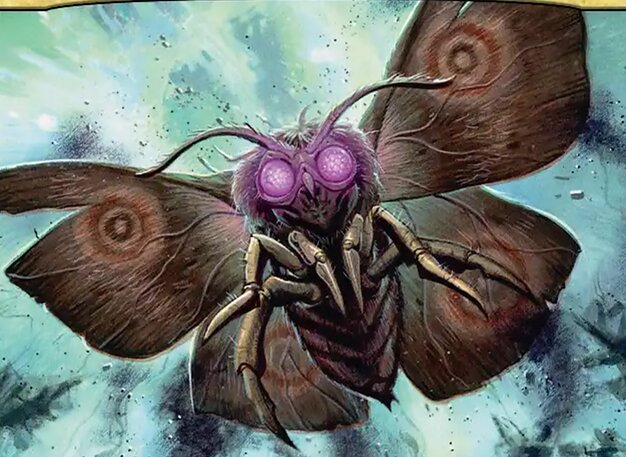
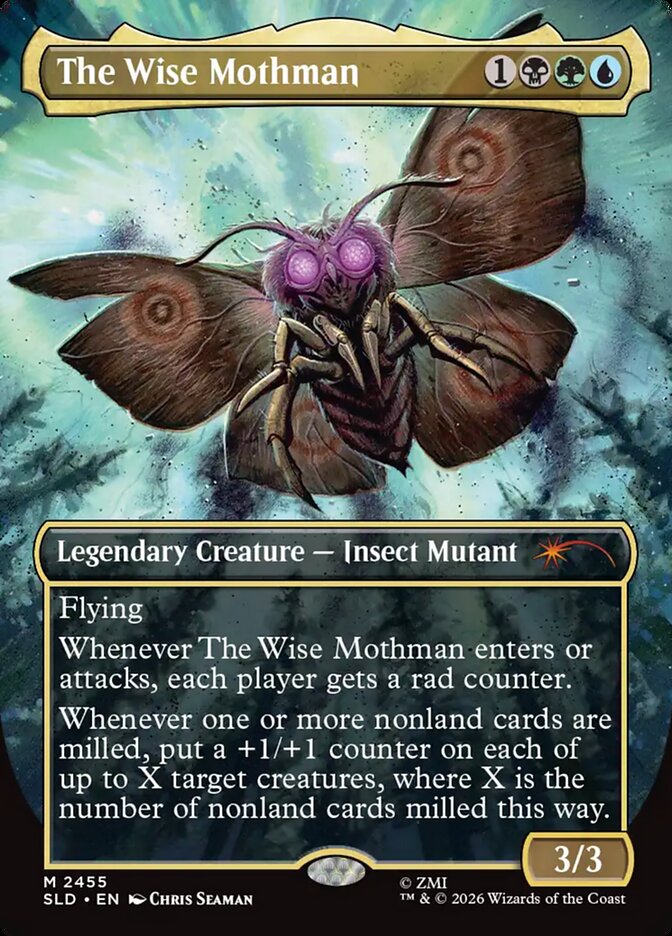
The Wise Mothman



 Commander
A Sultai combat engine that hands out rad counters and turns any nonland milling into a steady stream of +1/+1 counters across your board.
Public decks: 2Bracket: 3
Card text
Legendary Creature — Insect Mutant
Flying
Whenever The Wise Mothman enters or attacks, each player gets a rad counter.
Whenever one or more nonland cards are milled, put a +1/+1 counter on each of up to X target creatures, where X is the number of nonland cards milled this way.
Overview
- Plays like a value-y midrange commander: deploy The Wise Mothman, then keep it entering and attacking to seed rad counters.
- Leans on incidental milling (from rad counters and other effects) to grow creatures via distributed +1/+1 counters.
- Often wins by building a wide, oversized battlefield and pressuring life totals through evasive damage and big swings.
- Can spread counters across multiple threats, making your board less reliant on a single creature staying alive.
- Naturally creates table-wide game actions (rad counters, milling), so threat assessment and politics matter.
Common lines
- Cast the commander, attack early in the air, and let rad counters start generating milling triggers over time.
- Convert each milling event into board presence by distributing +1/+1 counters onto multiple creatures to diversify threats.
- Use the commander’s enter/attack trigger repeatedly to keep rad counters flowing and keep pressure on the table.
- Pivot from “chip in and grow” to a decisive combat turn once your board has accumulated enough counters.
Strengths
- Reliable combat pressure thanks to flying and repeated attack incentives.
- Turns otherwise small or incidental mill events into tangible board growth.
- Spreads power across multiple creatures, improving resilience to single-target removal.
- Scales with multiplayer: more players taking rad counters can mean more milling events to capitalize on.
Weaknesses
- Can be slowed significantly if the commander is removed repeatedly before it attacks or re-enters.
- Graveyard-focused opponents may benefit from the extra milling unless you plan for it.
- Board wipes can reset a lot of your accumulated +1/+1 counter work if you overextend.
- If milling doesn’t happen consistently, the deck can feel like a fair combat deck without enough payoff.
Rule zero notes
- This commander naturally gives all players rad counters and encourages milling; make sure the table is comfortable with that texture.
- If your build includes heavy graveyard hate to offset the milling, it can meaningfully impact graveyard decks—worth a quick heads-up.
- If you’re leaning into repeated enter/attack triggers (e.g., frequent recasts or extra combats), mention it so pacing expectations are clear.
Matchups
Best into
- Creature-light control pods where repeated combat triggers and incremental growth are hard to fully shut off.
- Midrange tables that try to win through board development rather than fast, noncombat finishes.
- Pods that struggle to answer multiple growing threats instead of one big finisher.
Struggles against
- Fast combo tables that can win before rad counters and milling translate into lethal combat pressure.
- Decks packed with sweepers that repeatedly reset your board and counters.
- Graveyard-centric strategies that can turn your forced/incentivized milling into upside.
FAQ
What is The Wise Mothman trying to do each game?
Get onto the battlefield, attack often, and use the resulting milling events to distribute +1/+1 counters and snowball a combat advantage.
Does this deck need dedicated mill support?
Not strictly, but the commander gets much stronger when milling happens consistently, since that’s what turns into your primary board growth.
How does it usually win?
Most builds will close through combat: a wide or semi-wide board of creatures that have grown large via repeated +1/+1 counter distribution.
How do I avoid helping graveyard decks too much?
Plan to pressure life totals quickly and consider including interaction that can check graveyard payoffs so the extra cards don’t become free value.
What should I prioritize when choosing counter targets?
Spreading counters across multiple creatures often plays best, so you keep pressure even if one threat gets removed.