

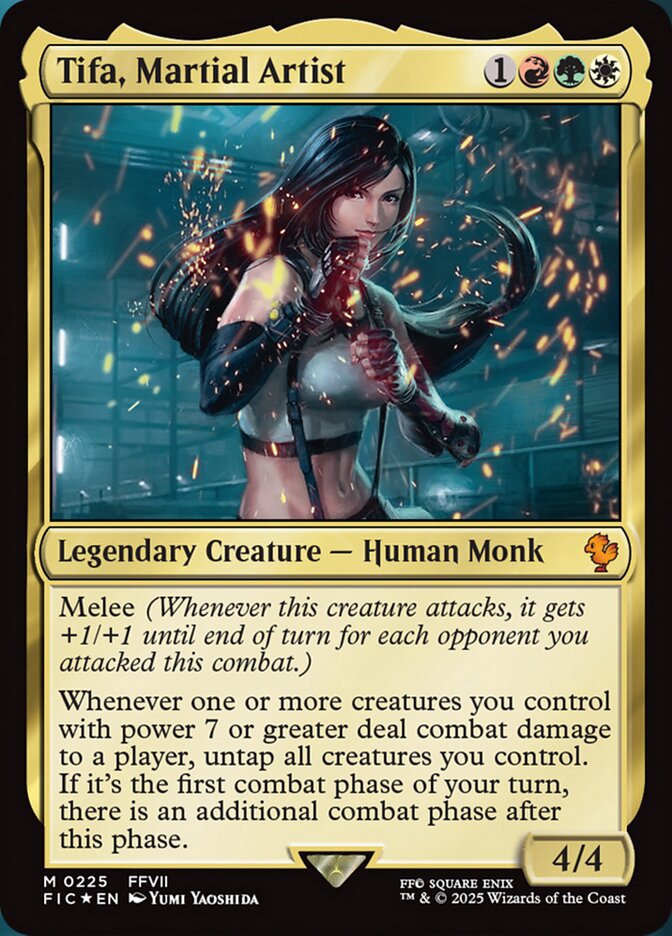
Tifa, Martial Artist




Tifa, Martial Artist is a Naya combat commander that turns big hits into untaps and an extra combat to overwhelm the table in one turn cycle.
Public decks: 1Bracket: Varies
Overview
- Build a board that can attack multiple opponents to scale Melee and pressure life totals.
- Prioritize getting at least one attacker to 7+ power so a single connection can untap your whole team and set up an extra combat.
- Play a midrange curve: ramp early, deploy threats, then pick a turn to convert board presence into a two-combat swing.
- Protection matters a lot because the deck often telegraphs the turn it’s about to pop off.
- Wins tend to come from repeated combat steps and snowballing damage rather than intricate stack-based combos.
Common lines
- Ramp into Tifa, then develop a couple of threatening attackers so you can safely swing at multiple players to turn on Melee.
- Set up a 7+ power attacker, connect once, untap the team, then re-attack in the extra combat to finish off weakened players.
- Hold up a protection spell when you commit to an all-in attack turn, since removing the 7+ power creature mid-combat can stop the chain.
- If the first big swing doesn’t end it, untapping after damage can still let you keep blockers up and avoid crackback.
Strengths
- Explosive damage output: one successful 7+ power hit can translate into a full untap and another combat.
- Naturally punishes shields-down opponents and slow value decks by compressing the game into a single turn of combat.
- Plays well with board-centric cards that add power, trample, or go-wide scaling (for example, Cathars' Crusade or Garruk's Uprising).
- Access to solid protection and resilience tools in Naya colors (for example, Lightning Greaves, Darksteel Plate, Clever Concealment).
Weaknesses
- Relies on combat damage to players; fog effects, pillow-fort plans, and dense removal can blunt the core engine.
- Needs a creature at 7+ power to truly “turn on” the commander; stumbling on board development can make Tifa feel like a fair attacker.
- Board wipes can be especially punishing if you’ve committed multiple creatures to enable multi-opponent attacks.
- Extra-combat turns can paint a target on you, forcing you to manage table threat perception carefully.
Rule zero notes
- This deck is combat-focused and can produce big, swingy turns with multiple combat phases.
- Turns may take longer when you’re sequencing multiple attacks and untaps; confirm the table is okay with that pace.
- If you’re running additional extra-combat cards (for example, Aurelia, the Warleader or Full Throttle), mention it up front since it increases burst potential.
- Expect a board-centric game; the deck typically commits creatures and asks opponents to have interaction.
Matchups
Best into
- Creature-light value pods that take time to set up and don’t interact much at instant speed
- Midrange battlecruiser tables where combat is the main axis and life totals drop naturally
- Decks that tap out often and can’t easily answer a key attacker before damage
Struggles against
- Pillow-fort and fog-heavy strategies that invalidate combat steps
- Removal-dense control shells that can pick off the 7+ power attacker at the critical moment
- Fast combo tables where combat clocks are simply too slow without early pressure
FAQ
Do I need Tifa to win?
Often Tifa is the best way to convert a good board into a lethal turn, but the deck can still win by simply attacking with large threats if she gets answered.
How do I reliably turn on the 7+ power requirement?
You typically want natural big bodies, scalable buffs, or board-wide counters; cards like Cathars' Crusade are an example of how lists can push multiple creatures over the threshold.
Why does attacking multiple opponents matter here?
Melee rewards you for spreading attackers across the table, so even normal creatures can swing above their weight when you’re pressuring two or three players in the same combat.
What kind of interaction should I prioritize?
Protection for the key attacker and your board tends to be premium; examples include Lightning Greaves, Gods Willing, Feat of Resistance, and Clever Concealment.
What’s the usual way the deck closes games?
Most wins come from setting up a 7+ power connection, untapping the team, and using the extra combat to knock out multiple players with stacked damage.