

Tuvasa the Sunlit



Tuvasa the Sunlit rewards you for casting enchantments steadily, turning card flow into a snowballing board and a commander that can threaten lethal out of nowhere.
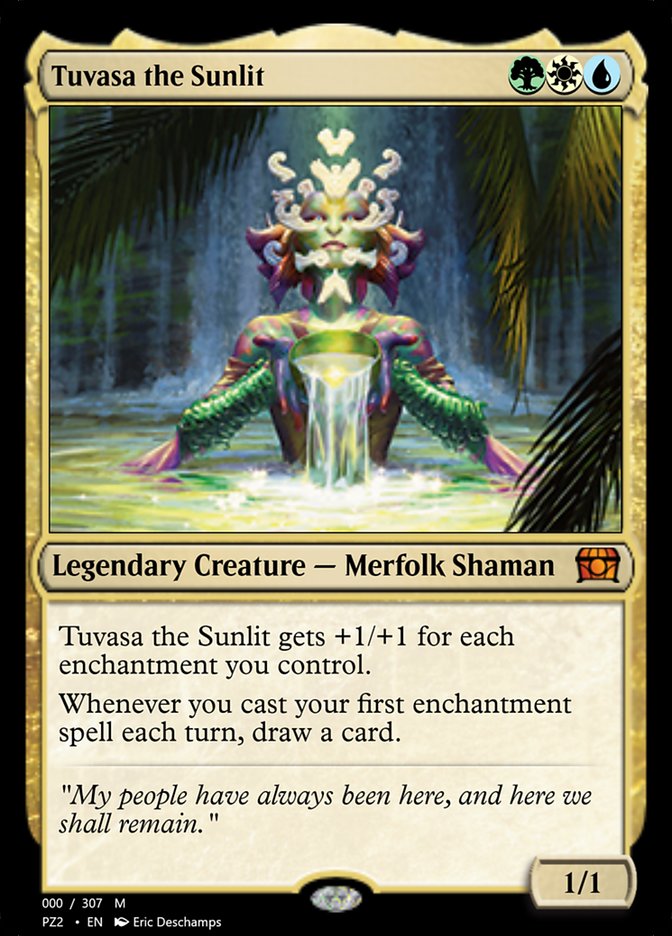
Public decks: 1Bracket: 4
Overview
- Plan to cast an enchantment on as many turns as possible to trigger Tuvasa’s once-per-turn draw.
- Build a board of value enchantments and enchantment creatures; Tuvasa naturally grows into a real combat threat as your enchantment count rises.
- Play a longer, incremental game where your engines keep your hand full and your permanents do most of the work.
- Often closes by either suiting up Tuvasa for commander-damage swings or by overwhelming the table with enchantment-driven token boards.
- Has access to enchantment-based interaction and sweepers, letting you reset selectively when the table gets ahead.
Common lines
- Deploy early mana development, land extra-drops, or land-aura ramp, then land Tuvasa with protection in mind.
- On each turn cycle, prioritize sequencing so your first enchantment cast happens when it’s most impactful (your turn for development, opponents’ turns for interaction if available).
- Stick one or two draw engines alongside Tuvasa so removal on your commander doesn’t fully shut off your momentum.
- Transition from “engine building” into “threat presentation” by converting enchantments into bodies or turning Tuvasa into a must-answer attacker.
- Use enchantment-based answers to keep artifacts/creatures in check while you keep advancing your board.
Strengths
- Reliable, low-opportunity-cost card advantage from simply doing the deck’s main thing (casting enchantments).
- Naturally scales into a large commander that can end games through combat without needing many dedicated slots.
- Enchantment-heavy boards tend to be resilient to some common forms of removal and can rebuild quickly with draw engines online.
- Flexible interaction suite in Bant, including enchantment-based removal and strong board wipes.
- Can pivot between voltron-style kills and wider “go over the top” boards depending on what you draw.
Weaknesses
- Tuvasa only draws on the first enchantment each turn, so big “stormy” enchantment turns can be less rewarding than they look.
- Commander reliance: repeated Tuvasa removal can slow the deck’s velocity and reduce pressure.
- Can be soft to sweepers or effects that cleanly answer enchantments, especially if your engines are concentrated on-board.
- Combat-centric closing lines can struggle into heavy fogs, pillowforts, or repeated bounce/removal.
- Engine turns can be mana-hungry; stumbling on early development can leave you behind faster pods.
Rule zero notes
- This snapshot suggests an enchantment-engine deck; clarify whether your win plan is mostly commander damage, token overwhelm, or alternate win conditions.
- If you’re running prison/pillowfort elements, call out how taxing the game can become for combat decks.
- If you include powerful mana engines (for example, Earthcraft is present here), mention that up front since it can spike the deck’s explosiveness.
- If you’re packing heavy artifact hate (for example, Aura Shards or Energy Flux are present here), warn artifact-focused players.
- If you use hard resets that hit multiple permanent types (for example, Farewell is present here), set expectations about board wipe frequency.
Matchups
Best into
- Creature-heavy midrange pods where enchantment-based removal and board wipes line up well
- Grindy tables where long-term card advantage and incremental engines matter
- Artifact-centric decks if you’re on enough artifact-hate enchantments
Struggles against
- Very fast combo tables that can win before your engines matter
- Decks with dense enchantment removal or repeatable permanent-based control
- High-interaction pods that can keep Tuvasa off the table repeatedly
FAQ
Is this deck more voltron or more value/control?
Tuvasa supports both: she becomes a real commander-damage threat naturally, but the core incentive is sustained enchantment-based value that can play a longer controlling game.
How do games usually end?
Common endgames are a huge Tuvasa attacking for commander damage or a board that snowballs into overwhelming combat from enchantment payoffs.
Do I need to cast enchantments on opponents’ turns to be effective?
You don’t have to, but getting Tuvasa’s draw on multiple turns per round can be a big edge if your build supports it.
What should I protect most carefully?
Your ongoing draw engines and Tuvasa herself; if either keeps getting answered, the deck can feel like it’s spinning its wheels.
Does this play well in casual pods?
Usually yes if your interaction and lock pieces are tuned to the table, but it’s worth disclosing any especially punishing hate enchantments or fast mana engines beforehand.