
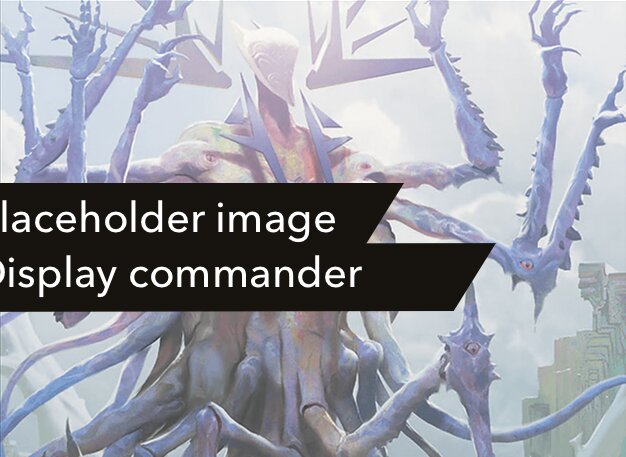
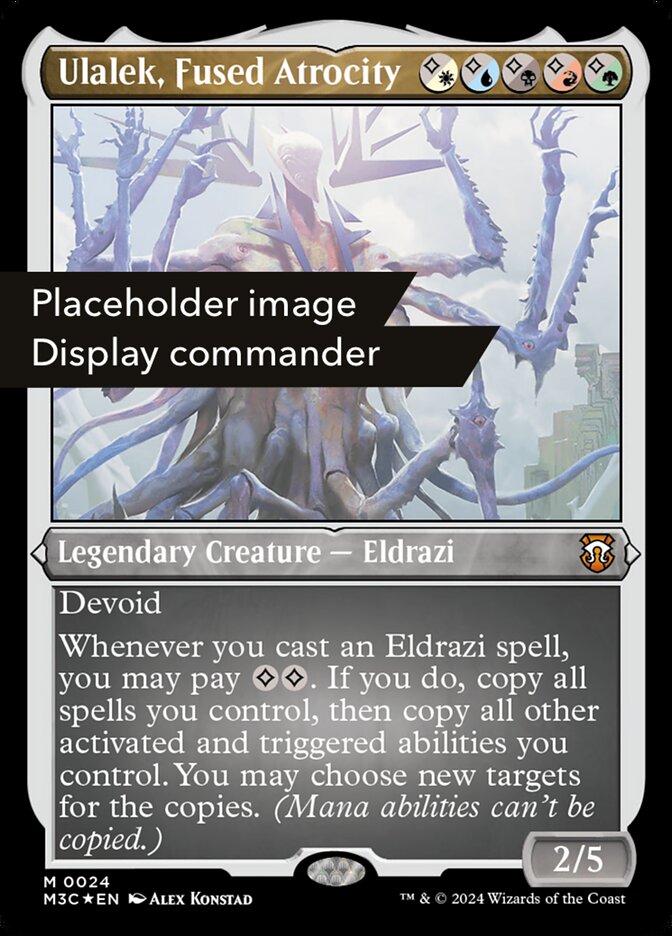
Ulalek, Fused Atrocity




 Commander
A five-color Eldrazi engine that can explode turns by paying {C}{C} to copy your whole stack and your non-mana abilities.
Public decks: 2Bracket: 3
Card text
Legendary Creature — Eldrazi
Devoid (This card has no color.)
Whenever you cast an Eldrazi spell, you may pay  . If you do, copy all spells you control, then copy all other activated and triggered abilities you control. You may choose new targets for the copies. (Mana abilities can't be copied.)
Overview
- Build around casting Eldrazi spells and generating reliable {C} so Ulalek can pay {C}{C} at the right moments.
- Plays like a big-mana value/combo commander: set up mana, cast an Eldrazi, then decide whether copying everything will swing the game.
- Ulalek rewards sequencing and stack management; you often want multiple spells and triggers on the stack before you pay to copy.
- Your closes tend to come from overwhelming advantage: doubled spells, doubled triggers, and big Eldrazi pressure finishing the table.
- Because it’s five-color but demands colorless mana, the mana base and ramp suite are a major deckbuilding constraint.
Common lines
- Develop mana early with an emphasis on producing {C}, then land Ulalek when you can protect it or immediately get value.
- Cast an Eldrazi to trigger Ulalek, then choose whether paying {C}{C} will copy enough spells/abilities to justify the burst.
- Hold interaction and other instant-speed spells so that, when you do pay {C}{C}, the copied stack swings tempo hard.
- Use copied triggered/activated abilities to snowball advantage, then convert that lead into combat damage and table-wide pressure.
Strengths
- Very high ceiling turns when you can copy multiple spells and multiple abilities at once.
- Naturally scales into the late game with big-mana play patterns and repeated value bursts.
- Five-color access lets you run broad answers and flexible support pieces (while still prioritizing {C}).
- Can pivot between grinding value and ending games quickly depending on the stack you assemble.
Weaknesses
- Mana is demanding: you need five colors plus consistent colorless to turn on the {C}{C} payment.
- Commander-centric: removing or taxing Ulalek can significantly reduce your deck’s explosiveness.
- Can be clunky if you draw Eldrazi without ramp, or ramp without enough impactful Eldrazi spells.
- Burst turns can paint a target; if you don’t close after a big copy turn, the table may gang up on you.
- Stack complexity can lead to mis-sequencing and wasted triggers if you’re not careful.
Rule zero notes
- Highlight that the deck can have very explosive turns once it has enough {C}{C} and multiple spells/abilities on the stack.
- Mention whether you’re aiming for big-mana value or for combo-like stack turns that can effectively end the game.
- If you run lots of extra-turn-style play patterns via copied stacks, clarify that up front (even if the win is still combat).
- Set expectations on game length: this commander often wants time to assemble mana and then take a decisive swing turn.
Matchups
Best into
- Midrange pods that give you time to set up mana and leverage a single explosive turn.
- Creature-based tables that struggle to stop a flood of copied spells/abilities plus large bodies.
- Games where interaction is mostly permanent-based rather than heavy on stack denial
Struggles against
- Fast combo tables that end the game before your mana engine comes online.
- Heavy countermagic/stack-control pods that can stop the key Eldrazi cast or the follow-up stack.
- Consistent commander-tax or repeated removal strategies that keep Ulalek off the battlefield
- Stax shells that restrict casting multiple spells or constrain your mana production
FAQ
What is Ulalek actually copying?
When you cast an Eldrazi, paying {C}{C} lets you copy all spells you control on the stack and also copy your other activated and triggered abilities that are currently on the stack.
Do I need to be an Eldrazi tribal deck?
You typically want a meaningful Eldrazi count to trigger Ulalek reliably, but the rest of the deck often focuses on mana, stack setup, and protection rather than only tribal payoffs.
How do games usually end?
Most wins come from a large advantage turn where copied spells and abilities generate overwhelming board presence and momentum, then you close with combat and follow-up pressure.
Is this a combo commander?
It can play combo-like because copying a stacked turn can be game-ending, but it can also function as a big-mana value engine depending on your build and table.
What should I prioritize in deckbuilding?
Consistent access to {C} alongside five colors, enough Eldrazi spells to trigger Ulalek, and a plan to protect your key turns from disruption.