

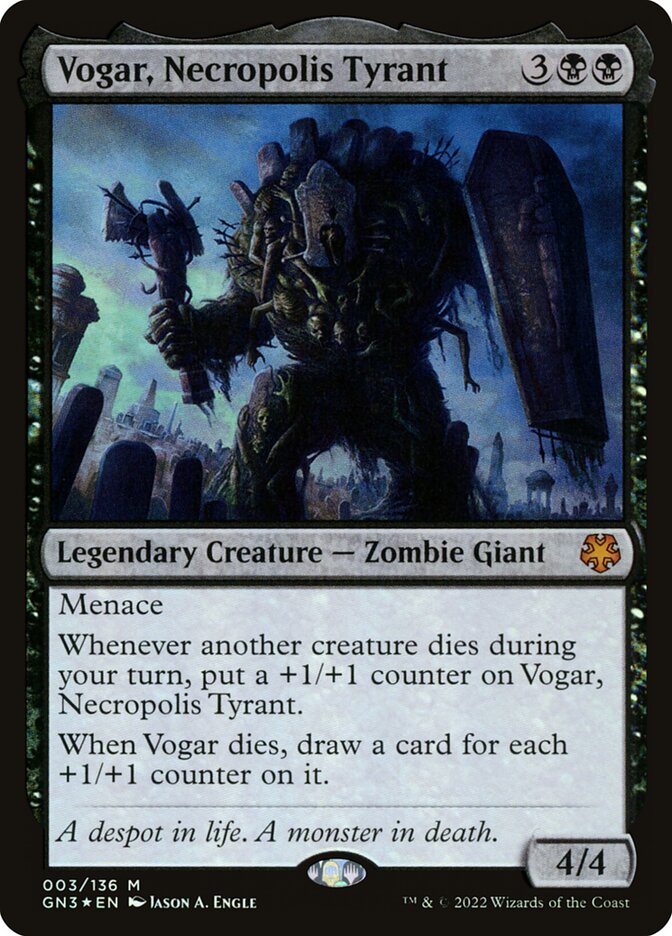
Vogar, Necropolis Tyrant

 Commander
Vogar turns your on-turn deaths into a growing menace threat, then cashes in its +1/+1 counters for a big reload when it finally goes down.
Public decks: 1Bracket: 3
Card text
Legendary Creature — Zombie Giant
Menace
Whenever another creature dies during your turn, put a +1/+1 counter on Vogar.
When Vogar dies, draw a card for each +1/+1 counter on it.
Building around this commander?
Use MTG Master to build or analyze a Commander deck around this card, check consistency, and find weak spots before your next game.
Overview
- Build Vogar by making creatures die during your turn, often via sacrifice outlets, edict creatures, or your own board wipes.
- Leverage menace plus a tall commander to pressure life totals and threaten commander-damage kills while your removal keeps lanes open.
- Plan to “bank” resources in counters: Vogar’s death trigger can turn a removal spell into a fresh hand.
- Mono-black tends to play a grindy game where repeated sacrifice and recursion can keep opponents short on boards.
- Wins often come from a huge Vogar attack, repeated drain-style closers, or overwhelming advantage after a big draw on death.
Common lines
- Deploy mana acceleration and early bodies, then land Vogar and start trading or sacrificing creatures during your turn to grow it.
- Use a sacrifice outlet to control when things die on your turn, stack up counters, then intentionally let Vogar die to refill.
- Clear the board on your turn to both reset opponents and add multiple counters to Vogar off the deaths.
- Follow a big Vogar death-draw by redeploying threats and interaction to stay ahead on the next rotation.
Strengths
- Natural resilience to spot removal: killing Vogar can translate into a large burst of cards.
- Strong at turning board churn into progress, especially when you can dictate when creatures die.
- Menace makes it easier to convert a single tall threat into real pressure.
- Mono-black tools support a mix of removal, sweepers, and attrition engines.
Weaknesses
- Vogar only grows from deaths during your turn, so it can be slower if you can’t reliably enable on-turn deaths.
- Graveyard hate and exile-based answers can blunt common black recursion plans and reduce your ability to rebuild.
- If opponents can remove Vogar without letting it die (or keep it from accumulating counters), your card advantage engine is muted.
- May be reliant on creature density and sacrifice infrastructure; awkward draws can feel low-impact.
Rule zero notes
- Disclose if you’re aiming for repeatable sacrifice locks (for example, effects like Grave Pact or Dictate of Erebos) since they can suppress creature decks.
- Mention whether the list includes fast mana bursts (for example, Dark Ritual) that can push early Vogar or early engines.
- Call out tutor density (for example, Demonic Tutor or Grim Tutor) if you’re assembling specific engines consistently.
- If you run deterministic sacrifice/recursion loops, flag that up front; the commander itself rewards that style even if your exact build varies.
Matchups
Best into
- Creature-heavy midrange pods where removal, edicts, and sweepers generate lots of on-turn deaths.
- Battlecruiser tables that give you time to set up sacrifice engines and a big commander threat.
- Decks that struggle to answer a single large menace attacker efficiently.
Struggles against
- Fast combo pods where your plan is a turn or two too slow without early disruption.
- Heavy exile/removal suites that can answer Vogar while limiting death triggers or rebuilding.
- Pillowfort and token-chump strategies that can make combat finishing harder even with menace.
FAQ
Do I want Vogar to die on purpose?
Often yes: once it has a meaningful number of +1/+1 counters, letting it die can convert that investment into a large hand refill.
How do I reliably trigger Vogar on my turn?
You typically want sacrifice outlets, edict-style creatures, and on-your-turn removal/sweepers so deaths happen when Vogar can see them.
Is this mainly a Voltron commander?
It can play like a Voltron-adjacent threat thanks to menace and scaling power, but the broader game plan usually leans on attrition and resource conversion.
What are example cards that fit the plan from the snapshot?
Examples include sacrifice/attrition pieces like Ashnod's Altar, Grave Pact, and Dictate of Erebos, plus engines like Black Market Connections.
How does the deck usually close games?
Common finishes are a huge Vogar connecting a couple times, or using big resource swings to land a closer like Gray Merchant of Asphodel and keep opponents from rebuilding.