

Ygra, Eater of All


 Commander
A Golgari commander that turns every creature into a Food and grows explosively as those Foods get sacrificed or die.
Public decks: 3Bracket: Varies

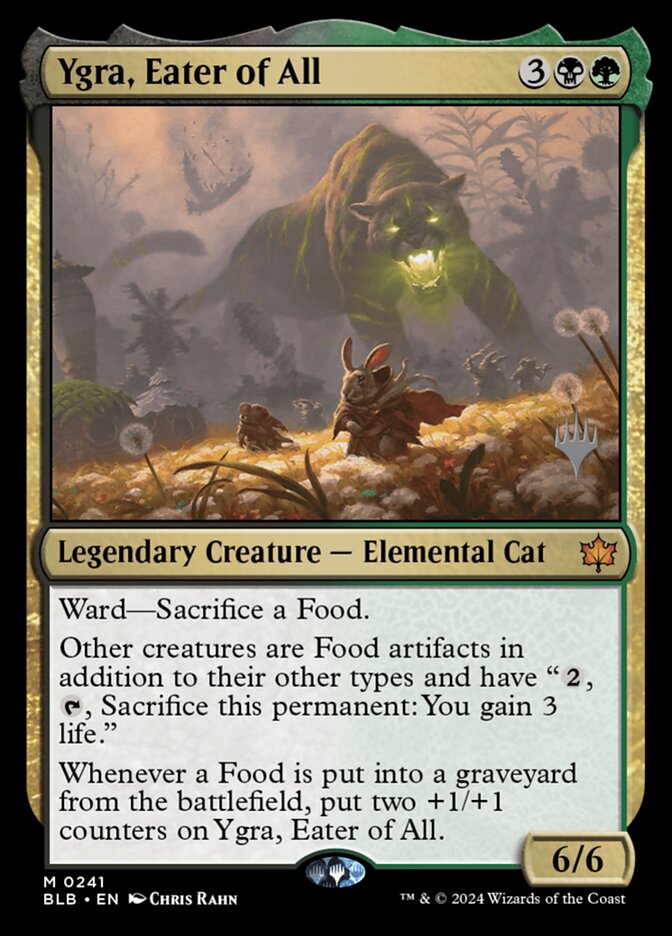
Card text
Legendary Creature — Elemental Cat
Ward—Sacrifice a Food.
Other creatures are Food artifacts in addition to their other types and have " ,
,  , Sacrifice this permanent: You gain 3 life."
Whenever a Food is put into a graveyard from the battlefield, put two +1/+1 counters on Ygra.
Building around this commander?
Use MTG Master to build or analyze a Commander deck around this card, check consistency, and find weak spots before your next game.
Overview
- Ygra makes all creatures into Food artifacts, giving the table a built-in way to cash creatures in for life.
- Your plan often revolves around creating lots of creature deaths and sacrifice triggers, then converting that churn into a huge Ygra via +1/+1 counters.
- Because any Food hitting the graveyard buffs Ygra, both your sacrifices and opponents’ sacrifices/board wipes can translate into commander pressure.
- Ward that asks for sacrificing a Food tends to be easier to pay once the game has creatures on board, but can be awkward early or after wipes.
- Games can pivot between value-grindy attrition and sudden lethal commander damage once Ygra gets large.
Common lines
- Deploy Ygra, then lean into sacrifice and combat trades so multiple Foods hit the graveyard in a turn.
- Use removal and combat to force opposing creatures into the graveyard, growing Ygra while clearing the way to attack.
- After a board reset, recast Ygra and rebuild toward a single large threat plan.
- If the table is converting creatures into life via the Food ability, you can often out-scale that with Ygra’s counter growth and close through commander damage.
Strengths
- Naturally punishes creature-heavy boards by turning trades and deaths into permanent growth.
- Can turn sweepers and mass deaths into a fast, threatening Ygra.
- Ward adds friction for spot removal in the midgame when Foods are plentiful.
- Strong at closing via commander damage once counters stack up.
Weaknesses
- Relies on creatures and/or sacrifice outlets to reliably fuel Food-to-graveyard triggers.
- Can be slowed by exile-based interaction that prevents creatures/Foods from going to the graveyard.
- Commander-centric: repeated removal and high commander tax can stall your main win plan.
- Ward cost can be hard to pay early, or after you’ve been swept and have few permanents to spare.
Rule zero notes
- This commander changes the texture of combat and board wipes by making every creature a Food with a built-in sacrifice-for-life ability.
- Clarify that the Food ability is granted to all creatures, including opponents’, and may encourage lots of sacrifices at the table.
- Let the table know if your build is primarily commander-damage focused or more of a grindy sacrifice/attrition plan.
- No specific speed/lock expectations are implied from the snapshot; power level can vary a lot by build.
Matchups
Best into
- Creature-heavy midrange pods where lots of bodies trade and die.
- Board states that naturally lead to frequent chump blocks and combat attrition.
- Tables that lean on destroy-based removal and sweepers.
Struggles against
- Exile-heavy interaction and effects that sidestep the graveyard.
- Fast combo pods that don’t engage much on the battlefield.
- Decks that can repeatedly remove Ygra before you get a death/sacrifice engine online.
Recent public decks

Staples
Browse all public decksFAQ
How does Ygra usually win?
Most wins tend to come from making Ygra enormous through repeated Food-to-graveyard triggers and then taking players out with commander damage.
Does Ygra help my opponents too much by giving their creatures the Food ability?
It can, since they can cash creatures in for life, but every Food that hits the graveyard also grows Ygra, so you often come out ahead if you can keep the deaths flowing.
What kinds of interaction hurt this deck the most?
Exile effects and other tools that prevent permanents from hitting the graveyard reduce Ygra’s ability to snowball.
Is Ygra more of an aggro commander or a value commander?
It often plays like value-attrition early, then switches into a commander-damage finisher once enough Food triggers stack up.
How relevant is the ward cost in practice?
It tends to matter most in the midgame when you can spare a Food without collapsing your board; early on, it’s not always available.