

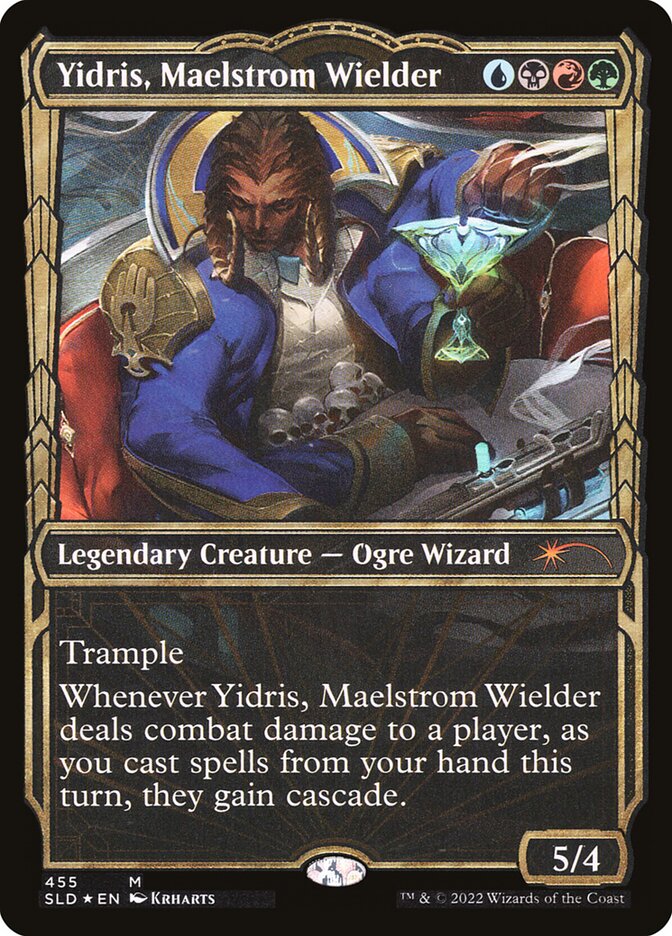
Yidris, Maelstrom Wielder



 Commander
A four-color combat trigger commander that turns one clean hit into a turn of spell-chaining cascade from your hand.
Public decks: 0Bracket: Varies
Card text
Legendary Creature — Ogre Wizard
Trample
Whenever Yidris deals combat damage to a player, as you cast spells from your hand this turn, they gain cascade. (When you cast the spell, exile cards from the top of your library until you exile a nonland card that costs less. You may cast it without paying its mana cost. Put the exiled cards on the bottom in a random order.)
Overview
- Game plan usually centers on connecting with Yidris once, then using the rest of the turn to cast multiple spells from hand with cascade.
- Typically plays like a midrange-combo engine: set up mana and protection, pick a safe window to attack, then explode in velocity.
- Cascade rewards careful curve planning; your deck tends to be built to reduce “misses” and keep chains impactful.
- Often wants haste/evasion and some way to keep Yidris on the table long enough to attack.
- Wins commonly come from overwhelming advantage in a single post-combat main phase, converting extra spells into a decisive board or combo finish.
Common lines
- Develop mana and interaction early, then deploy Yidris with protection available.
- Move to combat, find a safe attack to connect, then pivot into a big second main phase of chained spells.
- Use cascaded value to refuel hand, add mana, and/or assemble a finisher while opponents are tapped down from the combat step.
- If Yidris gets answered, spend a turn rebuilding and look for another attack window rather than forcing into open mana.
Strengths
- Explosive turns once the combat trigger happens, often generating multiple spells’ worth of advantage.
- Four-color access supports flexible answers and a wide range of win conditions.
- Cascade can turn medium hands into high-output turns, especially when opponents can’t interact on the stack repeatedly.
- Threatens to snowball quickly, forcing the table to respect your combat step.
Weaknesses
- Needs to deal combat damage to turn on the engine; fogs, blockers, and removal can shut off the big turn.
- Commander-dependent: repeated answers to Yidris can tax your tempo and mana.
- Cascade adds variance; poorly spaced mana values can lead to awkward hits at key moments.
- Attack step commitments can be punished by crack-backs or by holding up interaction you’d rather spend post-combat.
Rule zero notes
- Clarify whether your build is aiming for big value cascades or a more deterministic combo finish after the trigger.
- Mention your typical speed: how early you expect to cast Yidris and how soon you can realistically “go off” after connecting.
- Call out if you run extra-combat or heavy haste/evasion packages that make the trigger happen more consistently.
- If your list uses any lock pieces or unusually high interaction density to protect the cascade turn, disclose that upfront.
Matchups
Best into
- Slower midrange pods that give you time to land Yidris and take a setup turn.
- Tables light on instant-speed creature removal or with limited stack interaction.
- Creature battlecruiser games where connecting in combat is easier.
Struggles against
- Pods with lots of cheap removal and counterspells that can stop Yidris or the post-combat chain.
- Decks that clog combat with efficient blockers or frequent fog effects.
- Fast combo tables that end the game before you reliably get an attack trigger.
Recent public decks
No public decks are available yet.
FAQ
Do I need to build around cascade heavily?
You usually want your curve and spell mix to make cascade hits consistently useful, but the core requirement is simply connecting once and having spells in hand to cast.
How does the deck typically win?
Many games end after a single successful hit where the post-combat main phase generates a huge advantage and converts it into a lethal board state or combo line.
What’s the biggest gameplay skill test with Yidris?
Choosing the right attack window and sequencing spells post-combat so cascade chains don’t undercut what you still need to cast.
How do I protect the plan?
You generally want a mix of ways to force through combat damage (haste/evasion) and ways to keep Yidris alive through the turn cycle so you can attack safely.
What should I expect from the table once Yidris is out?
Yidris tends to draw removal and pre-combat interaction; opponents often treat your combat step as the moment they must respond or risk a runaway turn.