

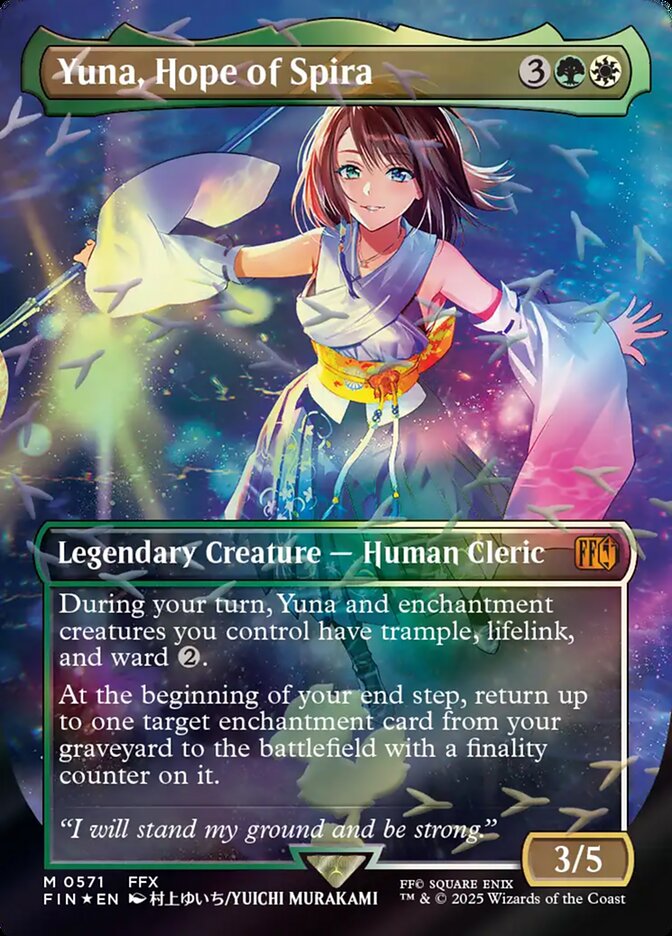
Yuna, Hope of Spira


 Commander
Yuna, Hope of Spira is a Selesnya enchantment-based midrange commander that turns your turn into a protected combat step while grinding value by recurring enchantments from the graveyard.
Public decks: 1Bracket: 4
Card text
Legendary Creature — Human Cleric
During your turn, Yuna and enchantment creatures you control have trample, lifelink, and ward  .
.
At the beginning of your end step, return up to one target enchantment card from your graveyard to the battlefield with a finality counter on it. (If a permanent with a finality counter on it would be put into a graveyard from the battlefield, exile it instead.)
Overview
- Leans into enchantments and enchantment creatures, then attacks with trample and lifelink on your turn.
- Uses repeatable end-step recursion to rebuild after removal and keep your board quality high (with the finality counter downside).
- Often plays like a steady value engine early, then pivots into a single decisive combat step once you’re set up.
- Ward {2} on your turn helps force through key attacks and makes spot-removal awkward during your main phase.
- Can mix board-centric pressure with tutoring for specific payoffs, depending on build choices.
Common lines
- Ramp early (mana creatures or rocks) into Yuna, then start committing enchantments knowing you can buy one back each end step.
- Trade or mill/discard enchantments naturally over the game, then convert the graveyard into a second hand via Yuna’s trigger.
- Build a threatening attacker (Yuna or an enchantment creature) and leverage trample + lifelink to win races and stabilize.
- Set up a protected “my turn” push, then look for a finisher-style turn to convert board presence into lethal damage.
Strengths
- Excellent resilience against spot removal through repeatable enchantment recursion.
- Strong combat math on your turn: trample and lifelink make stabilizing and racing easier.
- Ward {2} on your turn taxes interaction at the most important moment (when you’re committing to attacks or key plays).
- Naturally rewards grindy games where resources trade and the graveyard matters.
- Access to efficient tutoring and big closers can give the deck a reliable endgame.
Weaknesses
- Graveyard hate can shut off a major engine and force you to play fair from hand.
- Finality counters mean your recurred enchantments are more vulnerable to being exiled after a second removal or wipe.
- Exile-based removal and sweepers can line up well against your best permanents.
- Can be slower to close if your board gets repeatedly reset or if combat is heavily fogged/stonewalled.
- Yuna’s protection is largely “on your turn,” so opponents can still interact more freely at other times.
Rule zero notes
- This commander provides repeatable end-step recursion of enchantments; confirm how grindy you expect the game to be.
- Reanimated enchantments return with finality counters, meaning they’ll exile if they die again; this affects loop potential and rebuild patterns.
- If you’re running high tutor density (e.g., Enlightened Tutor, Eladamri's Call, Chord of Calling, Green Sun's Zenith, Finale of Devastation), mention it up front.
- If your win plan includes big, swingy combat finishes (e.g., Akroma's Will), call out that you can end games suddenly from a developed board.
- Ward {2} applies during your turn to Yuna and enchantment creatures you control; clarify this is more about forcing through your turn than hard-lock protection.
Matchups
Best into
- Creature-heavy midrange pods where combat and racing matter.
- Removal-heavy tables that trade resources and let recursion shine.
- Lower-interaction metas where a protected combat step can decide the game.
Struggles against
- Fast combo tables that don’t care about combat pressure.
- Decks packing lots of graveyard hate and exile removal.
- Frequent board-wipe environments that repeatedly clear enchantment creatures and payoff pieces.
FAQ
What does Yuna actually reward you for doing?
Playing an enchantment-heavy game where you can attack profitably on your turn and convert your graveyard into steady board rebuilds via the end-step trigger.
Is this more Voltron or more board-based?
It can be either: Yuna supports a tall attacker plan (example: Ancestral Mask) or a wider enchantment-creature board that all benefits from the turn-based keywords.
How do you usually win the game?
Most wins come from a decisive combat step once you have a threatening board, sometimes backed by a one-turn finisher like Akroma's Will or a tutor into a closer like Finale of Devastation.
How scary is the finality counter drawback?
It’s real: your recurred enchantment is effectively on borrowed time against removal, so you generally want immediate value or to force opponents into awkward trades.
What should I prioritize early?
Mana development into Yuna, then establishing enchantment-based value so that your end-step recursion starts generating advantage without overextending into sweepers.