
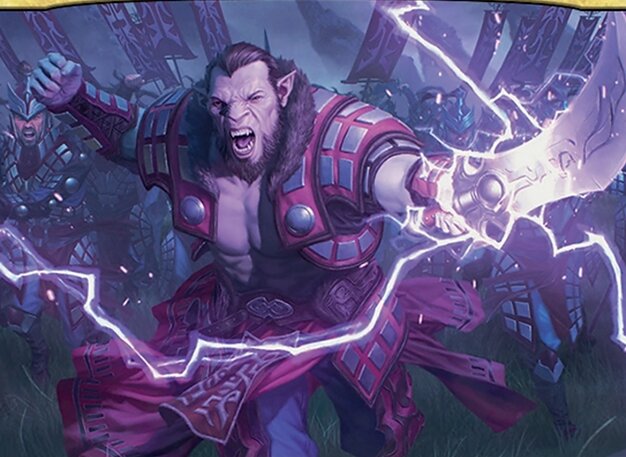
Zurgo Stormrender


 Commander
Zurgo Stormrender rewards you for making attacking tokens and then letting them die, turning combat into cards and table-wide life loss.
Public decks: 3Bracket: 3

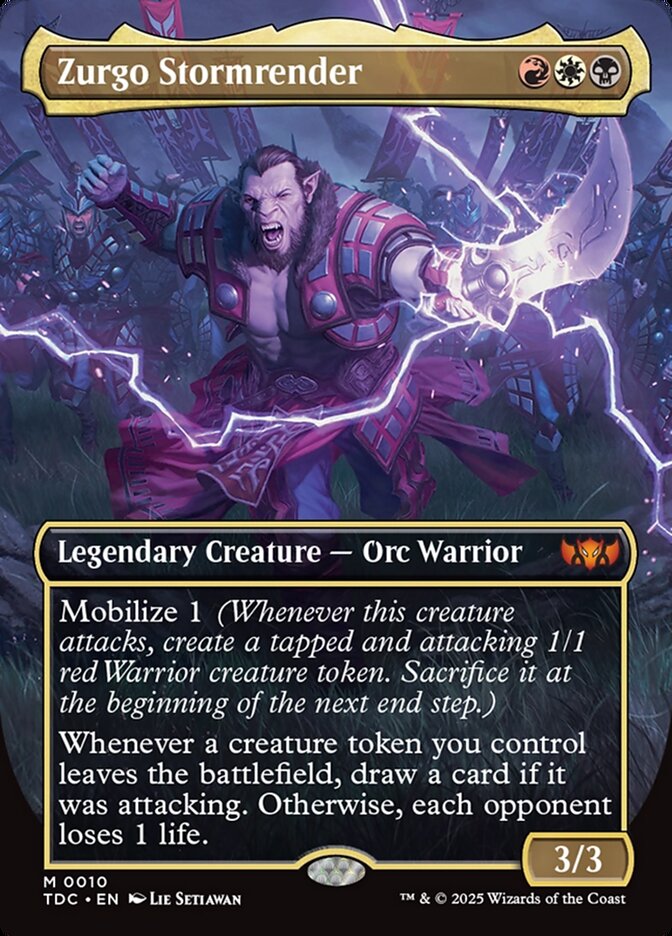
Card text
Legendary Creature — Orc Warrior
Mobilize 1 (Whenever this creature attacks, create a tapped and attacking 1/1 red Warrior creature token. Sacrifice it at the beginning of the next end step.)
Whenever a creature token you control leaves the battlefield, draw a card if it was attacking. Otherwise, each opponent loses 1 life.
Building around this commander?
Use MTG Master to build or analyze a Commander deck around this card, check consistency, and find weak spots before your next game.
Overview
- Leans into combat triggers: attacking generates temporary Warrior tokens via mobilize, then their exit fuels your commander.
- Splits payoff based on how tokens leave: attacking tokens dying draws cards, while non-attacking token exits drain the table.
- Typically wants lots of disposable tokens and reliable ways to have them leave the battlefield on your terms.
- Plays well as an aggressive midrange engine: pressure life totals while refilling your hand through token churn.
- Often closes by snowballing combat turns where multiple tokens are created and cashed in for cards and incremental drain.
Common lines
- Deploy Zurgo, move to combat, and start generating tapped-and-attacking tokens to immediately pressure and set up value.
- Trade tokens in combat so their death/cleanup converts into card draw rather than just lost material.
- Use sacrifice or cleanup timing to convert extra tokens into repeated drain when they weren’t attacking.
- Grind through removal by rebuilding with token makers, keeping your hand stocked from attacking-token exits.
Strengths
- Built-in card advantage tied to normal game actions (attacking and tokens dying).
- Naturally pressures opponents while keeping resources flowing.
- Good at turning chump attackers and temporary tokens into real value.
- Can pivot between combat-focused draws and non-combat drain depending on board state.
- Mardu colors support both proactive pressure and resilient grinding.
Weaknesses
- Reliant on having token output; without tokens, Zurgo’s payoff is limited.
- Vulnerable to effects that prevent combat, remove the commander repeatedly, or shut off token creation.
- Board stalls can reduce combat-driven card draw if attacks become unprofitable.
- Graveyard and sacrifice-hate style effects can make it harder to profitably cash in tokens.
- Can struggle to end the game quickly if opponents stabilize life totals and boards.
Rule zero notes
- Clarify whether the deck is primarily combat-midrange or built to maximize sacrifice/drain engines.
- Mention how aggressively you plan to pressure life totals with early attacks versus play a longer grind.
- If you run a high density of sacrifice outlets or token-doublers (if any), call out that games may become very value-snowbally.
- Set expectations on win pace: incremental drain and combat damage can take several turns to close.
Matchups
Best into
- Creature-heavy pods where combat trades are frequent and profitable.
- Midrange tables that give time for incremental drain and card advantage to take over.
- Removal-heavy pods where rebuilding with token churn keeps you ahead on resources.
Struggles against
- Decks that consistently fog, pillowfort, or otherwise deny meaningful attacks.
- Fast combo tables where combat and incremental drain are too slow to matter.
- Strategies that heavily punish token swarms or repeatedly wipe boards before you can convert value.
Recent public decks
Staples
Browse all public decksFAQ
What is Zurgo Stormrender trying to do each game?
Generate attacking tokens and convert their exit into cards, while using non-attacking token exits as a steady drain to close.
Do I need to build around sacrifice outlets?
Not strictly, but having ways to reliably make tokens leave the battlefield gives you more control over whether you want cards or drain.
How does the deck usually win?
Typically through sustained combat pressure backed by a full hand, plus incremental life loss from repeated token exits.
Is this more aggro or more aristocrats-style drain?
It often plays like a combat-forward value deck that can pivot into drain when attacks aren’t good, rather than being purely one or the other.
What should I prioritize when I’m behind?
Re-establish token production and look for safe attacks to restart the draw engine; if combat is impossible, lean on token churn to drain and stabilize.