
How to Build an Aristocrats Commander Deck: Sacrifice, Value, and Winning Through Death
By MTG Master EditorialPublished Updated 16 min read
There aren't many Commander strategies where you're actually happy when your own creatures die.
Aristocrats is one of them.
While other players are trying to protect their creatures and build an enormous battlefield, you're sacrificing yours, bringing them back, creating more, and somehow making everyone else lose life in the process.
And sometimes, the most dangerous creature on your battlefield is a completely harmless-looking 1/1 token.
That's what I find interesting about Aristocrats. You're not necessarily playing the biggest creatures or the most expensive spells. You're building a collection of cards that work together, where even losing a creature can become an advantage.
But there's a difference between a deck that has a few sacrifice synergies and a good Aristocrats deck.
If you want the strategy to work consistently, you need to understand what makes the engine function, how to keep it running, and how you're actually going to win.
Let's get into it.
What Exactly Is an Aristocrats Deck?
The basic idea is simple: you sacrifice your own creatures to generate value.
That value can be almost anything.
You might draw cards, create tokens, generate mana, force opponents to sacrifice creatures, or make everyone lose life.
And in a good Aristocrats deck, you can often do several of those things at once.
Imagine you have these three cards on the battlefield:
Viscera Seer
Blood Artist
Reassembling Skeleton
You sacrifice Reassembling Skeleton to Viscera Seer.
Viscera Seer lets you scry 1, and Blood Artist makes a target player lose 1 life while you gain 1 life.
You can then pay 
 to return Reassembling Skeleton to the battlefield tapped and repeat the process when you have enough mana.
Nothing spectacular happens from a single sacrifice.
But now imagine adding more cards that reward creatures dying, create additional tokens, or generate mana.
Suddenly, sacrificing a creature can trigger three or four different abilities.
That's when Aristocrats starts becoming dangerous.
The strategy gets its name from cards like Cartel Aristocrat and Falkenrath Aristocrat, which helped establish this style of sacrifice-based gameplay.
Today, Aristocrats has become much more than a couple of sacrifice creatures. It's an entire way of building Commander decks.
The Three Things Every Aristocrats Deck Needs
I don't think Commander decks should follow rigid formulas, but Aristocrats has three basic components that you really can't ignore.
You need creatures you're willing to sacrifice, ways to sacrifice them, and cards that reward you when they die.
If one of those pieces is missing, the deck can feel surprisingly bad.
1. Creatures You Actually Want to Sacrifice
First, you need something to sacrifice.
And ideally, you don't want to sacrifice your best creature every time you need to activate an ability.
This is why token generators and creatures that return from the graveyard are so useful.
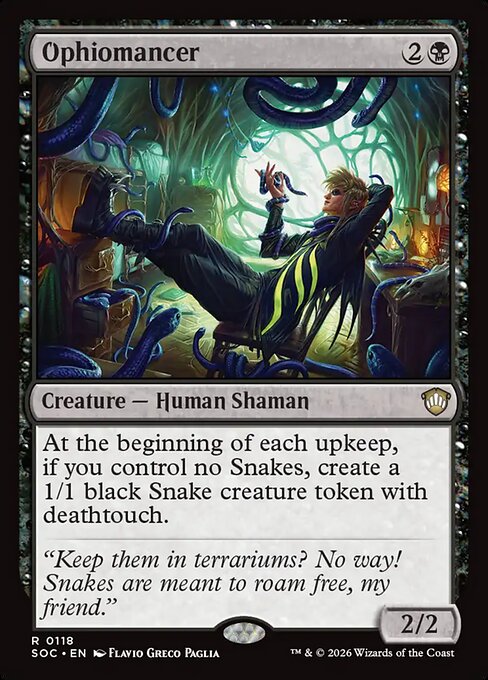
Cards like Ophiomancer, Jadar, Ghoulcaller of Nephalia, and Reassembling Skeleton can provide a steady supply of creatures.
I particularly like effects that generate tokens repeatedly rather than giving you five creatures once and then doing nothing for the rest of the game.
For example, Ophiomancer can create a Snake at the beginning of each upkeep if you don't control a Snake.
You must control no Snakes both when the upkeep begins and when the ability resolves. If you already have a Snake when the upkeep begins, sacrificing it afterward won't make the ability trigger that turn.
In a four-player Commander game, that's potentially four opportunities to create a creature during each full rotation of turns.
If you have a sacrifice outlet, you can sacrifice the Snake before the next upkeep and keep the engine running.
And that's much more interesting than it first appears.
Reassembling Skeleton is another good example. It's not a powerful creature, but that's not why you're playing it.
You're playing it because it keeps coming back.
In Aristocrats, a small creature that refuses to stay dead can be considerably more valuable than a huge creature that does nothing when it dies.
2. Sacrifice Outlets: You Decide When Things Die
A sacrifice outlet is simply a card that allows you to sacrifice your own creatures.
But not all sacrifice outlets are equally useful.
Some require mana. Others can only be activated once per turn or at sorcery speed. And some let you sacrifice creatures whenever you have priority, without paying mana.
Those last ones are particularly important.
Cards such as Viscera Seer, Carrion Feeder, Ashnod's Altar, and Goblin Bombardment are classic examples.
I really like sacrifice outlets that don't require mana because they give you much more control over the game.
Imagine an opponent casts Swords to Plowshares targeting one of your creatures.
If you can sacrifice that creature in response, you still get any relevant death triggers, and the removal spell will generally fail to affect its original target.
The same idea applies when somebody casts a board wipe.
If your creatures are going to die anyway, you might as well get some value out of them before they disappear.
There's also a big difference between sacrificing a creature as a cost and waiting for it to die naturally.
Being able to choose exactly when a creature dies makes your deck much more flexible.
One warning, though: sacrificing a creature in response won't stop a board wipe from destroying your other creatures. You're getting value before they die, not magically saving the battlefield.
3. Payoffs: Make Every Death Matter
Now we get to the fun part.
You have creatures to sacrifice and ways to sacrifice them.
But why are you doing it?
That's where your payoffs come in.
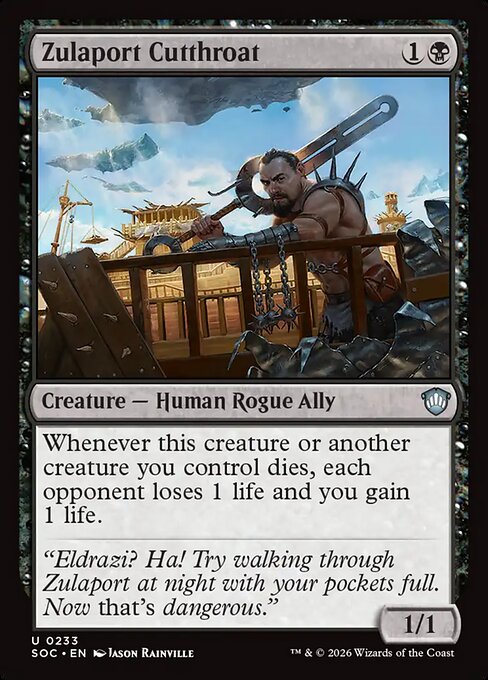
Blood Artist, Zulaport Cutthroat, Bastion of Remembrance, and Cruel Celebrant are classic examples of cards that turn creatures dying into life loss for opponents while you gain life. These effects do not deal damage.
Others reward you in different ways.
Midnight Reaper can help you draw cards when your nontoken creatures die. Pitiless Plunderer generates Treasure tokens. Grave Pact can force your opponents to sacrifice creatures.
And some cards do more than one useful thing.
The important part is having enough payoffs that sacrificing your creatures actually accomplishes something.
I've seen decks with lots of sacrifice outlets and plenty of creatures, but very few ways to benefit from them dying.
At that point, you're just sacrificing creatures because you can.
Which is entertaining, I suppose, but not a particularly reliable way to win.
Choosing an Aristocrats Commander
One of the things I like about Aristocrats is how differently the archetype can play depending on your commander.
Some commanders double your death triggers, others reward sacrifices directly, and some focus on bringing creatures back from the graveyard.
Here are a few I'd consider.
Teysa Karlov: Death Triggers Everywhere
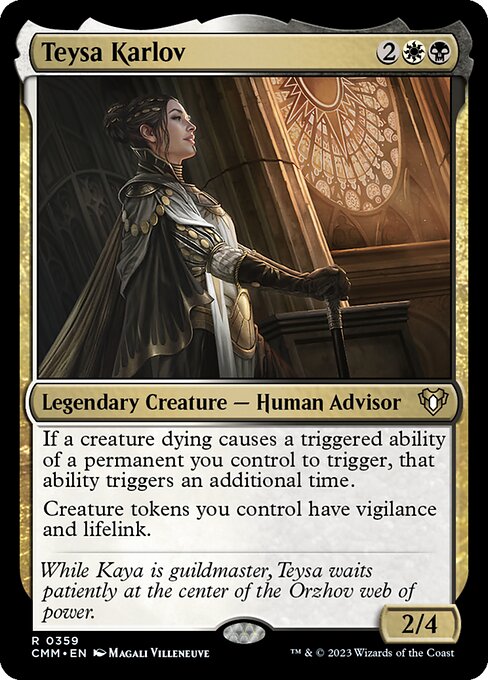
Teysa Karlov is probably one of the most recognizable Aristocrats commanders.
She adds an extra trigger when a creature dying triggers an ability of a permanent you control. That creature can belong to an opponent too, if its death meets the ability's conditions.
That means cards like Blood Artist or Zulaport Cutthroat can become much more dangerous.
And you don't necessarily need infinite combos.
With enough creatures dying, a couple of drain effects can cause serious damage to the entire table.
What I like about Teysa is that her strategy is extremely clear. You want creatures to die, and you want to benefit as much as possible when that happens.
She's also in Orzhov colors, giving you access to excellent removal, token generation, recursion, and life-drain effects.
Just remember that Teysa doesn't double every ability involving sacrifice. She doubles triggered abilities caused by creatures dying, not the activated abilities of your sacrifice outlets.
Meren of Clan Nel Toth: Nothing Stays Dead
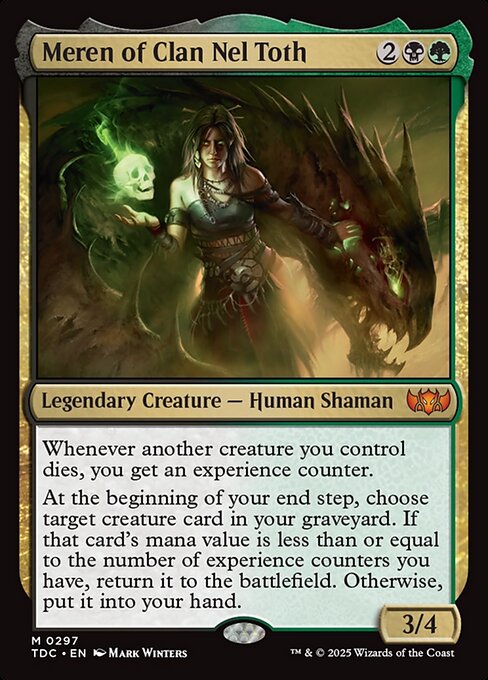
Meren of Clan Nel Toth approaches Aristocrats differently.
Instead of doubling death triggers, she helps you recover creatures from your graveyard.
With enough experience counters, you can repeatedly bring useful creatures back to the battlefield.
This makes Meren particularly interesting if you enjoy longer games and recursive value engines.
Cards with enter-the-battlefield abilities, death triggers, and sacrifice synergies can become extremely useful when you're able to reuse them.
The downside is that graveyard hate can be painful.
If your entire strategy depends on having creatures available in the graveyard, a well-timed Bojuka Bog can make things complicated.
Elas il-Kor, Sadistic Pilgrim: Simple but Dangerous
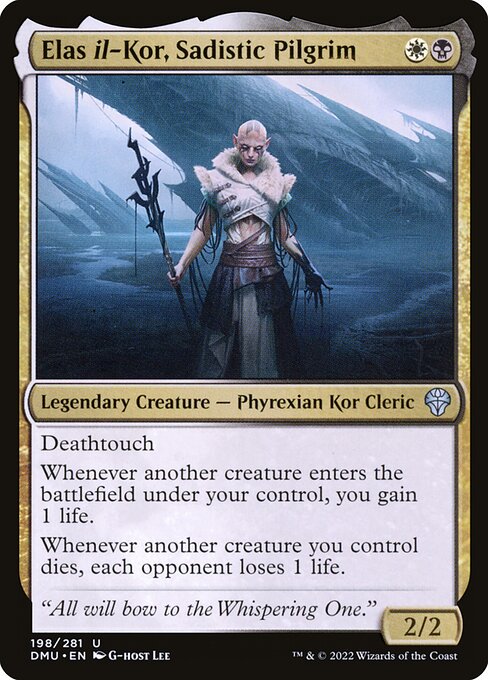
Elas il-Kor, Sadistic Pilgrim is a great example of how a commander doesn't need a complicated ability to be effective.
You gain life when another creature enters under your control, and each opponent loses life when another creature you control dies.
That's it.
But when your deck creates and sacrifices lots of creatures, those small triggers add up quickly.
I like commanders like this because they let the rest of the deck do the interesting work.
You don't need to assemble a complicated interaction involving your commander. Just play creatures, sacrifice them, and let the abilities accumulate.
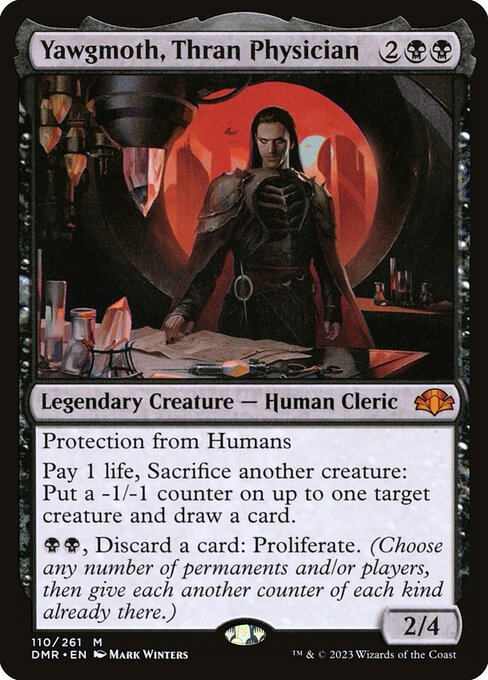
Yawgmoth, Thran Physician: Sacrifice With a Lot of Control
If you prefer mono-black, Yawgmoth, Thran Physician is another very interesting choice.
Once he's on the battlefield, he supplies a sacrifice outlet, lets you draw cards, and can weaken opposing creatures with -1/-1 counters.
That solves an important problem before you've even started building the deck.
You already have access to a powerful way to sacrifice creatures and generate value.
Yawgmoth can be particularly strong, but he also requires careful resource management: activating that ability costs 1 life and sacrificing another creature. You can choose no target for the counter and still draw a card when the ability resolves.
And depending on how you build him, he can become a very powerful combo commander.
How Many Sacrifice Outlets and Payoffs Do You Need?
I wouldn't use an exact number for every Aristocrats deck.
It depends on your commander, whether you generate tokens, how much recursion you play, and how many cards perform multiple roles.
But for a typical Commander deck, I'd start by looking at something like 7–10 reliable sacrifice outlets and a similar number of meaningful payoffs.
Then I'd adjust after playing a few games.
If your commander is already a repeatable sacrifice outlet, you might need fewer in the 99.
If you're playing Teysa Karlov, which provides neither a sacrifice outlet nor creatures to sacrifice, you'll need the rest of the deck to provide those pieces reliably.
And don't forget that a lot of creatures in Aristocrats decks perform multiple roles.
A creature might create tokens, draw cards when it dies, or return from the graveyard.
That's much better than having every card serve exactly one purpose.
The important question isn't whether you have the perfect number of cards in each category.
It's whether you can reliably get the engine running.
Card Draw: Don't Run Out of Things to Sacrifice
Aristocrats decks can use up resources surprisingly quickly.
You're sacrificing creatures, casting new ones, recovering things from the graveyard, and sometimes spending mana on several abilities during the same turn.
If you don't have enough card advantage, you can end up with a sacrifice outlet, a payoff, and absolutely nothing left to sacrifice.
Not ideal.
Fortunately, black has some excellent tools for drawing cards when creatures die.
Midnight Reaper, Grim Haruspex, Morbid Opportunist, and Skullclamp are all worth considering.
But read the card text carefully.
For example, Midnight Reaper triggers when a nontoken creature you control dies; Grim Haruspex requires another nontoken creature you control to die. Neither draws you cards from ordinary creature tokens.
And Morbid Opportunist only triggers once each turn.
That's still potentially very useful in a multiplayer game, but it doesn't mean you'll draw ten cards when ten creatures die at once.
I like combining sacrifice-based card draw with a few other sources of card advantage.
That way, if someone removes your sacrifice engine, you can still find cards and rebuild.
Recursion: Your Graveyard Is a Resource
One of the biggest advantages of Aristocrats is that your creatures don't necessarily need to stay dead.
Cards like Victimize, Living Death, Phyrexian Reclamation, and Animate Dead can help you recover important creatures.
And some creatures can bring themselves back.
This creates an interesting cycle.
You sacrifice creatures to generate value, use that value to find or recover more creatures, and then sacrifice them again.
But I'd be careful about relying too heavily on recursion.
Graveyard hate is common in Commander, and it doesn't take much to disrupt a deck that depends entirely on its graveyard.
I like having some token generators and card-draw engines that work without needing anything in the graveyard.
That way, if somebody exiles your graveyard, you can continue playing Magic rather than spending the next five turns looking disappointed.
Winning Without Infinite Combos
This is something I particularly like about Aristocrats.
You don't need an infinite combo to win.
If you have several effects that make opponents lose life when your creatures die, sacrificing ten or fifteen creatures can be enough to put the table under serious pressure.
Let's take a simple example.
You control Zulaport Cutthroat, Bastion of Remembrance, and a sacrifice outlet.
You sacrifice ten other creatures you control.
Each opponent loses 20 life in total from the two drain effects, and you gain 20 life.
That's an enormous life swing, and you haven't used an infinite combo.
Add another payoff or a commander like Teysa Karlov, and things can become even more dangerous.
This is why token generation is so powerful in Aristocrats.
Those little creatures aren't necessarily there to attack.
Sometimes their real purpose is to die at exactly the right moment.
Of course, infinite combos are another option.
Cards involving Gravecrawler, Phyrexian Altar, or various recursion engines can create repeatable loops when the right conditions are met.
But I wouldn't automatically include every infinite combo available.
If your group enjoys high-power Commander, those combinations can be perfectly appropriate.
If you're building a casual Aristocrats deck, winning through accumulated death triggers can be just as satisfying.
Personally, I enjoy having a deck that can become dangerous through normal gameplay rather than depending entirely on assembling the same two-card combo every game.
What About Board Wipes?
This is where Aristocrats gets interesting.
Most creature decks hate board wipes.
Aristocrats decks can sometimes benefit from them.
Imagine you have a Blood Artist and several creatures on the battlefield, and somebody casts Wrath of God.
All those creatures die together, and Blood Artist's triggered ability sees the creatures that die alongside it.
That can produce a lot of triggers.
With a sacrifice outlet, you can sometimes generate even more value before the wipe resolves.
But don't make the mistake of thinking board wipes are always good for you.
If someone destroys all your creatures and you don't have any payoffs or recursion available, you've still lost your battlefield.
And exile-based board wipes can be especially problematic because creatures that are exiled instead of dying won't trigger your usual death effects.
That's why I think a good Aristocrats deck needs a way to recover, not just a way to benefit when things die.
Interaction and Protection Still Matter
It's tempting to fill every available slot with sacrifice synergies.
There's always another card that creates tokens, another creature that drains life, or another engine that looks interesting.
But your opponents aren't going to sit there and let you assemble everything.
You still need removal, board wipes, and some protection.
In Orzhov colors, cards like Swords to Plowshares, Anguished Unmaking, and Generous Gift can answer dangerous threats.
In Golgari, you have options like Beast Within and Assassin's Trophy.
And don't forget graveyard interaction.
Just because your own deck uses the graveyard doesn't mean you should allow your opponents to do whatever they want with theirs.
You can also use sacrifice outlets defensively, making some targeted removal less effective and letting you decide how your creatures leave the battlefield.
But sacrifice outlets aren't a complete substitute for protection.
Sometimes you really need an important permanent to survive.
Common Mistakes When Building Aristocrats
There are a few problems I'd watch out for when putting together an Aristocrats deck.
Too many payoffs, not enough creatures. Having five cards that reward you when creatures die is great, but not if you have nothing to sacrifice.
Too many sacrifice outlets. You need reliable access to them, but drawing four sacrifice outlets and no creatures or payoffs isn't particularly exciting.
Relying entirely on the commander. If your commander gets removed repeatedly, the rest of your deck should still be able to function.
Forgetting about mana. Just because your creatures are cheap doesn't mean you don't need ramp. Recursion and repeated activations can consume a surprising amount of mana.
No way to finish the game. Generating value is fun, but eventually you need to turn that value into a win.
And one more thing: don't assume that every card mentioning sacrifice belongs in your deck.
A card can be powerful in one Aristocrats strategy and completely unnecessary in another.
Choose cards that support what your particular deck is trying to accomplish.
Test Your Aristocrats Deck Before Buying Every Card
One of the things I recommend when building a new Commander deck is testing it before spending too much money.
Aristocrats is a particularly good example because there are so many moving parts.
You might have plenty of sacrifice outlets but not enough creatures. Or lots of creatures, but very few ways to turn their deaths into useful resources.
And sometimes the deck looks fantastic on paper but struggles to get going during the first few turns.
In MTG Master Deck Builder, you can build your Aristocrats Commander deck, explore cards, and use the Deck Analyzer to check how the different pieces work together.
I like looking at things such as mana curve, consistency, interaction, resilience, and synergy.
The combo detection tools can also be useful, especially in a strategy where small interactions can unexpectedly turn into infinite loops.
And the opening-hand simulator can help you see whether your deck has reasonable early plays.
For example, if you keep drawing opening hands containing three expensive payoffs but no creatures or sacrifice outlets, that's probably something worth reviewing.
No analyzer can replace playing real games, of course.
But it can help you identify problems before you buy a stack of cards that don't actually make your deck work better.
Is Aristocrats the Right Archetype for You?
I think Aristocrats is a great choice if you enjoy finding synergies, managing resources, and building engines where several cards work together.
It's also interesting if you like having options.
Sometimes you'll sacrifice creatures to draw cards. Other times you'll use them to generate mana, remove threats, or drain your opponents.
And sometimes you'll sacrifice your entire battlefield because you've worked out that doing so will win the game.
That's not something most creature decks get to say.
But Aristocrats isn't for everyone.
If you prefer attacking with enormous creatures or playing a straightforward combat strategy, constantly managing sacrifice triggers might not be particularly appealing.
And if you don't enjoy keeping track of several abilities triggering at once, some Aristocrats decks can become a little exhausting.
Personally, I think the most satisfying version of Aristocrats is one where your creatures are useful both when they're alive and when they die.
You build your engine, make some interesting decisions, recover from removal, and gradually turn small advantages into a serious threat.
And when an opponent proudly announces a board wipe, only to realize that killing your creatures might eliminate the entire table...
Well, that's a pretty good reason to play Aristocrats.
Build your Aristocrats engine
Choose your commander and start a deck built around sacrifice, recursion and the payoffs you enjoy.