
How to Build a Combo Commander Deck: Find Your Pieces, Protect Them, and Win
By MTG Master EditorialPublished Updated 22 min read
There's a particular moment in Commander when someone plays a card that doesn't look especially dangerous.
Maybe it's a small creature. An artifact. An enchantment that doesn't seem to do much on its own.
Nobody pays too much attention.
Then they play another card.
And suddenly someone at the table asks, "Wait, is that infinite?"
Yes.
Apparently, the game is about to end.
That's Combo.
Instead of relying entirely on combat or gradually building the biggest battlefield, Combo decks try to assemble specific interactions between cards that produce an extremely powerful result.
Sometimes that's infinite mana. Sometimes it's unlimited creature tokens, repeated damage, or a combination that wins the game immediately.
But there's quite a difference between including a couple of combos in your Commander deck and building a deck specifically designed to find and execute them.
And that's what I want to focus on here.
Because a good Combo deck isn't simply a collection of powerful card interactions. You need ways to find your pieces, enough resources to assemble them, protection against opponents trying to stop you, and a plan for when things don't work out.
And yes, you should probably understand exactly how your combo works before announcing that you've won.
Your opponents will appreciate that.
What Exactly Is a Combo Deck?
A Combo deck is built around assembling cards that interact in a way that produces a particularly powerful effect.
The important part is that the cards become much stronger together than they would be individually.
Take a simple example.
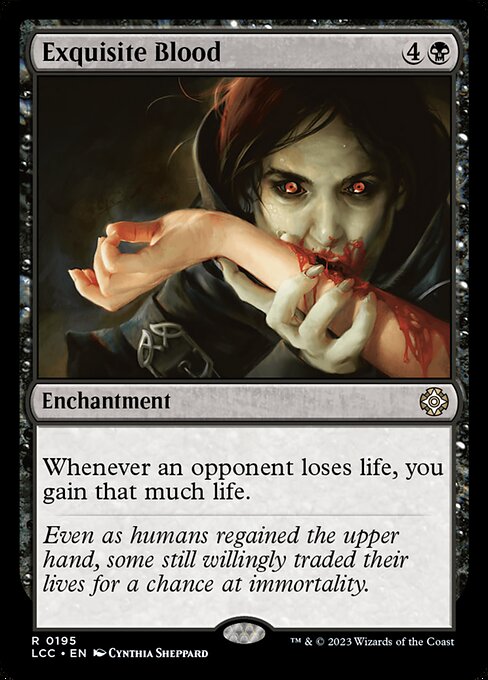
Exquisite Blood makes you gain life whenever an opponent loses life.
Sanguine Bond makes a target opponent lose life whenever you gain life.
Individually, both are useful enchantments in a lifegain deck.
But put them together, and things change.
If an opponent loses life, Exquisite Blood triggers and makes you gain that much life.
That life gain triggers Sanguine Bond, making a target opponent lose that much life.
Which triggers Exquisite Blood again.
And the sequence continues.
Once you have both enchantments on the battlefield and something starts the process, you can repeatedly drain opponents until they're eliminated, assuming nobody interrupts the loop.
That's a combo.
Two cards that are reasonable individually become a potential win condition when combined.
But not every combo is infinite.
Some simply generate a large amount of mana, draw several cards, create a powerful battlefield, or put you so far ahead that winning becomes very likely.
I think it's useful to distinguish between those different kinds of interactions when building a Commander deck.
Combos Don't All Work the Same Way
When people talk about combos in Commander, they often immediately think of infinite loops.
But there are several types worth understanding.
Infinite Combos
These are combinations that allow you to repeat a sequence of actions without a fixed limit, assuming the necessary conditions remain available.
You might generate mana, create creature tokens, trigger abilities, or deal damage repeatedly.
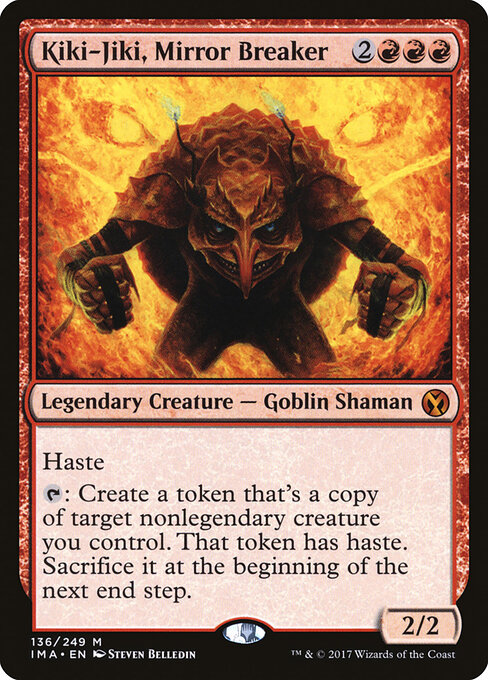
A classic example is Kiki-Jiki, Mirror Breaker with Zealous Conscripts.
With both creatures on the battlefield and Kiki-Jiki untapped, you activate Kiki-Jiki to create a token copy of Zealous Conscripts. Kiki-Jiki already has haste.
When the token enters, its ability can untap Kiki-Jiki.
Now you can activate Kiki-Jiki again.
Repeat the process and create as many hasty Zealous Conscripts tokens as you need.
If you can attack with them, that can end the game.
But notice the condition: you need to be able to attack.
If you assemble the combo after combat, creating a million creatures doesn't automatically mean you've won. A delayed triggered ability also makes you sacrifice each token at the beginning of the next end step.
That's why knowing the actual result of a combo matters.
"Infinite creatures" and "I win immediately" aren't always the same thing.
Finite Combos
Some combinations aren't infinite but still generate enormous advantages.
Maybe two cards let you reuse an enter-the-battlefield ability several times.
Perhaps an interaction creates ten tokens, draws five cards, or produces enough mana for a powerful finishing spell.
Those are still meaningful combos.
And personally, I think finite combos can be particularly enjoyable in casual Commander.
They produce exciting turns without necessarily ending the game on the spot.
I wouldn't dismiss a combination simply because it isn't infinite.
Sometimes a strong value engine is exactly what your deck needs.
Combos That Win the Game Directly
Some combos have a very clear finishing condition.
For example, Thassa's Oracle and Demonic Consultation are a well-known combination.
Thassa's Oracle has an ability that can make you win if your devotion to blue is at least the number of cards remaining in your library when that ability resolves.
Demonic Consultation can exile your library if you name a card that isn't in it.
By casting Consultation while Oracle's triggered ability is on the stack, you can potentially empty your library before that ability resolves.
If you satisfy Oracle's condition when it resolves, you win.
That's a very different kind of combo from generating creatures or accumulating value over several turns.
It's compact, efficient, and particularly relevant in high-power and competitive Commander.
But it also demands careful timing.
If you simply empty your library without a reliable way to win, things can go badly.
Running out of cards isn't automatically a victory.
Choosing Your Combo Commander
Not every Combo deck needs its commander to be part of the combo.
Sometimes your commander provides card draw, mana, or ways to find the necessary pieces.
Other times, the commander is one of the pieces, meaning you effectively have part of your combo available from the beginning of every game.
Both approaches can work.
I particularly like commanders that are useful even when the combo isn't assembled.
That gives the deck something meaningful to do while you're looking for your pieces.
Kinnan, Bonder Prodigy: Turn Mana Into More Mana
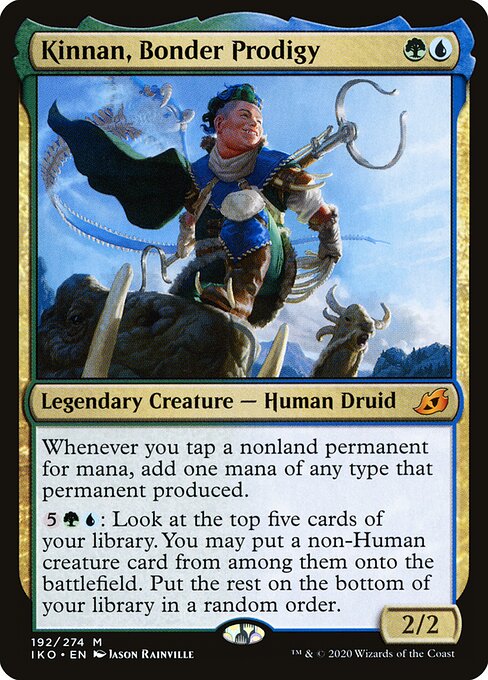
Kinnan, Bonder Prodigy is an excellent example of a commander that naturally supports combos.
Whenever you tap a nonland permanent for mana, Kinnan adds one additional mana of a type that permanent produced.
That makes mana-producing artifacts and creatures considerably more powerful.
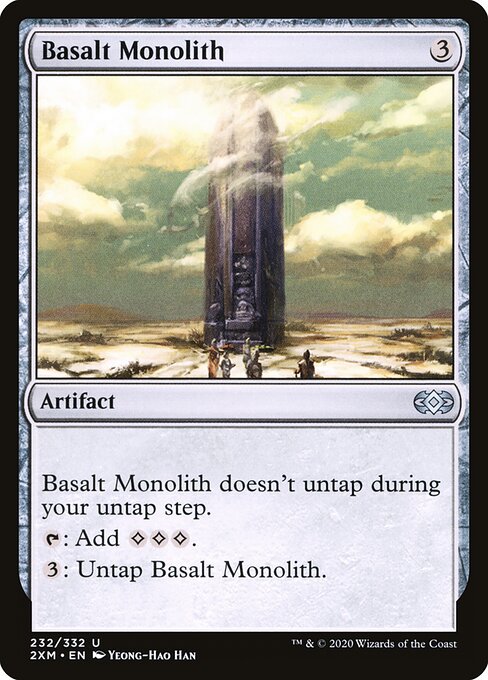
And it creates a well-known interaction with Basalt Monolith.
Normally, Basalt Monolith taps for three colorless mana and costs three mana to untap.
With Kinnan on the battlefield, tapping Basalt Monolith produces four colorless mana instead.
You spend three to untap it.
That leaves one additional colorless mana.
Repeat the process and you can generate as much colorless mana as you need.
But there's an important detail.
Infinite mana isn't automatically a win condition.
You still need something useful to do with it.
Kinnan has an activated ability that can help you find powerful non-Human creatures, but it also requires blue and green mana, so unlimited colorless mana alone doesn't pay the entire activation cost.
This is exactly the kind of detail I think every Combo player should understand.
Producing an unlimited resource is only part of the plan.
You need a reliable way to convert that resource into a victory.
Niv-Mizzet, Parun: Draw Cards, Deal Damage
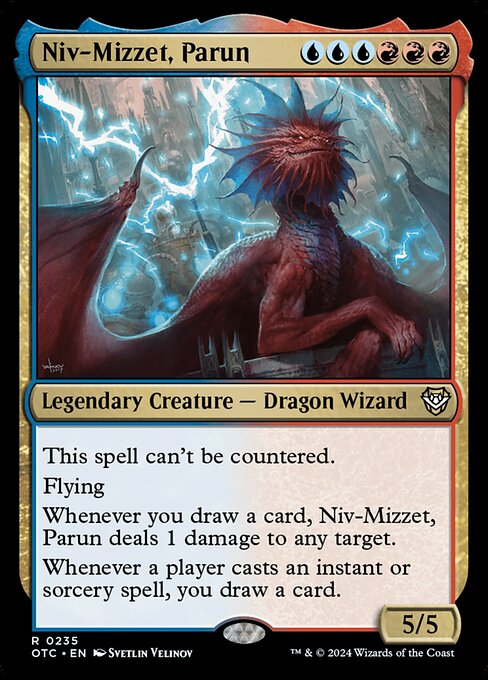
Niv-Mizzet, Parun is a great example of a commander that can become part of a combo.
Whenever you draw a card, Niv-Mizzet deals 1 damage to any target.
Now imagine enchanting Niv-Mizzet with Curiosity.
Curiosity lets you draw a card whenever the enchanted creature deals damage to an opponent.
You draw a card.
Niv-Mizzet deals 1 damage to an opponent.
Curiosity triggers and lets you draw another card.
That triggers Niv-Mizzet again.
And the process continues while you choose to draw, have cards available, and keep dealing damage to an opponent.
This isn't a literally unlimited loop because your library contains a finite number of cards.
But it can deal enough damage to eliminate the table if you have enough cards available.
What I like about Niv-Mizzet is that the commander still supports a normal Spellslinger strategy.
You can draw cards, cast instants and sorceries, and generate value without needing Curiosity every game.
That's a good quality in a Combo commander.
Your deck should still be able to play Magic while you're looking for the finish.
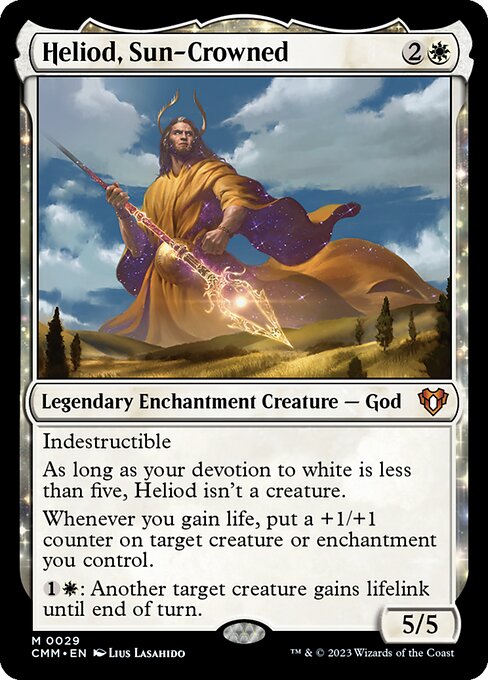
Heliod, Sun-Crowned: Lifegain Becomes Damage
Heliod, Sun-Crowned is another commander with a well-known combo.
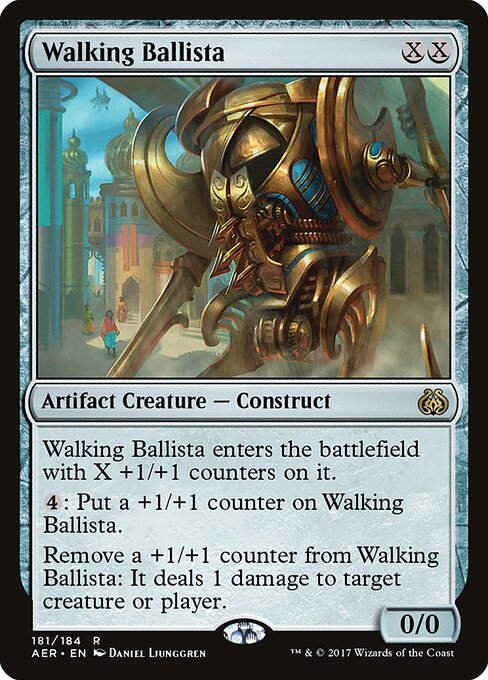
The combination involves Walking Ballista.
Heliod can give another target creature lifelink for 
 . Whenever you gain life, his triggered ability puts a +1/+1 counter on target creature or enchantment you control.
Walking Ballista can remove a +1/+1 counter from itself to deal 1 damage to any target.
With Walking Ballista having lifelink and at least two +1/+1 counters, you can remove a counter to deal damage to an opponent.
You gain 1 life because of lifelink.
That life gain triggers Heliod, allowing you to put a +1/+1 counter back onto Walking Ballista.
Now you can repeat the process.
The reason the initial counters matter is that Walking Ballista needs to survive after removing one.
If you remove its only counter and it becomes a 0/0, it dies before the loop can continue.
I like this example because both cards can have useful roles outside the combo.
Heliod supports lifegain strategies, and Walking Ballista can function as a scalable damage source.
You can build a deck that includes the combo without making every game entirely about finding it.
Kess, Dissident Mage: Reuse Important Spells
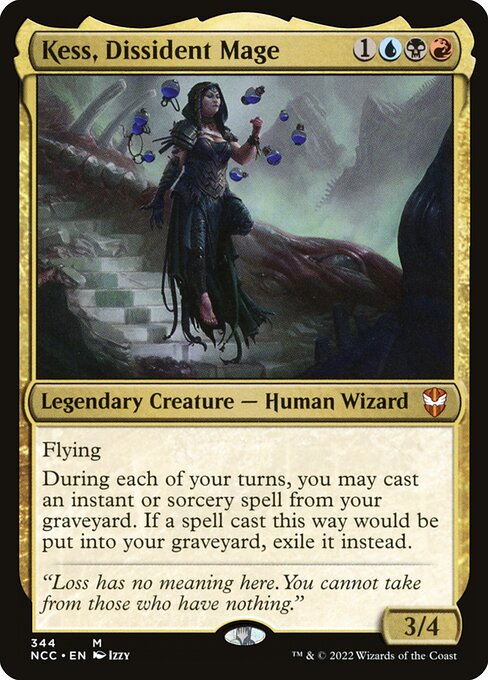
Kess, Dissident Mage doesn't necessarily provide a win condition on her own.
Instead, she allows you to cast one instant or sorcery from your graveyard during each of your turns.
That's valuable in a Combo deck because many important pieces are instants or sorceries.
Perhaps you need to reuse a tutor.
Maybe you want another card-selection spell.
Or you need to recover a spell that an opponent countered earlier.
Kess also gives you access to Grixis colors, opening up plenty of options for interaction, tutors, recursion, and win conditions.
What I like about Kess is that she supports the process of assembling your combo rather than forcing one specific finish.
The disadvantage is that graveyard hate can interfere with her ability.
And she doesn't make the spell free. You still pay its costs and follow normal timing restrictions. If a card cast this way would go to your graveyard that turn, it is exiled instead.
Thrasios, Triton Hero: A Place to Spend Your Mana
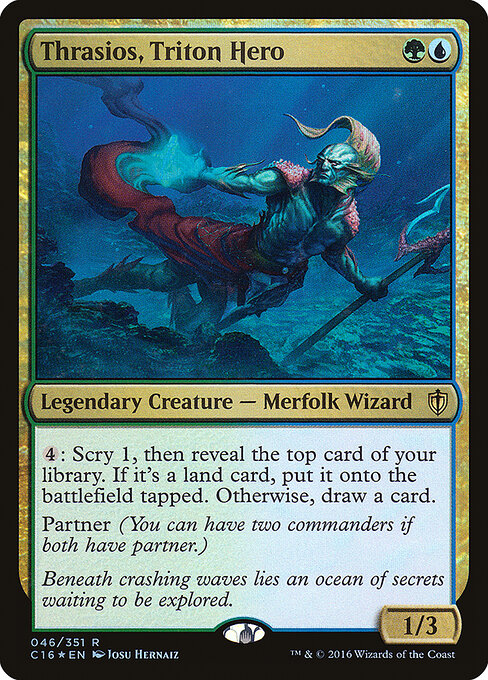
Thrasios, Triton Hero is particularly interesting because he provides an excellent way to use large amounts of mana.
His activated ability costs four mana and lets you scry 1, then reveal the top card of your library. If it is a land, put it onto the battlefield tapped; otherwise, draw a card.
Do not keep activating it with an empty library without a way to avoid losing for attempting to draw from an empty library. Access to your library still needs a winning payoff.
If you generate unlimited colorless mana through another combination, Thrasios can repeatedly activate that ability.
That can give you access to the cards in your library and put lands onto the battlefield.
And because Thrasios has partner, you can combine him with another eligible partner commander to access additional colors and abilities.
I like this approach because the commander isn't necessarily generating the infinite resource.
He's giving you something useful to do once you've generated it.
Sometimes that's exactly what a Combo deck needs.
Decide What Your Combo Actually Needs
Before adding twenty tutors and all the most powerful interaction available, I'd start with a simpler question.
What does your combo require?
For each combination, I'd write down the actual requirements.
Do both cards need to be on the battlefield?
Does one need to be in your graveyard?
Do you need an additional creature, a specific amount of mana, or a way to give something haste?
Can you execute the combo immediately, or do you need to wait until your next turn?
And, most importantly, what happens when it works?
For example, Kinnan with Basalt Monolith produces unlimited colorless mana.
That's the output.
If your deck doesn't have a way to use that mana, the combo isn't a complete win condition.
The same applies to combinations that generate unlimited tokens without haste or require another card to turn repeated triggers into damage.
This is where I think some Combo decks go wrong.
Players find interactions labeled "infinite" and assume that automatically makes them good.
But the details matter.
A combo that needs five cards, fifteen mana, and an opponent with no interaction might be much less useful than a simpler combination that fits naturally into your deck.
Tutors: Finding Your Combo Pieces
One of the biggest differences between a deck that occasionally wins with a combo and a dedicated Combo deck is consistency.
If you have two specific cards in a hundred-card deck, you can't expect to draw both every game.
Sometimes you'll find them naturally.
Other times, one will be near the bottom of your library.
That's where tutors become useful.
Cards like Demonic Tutor, Enlightened Tutor, Worldly Tutor, and Solve the Equation can help find different kinds of combo pieces.
They don't all search for the same card types, and some put the card into your hand while others put it on top of your library.
But they improve your ability to find what you need.
And that makes a huge difference.
I wouldn't automatically include every tutor available, though.
First, some are expensive.
Second, they can dramatically increase the consistency and power of your deck.
And third, searching for exactly the same cards every game can become repetitive.
Personally, I think tutors are something you should choose according to the experience you want.
If you're building a competitive Combo deck, efficient tutors are an important part of the strategy.
If you're building a casual Commander deck that happens to contain a couple of combos, you might prefer fewer tutors and more variety between games.
Neither approach is automatically better.
They're simply different kinds of Commander.
Card Draw and Selection: You Need to See Your Deck
Tutors are useful, but I wouldn't build a Combo deck that depends entirely on them.
You still need card draw and selection.
Cheap spells like Ponder, Preordain, and Consider help you move through your library.
Larger draw effects and repeatable engines can provide the resources needed for longer games.
And some commanders naturally generate card advantage while you're assembling your pieces.
I particularly like having ways to improve your hand without using too much mana.
If you're trying to assemble a combo that already requires several mana, spending your entire turn drawing three cards might slow you down too much.
But there's a balance.
You don't want to fill the deck with card draw and forget the actual win conditions.
Drawing half your library is impressive.
But if you still can't win, you're simply becoming very good at finding cards.
The important part is finding the right balance between setup, interaction, and execution.
Protection: Finding the Combo Is Only Half the Problem
Imagine you've spent several turns finding your combo pieces.
You've got both cards.
Enough mana.
Everything is ready.
You cast the first piece.
It resolves.
Then you cast the second.
And somebody responds with a removal spell.
That's Commander.
Your opponents are allowed to interact.
And if you're playing a dedicated Combo deck, they'll probably be paying particular attention to what you're doing.
That's why protection matters.
Depending on your colors, cards like Swan Song, An Offer You Can't Refuse, Veil of Summer, Silence, and Flusterstorm can help protect important turns.
But they don't all solve the same problems.
Counterspells can stop certain answers.
Silence can prevent opponents from casting spells for the rest of the turn after it resolves, but it doesn't stop abilities and won't undo spells already on the stack.
Veil of Summer provides useful protection against certain blue and black interaction, but it doesn't make every combo immune to removal.
I like protection that matches the actual weaknesses of the combo.
If your finish depends on a creature surviving, you may need creature protection.
If it depends on resolving an important spell, stack interaction becomes more valuable.
And sometimes the best protection is simply waiting.
If an opponent has tapped out to cast a big spell, that might be a much better opportunity to attempt your combo than when everyone has six untapped lands.
The Stack: Understand Where Opponents Can Stop You
This is something every Combo player should learn.
Most combos don't happen as one single, unstoppable action.
They involve spells, activated abilities, triggered abilities, and moments when opponents can respond.
For example, with Kiki-Jiki and Zealous Conscripts, your opponents may be able to remove Kiki-Jiki while the token's enter-the-battlefield trigger is waiting to resolve.
If Kiki-Jiki is no longer there, you can't keep activating it to create more copies.
With Heliod and Walking Ballista, removing Walking Ballista at the right moment can stop the loop.
And when you're trying to win with Thassa's Oracle, opponents can respond to the triggered ability before it resolves.
That's why understanding the stack matters.
You don't necessarily need to become a judge.
But you should know which abilities are activated, which ones trigger, when costs are paid, and where opponents get priority.
I also recommend practicing your combo outside a real game.
Not because you need to memorize a hundred rules, but because it makes the actual game much smoother.
There's nothing wrong with discovering a new interaction.
But if you're going to announce that you've won, it's useful to know that the interaction actually works.
Infinite Doesn't Mean You Have to Repeat Everything a Million Times
There's another practical detail worth mentioning.
When you have a repeatable loop, you normally don't need to physically perform every iteration.
If the sequence is deterministic and can be repeated legally, you can explain the loop and specify a finite number of repetitions.
For example:
"I repeat this sequence a thousand times, creating a thousand tokens."
Then opponents have an opportunity to identify where they want to respond.
But you need to be able to explain how the loop works.
And if the process depends on random results, hidden information, or choices that change each iteration, you can't necessarily shortcut it in the same way.
Also, don't just announce "infinite" without explaining what resource you're generating.
Infinite mana?
Creature tokens?
Damage?
Life?
They're not interchangeable.
And if you're generating unlimited mana, you still need to explain how that leads to victory.
Clear communication makes Combo decks much more enjoyable to play against.
Especially when the alternative is spending twenty minutes physically repeating the same actions.
What Happens When Your Combo Gets Interrupted?
This is probably one of the most important questions when building Combo.
What happens if somebody removes one of your pieces?
Or counters the spell that was supposed to win?
Do you have a way to try again?
Can you recover the missing card?
Or does the deck effectively stop functioning?
I like having some redundancy.
That doesn't necessarily mean including six different infinite combos.
It might mean having more than one way to find an important card, some recursion, or a secondary win condition.
Cards like Eternal Witness, Regrowth, and Sevinne's Reclamation can recover certain resources, depending on your colors and the cards involved.
And some decks can continue generating value through their commander while preparing another attempt.
But I'd avoid making every card dependent on one specific combo.
If your deck does absolutely nothing without two particular cards, your opponents only need to stop those cards.
A good Combo deck should be able to play a reasonable game of Magic even when the perfect finish isn't available.
How Many Combos Should Your Deck Have?
There's no perfect answer.
Some dedicated Combo decks are built around one extremely efficient win condition, supported by tutors, protection, and recursion.
Others include several different combinations that share important pieces.
And some ordinary Commander decks include one or two combos as alternative ways to finish games.
Personally, I prefer combinations where the individual cards are useful outside the combo.
That gives the deck more flexibility.
If you're playing Heliod in a lifegain deck, he already supports your main strategy.
Walking Ballista can provide damage and interact with creatures.
When you find both, you have access to the combo.
But if you draw only one, it may still contribute.
Compare that with a combo where several cards accomplish practically nothing unless all the pieces are together.
That can work in a highly optimized deck with enough tutors.
But in a more casual deck, it might create a lot of frustrating hands.
I'd start with one clear primary win condition and decide whether you need a secondary one.
Then build the rest of the deck to support those plans.
Combo and Commander Brackets
This is something I'd definitely consider before bringing a Combo deck to a table.
Not all combos belong in the same kind of Commander game.
A slow interaction involving several expensive cards is very different from a compact two-card combo that can win during the first few turns.
Under the Commander bracket system, Brackets 1 and 2 aren't intended for two-card infinite combos, while Bracket 3 allows them only when they aren't expected to end games early.
Deliberately holding a combo until later does not automatically make a deck that finds it quickly and consistently fit Bracket 3. The usual speed and consistency of the plan matter too.
Brackets 4 and 5 allow much more optimized combo strategies.
But I wouldn't look only at the number of cards involved.
Speed, consistency, tutors, fast mana, and protection matter too.
A deck that can regularly assemble a protected win during the first few turns is a different experience from one that occasionally discovers a combo during a long casual game.
And adding a combo doesn't automatically make your deck cEDH.
Competitive Commander is about the entire deck functioning efficiently against other competitive strategies, not simply having one powerful interaction.
I think the important thing is being clear about what your deck is designed to do.
If your main plan is to win with a fast combo, that's useful information for your playgroup.
And if your deck includes a combo as a backup plan in a more casual strategy, that's worth explaining too.
Nobody needs to reveal their entire decklist before a game.
But having roughly compatible expectations makes Commander more enjoyable for everyone.
Common Mistakes When Building Combo
There are several things I'd watch out for.
Including combos without understanding them. Read the cards carefully. Make sure the interaction actually works and you know what it produces.
Having infinite mana but no payoff. Generating unlimited resources isn't automatically a victory.
Too many disconnected combos. A deck full of unrelated two- and three-card combinations can become very inconsistent.
Not enough ways to find your pieces. If your entire strategy depends on two cards, you need a realistic way to access them.
No protection. Your opponents will try to stop you. Plan for it.
No recovery plan. If one removal spell makes the deck useless, you're relying too heavily on a single interaction.
Ignoring your mana curve. A combo that needs twelve mana isn't particularly helpful if your deck struggles to reach six.
Not considering your playgroup. A fast, highly consistent combo deck may not be a good fit for every Commander table.
And one more thing.
Don't assume every interaction labeled "infinite" is automatically worth including.
Sometimes a simple card that draws two cards or protects your commander improves your deck much more than another complicated combo.
Test Your Combo Deck Before Buying Everything
Combo is probably one of the archetypes where testing matters most.
You might discover a fantastic interaction between two cards and immediately want to build an entire deck around it.
But then you start playing.
And realize you rarely draw both pieces.
Or you find them, but don't have enough mana.
Or you assemble everything perfectly and someone removes the important creature.
That's why I'd test the deck before buying all the cards.
In MTG Master Deck Builder, you can build your Combo Commander deck, explore card interactions, and use the Deck Analyzer to review consistency, speed, interaction, resilience, and synergy.
The combo detection tools are particularly useful here.
You can inspect combinations available in your deck and discover interactions you may not have noticed.
That includes situations where you're only one card away from completing a potential combo.
But I wouldn't treat every detected combination as a reason to change the deck.
Some combos are interesting but don't fit your strategy.
Others require conditions that might be difficult to achieve during a real game.
And some might push your deck toward a level of power you don't actually want.
The opening-hand simulator can also help you understand whether your deck has reasonable early development.
If you constantly draw combo payoffs but no setup, or tutors without enough mana to use them efficiently, that's worth reviewing.
And remember that combo detection doesn't replace checking how the actual interaction works.
Before relying on a combo to win games, make sure its conditions, timing, and result are correct.
Is Combo the Right Archetype for You?
I think Combo is a great choice if you enjoy discovering interactions, solving complicated problems, and finding ways to make several cards work together.
There's something particularly satisfying about recognizing a combination that wasn't obvious when you first looked at the cards.
And I like how Combo rewards preparation.
You need to understand your pieces, plan your turns, manage resources, and recognize the right moment to attempt a win.
But Combo isn't for everyone.
If you prefer winning through combat, building enormous battlefields, or letting games develop more naturally, a dedicated Combo deck might feel a little repetitive.
Especially if you're searching for the same two cards every game.
Personally, I think the most interesting Combo decks are those where the individual pieces still contribute something useful outside the final interaction.
You can develop your strategy.
Generate value.
Interact with opponents.
And when the opportunity appears, assemble the combination that wins.
You don't necessarily need the fastest combo.
Or the most expensive tutors.
Or a deck that wins on turn three.
You just need a strategy that works and that you enjoy playing.
And when you finally put the last piece onto the battlefield and somebody asks, "Wait, does that go infinite?"
At least make sure the answer is actually yes.
Build Combo with a complete winning plan
Balance combo pieces, mana, tutors, protection and recovery in Deck Builder.