MTG Master Guide — Mana Base & Opening Hand Intelligence

Mana is the hidden engine of every Commander deck.

A mana base can look acceptable on paper and still lose games before your real plan ever starts.

In MTG Master, mana is not treated as a land count checkbox or a decorative pie chart. It is read as a living game system: how your deck develops mana, when colors arrive, where early turns crack, and why opening hands fail in actual play patterns.

This guide walks through every mana-focused layer in MTG Master so you can move from instinct to diagnosis. Instead of asking only “Do I have enough lands?”, you can ask sharper Commander questions: “Which color is really under pressure?”, “Which benchmark is missing?”, and “What swap gives me the cleanest first upgrade?”

What the Mana System Is Really Measuring

The mana tools are built around two ideas that Commander players often separate when they should be read together:

  • Alignment: whether your mana base supports the color demands your deck creates over the course of a game
  • Execution: whether that mana turns into smooth early turns, clean commander timing, and playable opening hands
That is why MTG Master includes both broad mana-pressure views and opening-hand simulation. One tells you how the shell is built. The other reveals how it behaves when the game actually starts.

1. Mana Base Analysis: the benchmark and alignment view

The Mana Base area is the first place to look when you want to know whether your deck can function on curve and in the right colors.

It evaluates things like:
  • How reliably you can produce untapped colored mana early
  • Whether your commander colors arrive on time
  • How your mana production lines up with real spell demand
  • Which parts of the mana base add hidden stress

Think of this as the structural view of your mana. It is less about one flashy opener and more about whether the shell is coherent enough to support the games you want to play.

2. Mana Pressure & Alignment: demand vs support over the game

This layer explains why a mana base can feel stretched even when the land count itself looks normal.

Color Pressure compares:
  • Demand: how much your deck asks from each color
  • Support: how much your mana base truly gives that color
Status labels mean:
  • Strained: you need more of that color than the mana base is comfortably providing
  • Aligned: the color is in a healthy place
  • Surplus: that color is over-supported and may be a place to trim
Mana pressure and color support view in MTG Master

This is often where the hidden truth appears. A deck can feel generally fine while one color is carrying too much weight all game long.

3. Mana Integrity and early-turn stress

The integrity score gives you a fast read on balance and stability, but the real value is in the explanation around it.

The integrity panel highlights:
  • What is already working well
  • Which color commitments are getting stretched
  • Recommendations for where the mana base should be reinforced
Early Turn Stress adds another lens:
  • Which turns ask the most from your mana
  • Which colors spike first
  • Where sequencing pressure becomes a real gameplay tax
Mana integrity and alignment view in MTG Master

Together, these views answer a practical question: is the deck built for the turns where it wants to be strongest, or are you forcing awkward mana every game?

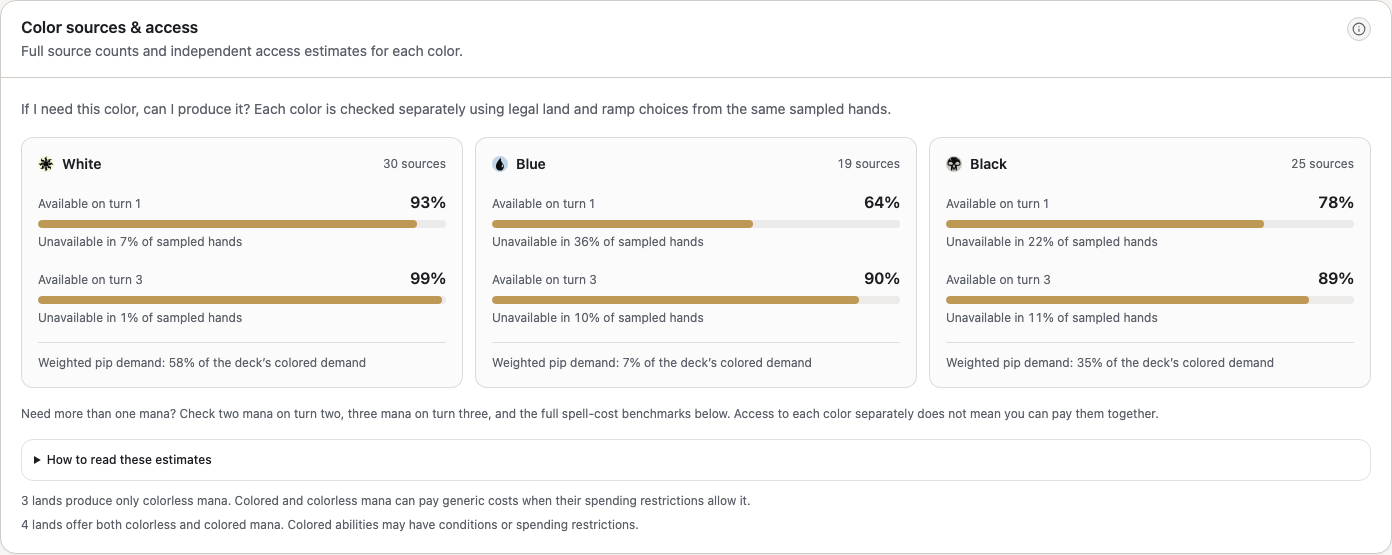
4. Benchmark metrics: can the deck actually execute?

Benchmarks are the execution layer. They are not broad opinions about your mana base. They are focused checks for real gameplay readiness.

Key benchmark reads include:
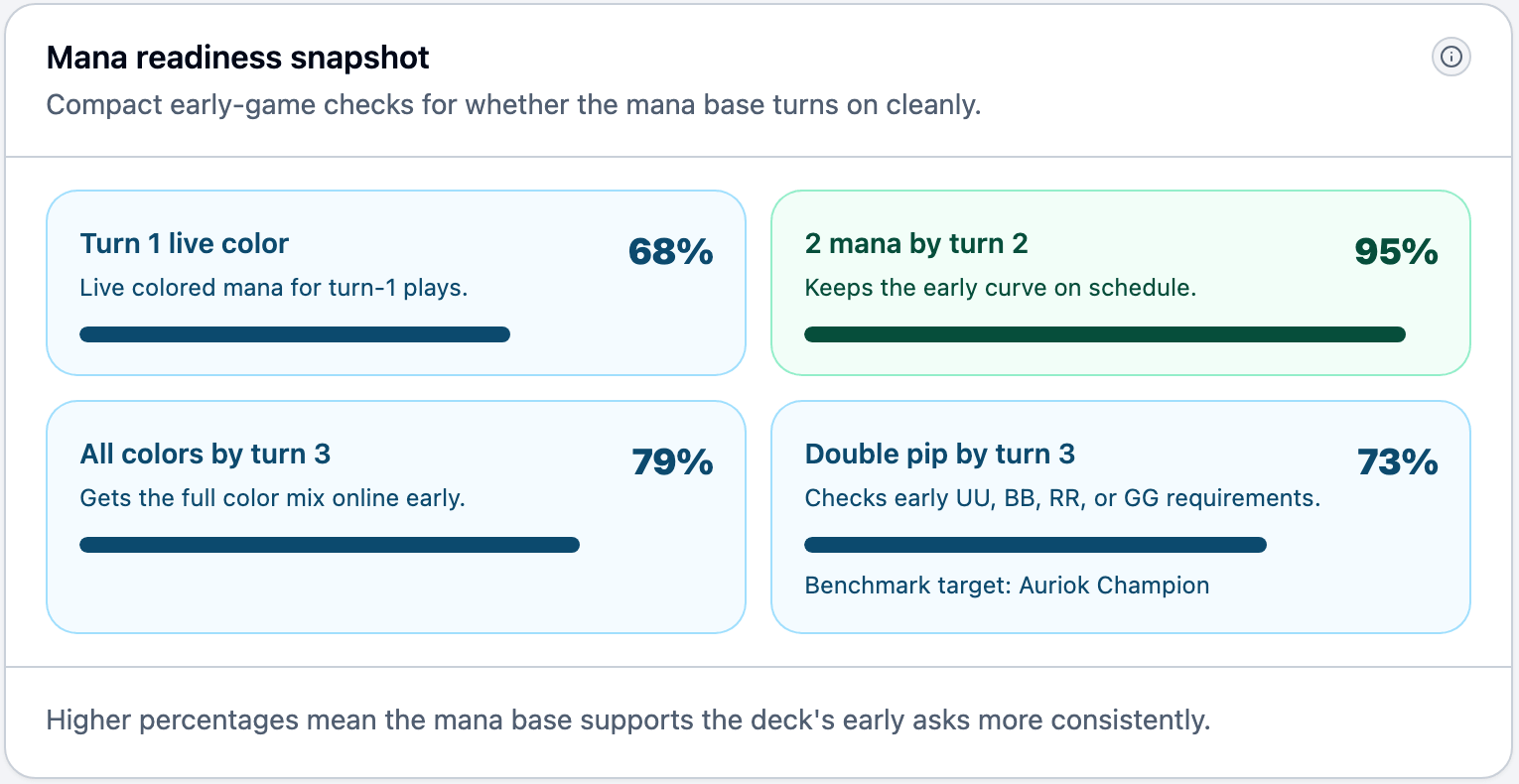
  • Turn 1 Live Color: can you make untapped colored mana immediately?
  • 2 Mana by Turn 2: are you hitting the basic pace of an early game?
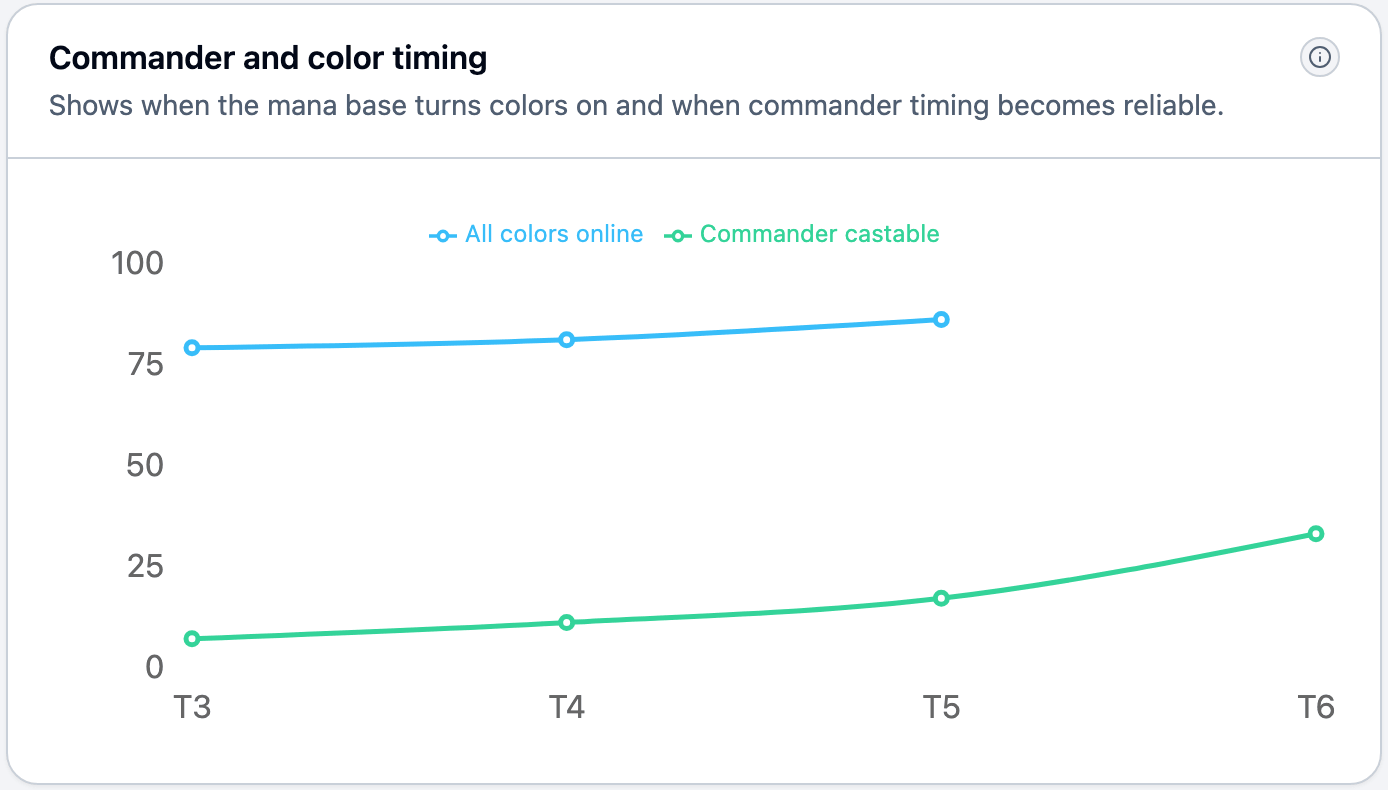
  • Commander Color by Turn 3: do the colors arrive in time for your commander plan?
  • Double Pip by Turn 3: can the deck support heavier color requirements like UU or BB?
Mana readiness benchmark view in MTG Master
Commander and color timing chart in MTG Master

If a benchmark is weak, you are not just missing a number. You are missing a turn pattern your deck is trying to rely on.

5. Opening Hand Analysis: simulation instead of guesswork

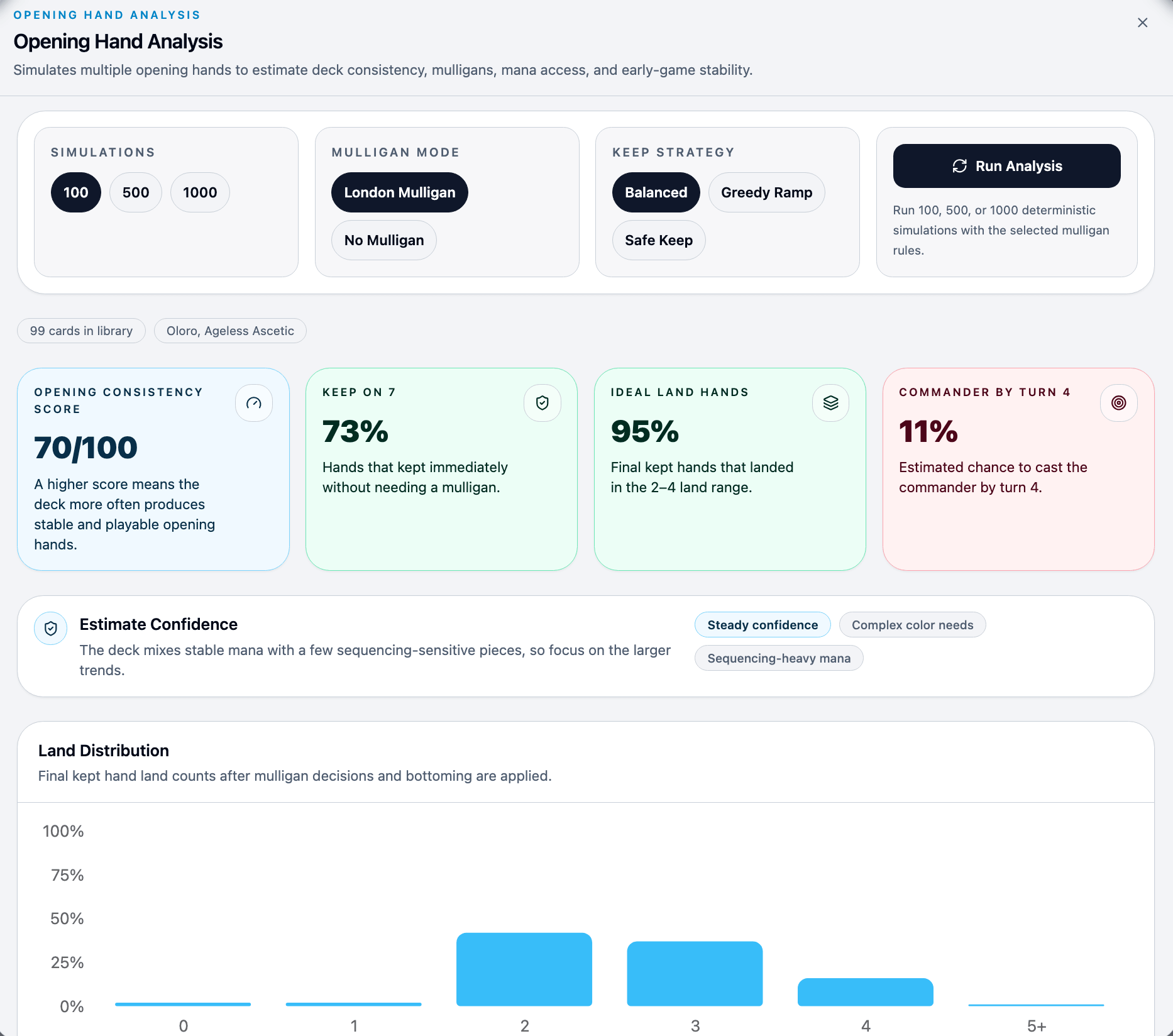
Opening Hand Analysis runs real hand simulations so you can see how the deck behaves before the middle game ever begins.

This layer measures things like:
  • Opening Consistency Score
  • Keep on 7 rate
  • Ideal land hands after mulligans
  • Commander by Turn 4 probability
  • Land distribution, mulligan patterns, and early mana development
Opening hand analysis overview in MTG Master

This is where MTG Master stops talking about abstract mana quality and starts showing the hands you would actually keep, ship, and regret.

6. Why hands fail: the causality layer

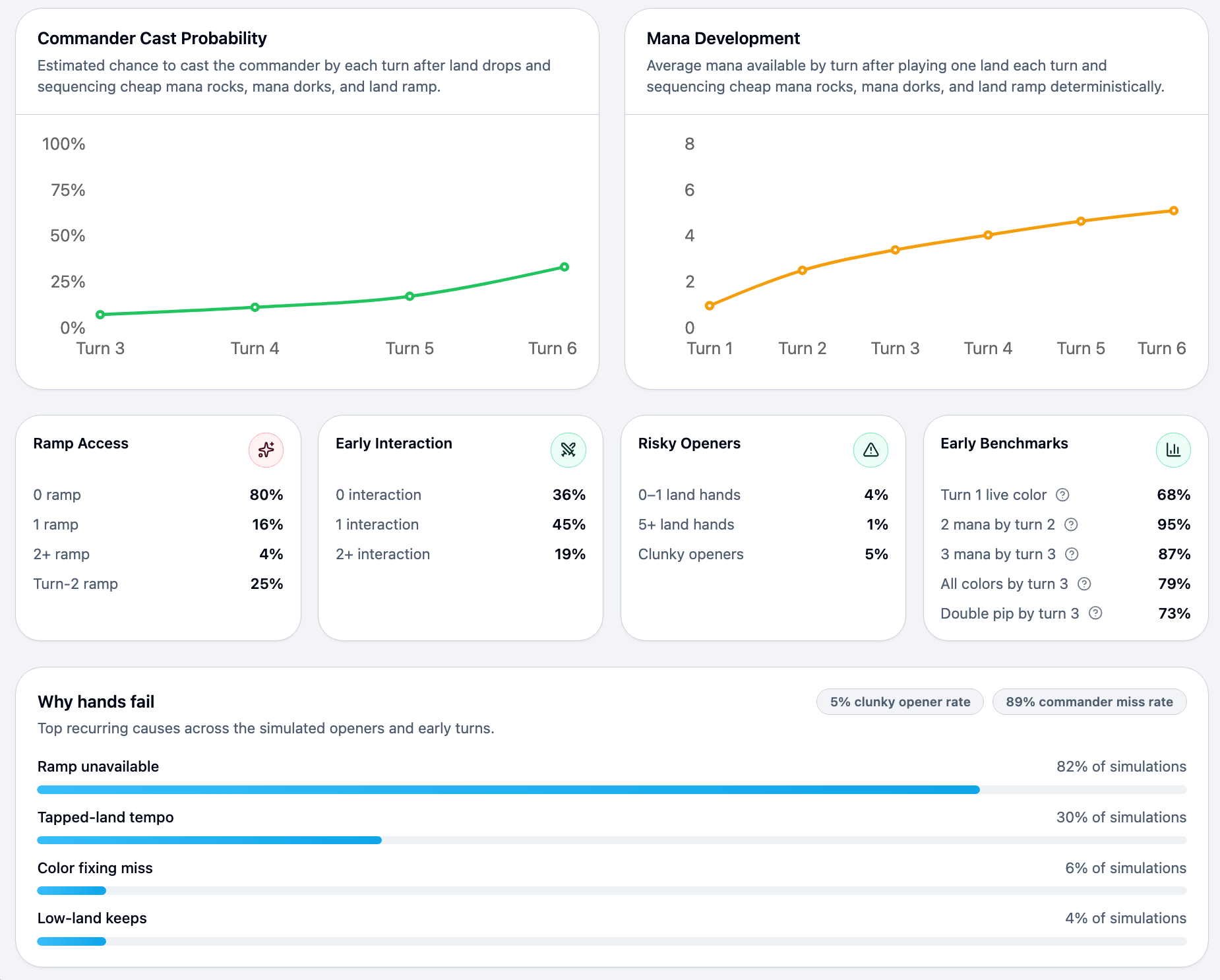
Metrics tell you what misses. The failure view tells you why those misses keep happening.

Common failure causes include:
  • Tapped-land tempo slowing your first real turn
  • Missing early color even when total mana is technically fine
  • Low-land keeps or clunky development patterns
  • Hands with enough mana, but in the wrong colors
Opening hand failure analysis in MTG Master

This is one of the most useful parts of the system because it turns a benchmark miss into a readable gameplay problem you can actually fix.

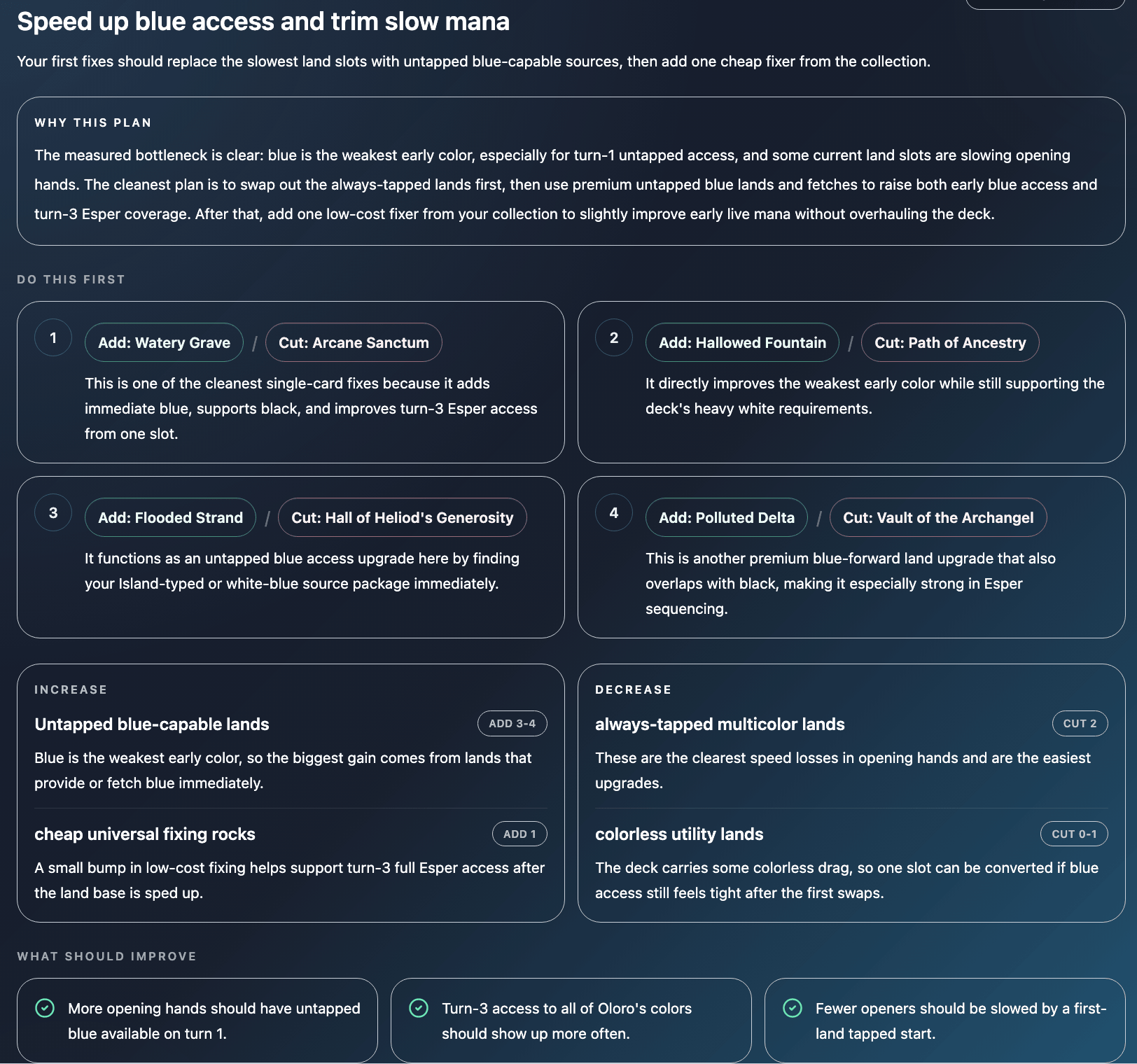
7. Premium Mana Fix Plan: from diagnosis to action

Once the deck has shown you where it is stumbling, the Fix Plan turns that signal into concrete upgrades and cuts.

The Fix Plan is built around:
  • Collection-aware upgrades
  • Preferred swaps with Add / Cut actions
  • Benchmark-linked priorities tied to real weaknesses
  • Fix candidate modes: collection first, collection only, or any card
Typical recommendations include:
  • Replacing slow taplands with untapped colored sources
  • Reducing low-impact colorless utility lands
  • Rebalancing a strained color without hurting the rest of the base
  • Improving early development before adding speculative ramp
Premium mana fix plan preview in MTG Master

The value is not just that it suggests cards. The value is that each swap is tied to a named bottleneck and a real gameplay improvement.

8. Recommended workflow: how to use the full mana system

The strongest way to use these tools is as a sequence, not as isolated widgets.

A strong workflow looks like this:
  • Check Mana Pressure and Integrity to find strained colors and broad imbalance
  • Review benchmarks to see which early turns are failing
  • Run Opening Hand Analysis to confirm how those issues show up in kept hands
  • Read the failure causes to find the real source of the stumble
  • Apply the Fix Plan and re-test the deck

That turns the mana suite into a full loop: diagnosis, understanding, action, and validation.

9. Core principles MTG Master follows for mana

The platform is built on a few practical truths that matter much more than generic mana advice.

The big ones are:
  • Demand vs support matters more than raw land count
  • Turn 1 to turn 3 decides a huge number of Commander games
  • Untapped mana is not the same as tapped mana
  • Immediate colored access matters more than theoretical late fixing
  • Simulation reveals the truth faster than intuition alone

Put more bluntly: a land that produces the right color too late often plays like it never produced it at all.

Final takeaway

MTG Master’s mana tools are built to answer a harder and more useful question than “How many lands should I play?”

They ask whether your mana base truly supports your deck’s real gameplay: its color pressure, its early turns, its commander timing, and the hands you actually keep.

By combining alignment, benchmarks, simulation, root-cause analysis, and a guided Fix Plan, the platform gives you a full path from diagnosis to optimization.

Learn how MTG Master analyzes Commander mana bases with color pressure, benchmarks, opening-hand simulations, root-cause failure views, and premium fix plans.

Related guides

MTG Master is free to use. Optional Pro features are available through credits or subscriptions.

Magic: The Gathering, Wizards of the Coast, and all related trademarks are the property of Wizards of the Coast LLC in the U.S. and other countries. © 1993–2026 Wizards. All rights reserved.

MTG Master is an independent, fan-made project and is not affiliated with, endorsed, sponsored, or approved by Wizards of the Coast. MTG Master uses certain Wizards-owned intellectual property under the terms of the Wizards Fan Content Policy. To learn more about Wizards of the Coast and their policies, please visit company.wizards.com.

Card data, images, and some pricing information are sourced from Scryfall. Scryfall provides this information without warranty; always check local stores for final prices and availability.

We use cookies for analytics to improve the site.

Analytics only runs if you choose “Accept”. You can change your choice anytime.