
MTG Card Conditions Explained: Mint, Near Mint, Played, Damaged and Everything Between
By MTG Master EditorialPublished Updated 6 min read
If you collect Magic cards or have ever sold a few through a TCG marketplace, you've probably had this problem: a card looks pretty good, but you're not completely sure which condition to choose.
Is that tiny white mark on the corner enough to make it Slightly Played? What about a scratch that's only visible under the light? And at what point does a card become Damaged?
I've had to think about this myself when sorting cards from my collection, especially older ones that have been played without sleeves.
The problem is that grading isn't an exact science. Different marketplaces may have slightly different standards, and two people can look at the same card and disagree about its condition.
This guide explains the six condition levels used in MTG Master, what I would look for in each one, and how to avoid overgrading cards when adding them to your collection or preparing them for sale.
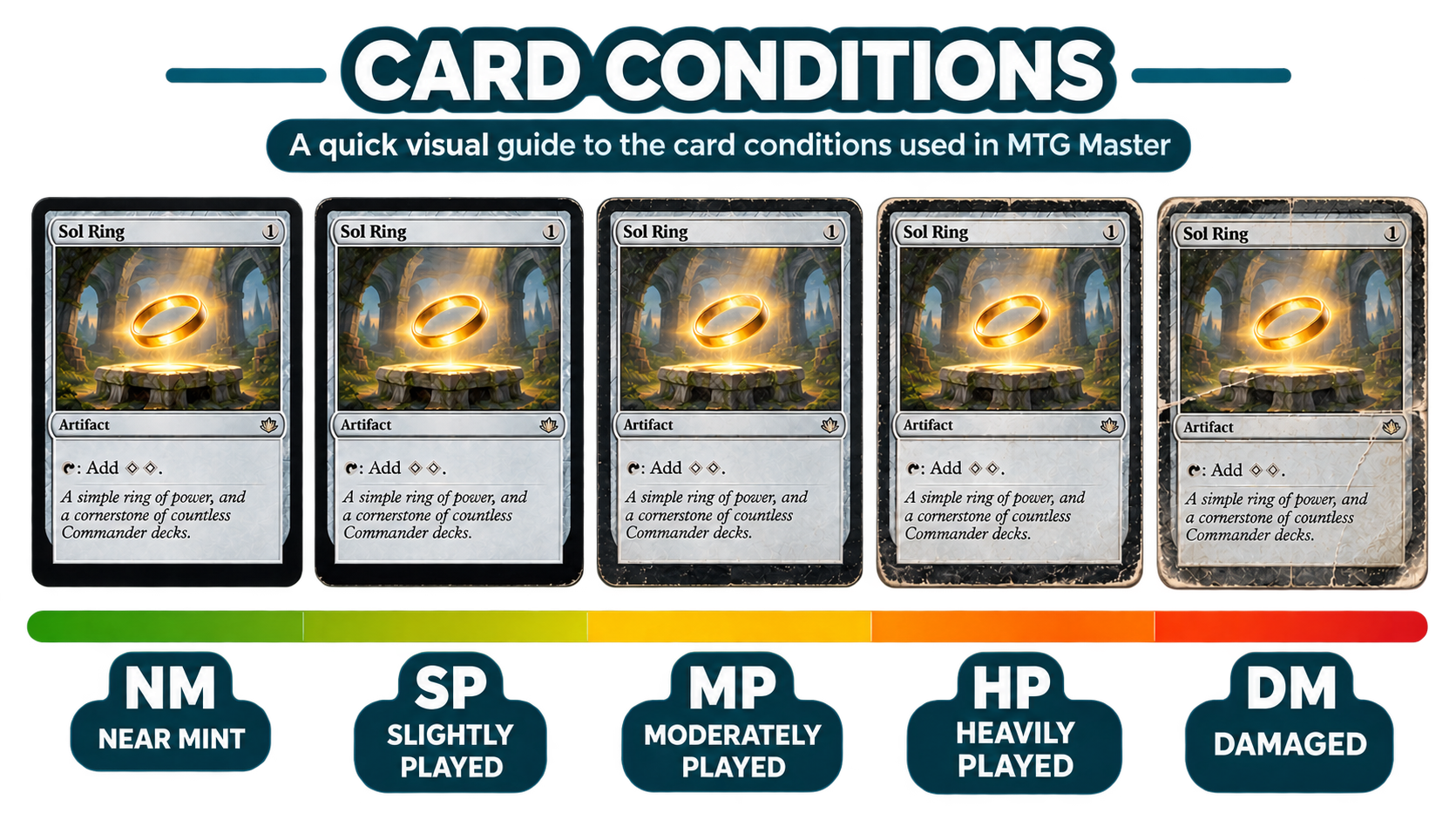
Illustrative examples from Near Mint (NM) to Damaged (DM). Mint (M) is not pictured; all six conditions are explained below. Always check the marketplace’s own grading criteria.
View the image at full sizeMint (M)
Mint is the highest condition grade. The card should be essentially perfect, with no visible wear, scratches, whitening or damage.
This is a grade I'd use very carefully.
Even a card pulled directly from a booster isn't automatically Mint. Printing imperfections, small marks from packaging or other minor defects can prevent it from qualifying.
If I notice any imperfection, I'd rather classify it as Near Mint.
Near Mint (NM)
Near Mint means the card is almost like new.
It doesn't necessarily have to be absolutely perfect. A tiny printing imperfection or an almost invisible mark might be acceptable, depending on the grading standard.
But overall, the card should look exceptionally clean.
The corners should be sharp, the edges should have practically no visible wear, and the surface shouldn't show obvious scratches or signs of play.
One thing I always check is the back of the card. Sometimes the front looks perfect, but when you turn it over, you notice small white spots around the edges.
If those marks are clearly visible, I'd think twice before calling it Near Mint.
Slightly Played (SP)
This is where cards start showing some signs of handling.
Maybe there's a little whitening on one corner, a couple of small marks around the edges, or a very light surface scratch.
Nothing serious, though. The card should still look good, especially when you're not examining it closely.
Personally, I'd rather classify a card as Slightly Played than risk selling it as Near Mint when I'm not entirely convinced.
The price difference is often less frustrating than dealing with an unhappy buyer.
Moderately Played (MP)
Moderately Played is for cards with more noticeable wear.
You might see several white spots around the borders, surface scratches, small scuffs, or corners that have clearly been handled a lot.
The difference from Slightly Played is that you no longer need to look particularly hard to notice the imperfections.
But the card should still be in reasonably good physical condition, without severe structural damage.
A card that has spent years in a deck, occasionally without sleeves, might easily end up here.
Heavily Played (HP)
At this point, the card has clearly seen plenty of games.
The borders might be heavily worn, several corners damaged, and the surface covered with obvious scratches or scuffs.
There might also be light creases or other visible defects.
That doesn't necessarily make the card useless. Plenty of people buy heavily played cards because they want to use them in decks, not display them in a collection.
But I think it's particularly important to show real photographs when selling cards in this condition.
Two cards described as Heavily Played can look quite different depending on the amount and type of wear.
Damaged (DM)
This is the lowest condition category.
We're talking about cards with serious damage: deep creases, significant bending, tears, extensive surface wear, water damage, or heavily damaged corners and borders.
Some cards may still be usable for casual play, but others might no longer be suitable for sanctioned tournaments if the damage makes them identifiable through sleeves.
And something worth remembering: even if a card is extremely expensive, damage doesn't disappear because it's rare.
A damaged dual land is still a damaged card.
Its value might be considerably lower than a Near Mint copy, but its condition should be described accurately.
Always Check Both Sides
This is probably the easiest mistake to make.
You look at the artwork, see that everything looks good, and immediately classify the card.
Then you turn it over and discover whitening around almost every corner.
When grading cards, check the front, back, edges, corners and surface. Good lighting helps, and tilting the card slightly can reveal scratches that aren't visible straight on.
For foil cards, I'd pay particular attention to surface scratches, clouding and any significant curling or deformation.
And don't automatically assume that an older card deserves a better grade because its wear is normal for its age. Condition describes the card as it is today.
Not Every Marketplace Grades Cards Exactly the Same Way
Something worth remembering if you buy and sell cards online.
Different TCG marketplaces may use different condition names, grading scales or rules about what counts as acceptable wear.
A card classified as Slightly Played in one marketplace might fall into a different category somewhere else.
That's why I'd always recommend checking the grading standards of whichever marketplace you're selling on, especially for expensive cards or anything with unusual damage.
The categories in MTG Master are intended to help you organize your collection consistently, but they shouldn't replace the specific requirements of the marketplace where you list your cards.
When in Doubt, Choose the Lower Condition
This is probably the simplest advice I can give.
If you're hesitating between Near Mint and Slightly Played because of some visible wear, choosing Slightly Played is usually the safer option.
And if you're selling an expensive card, upload photographs rather than relying entirely on the condition label.
In MTG Master, you can record the condition of cards in your collection, making it easier to keep track of what you own, particularly when you have multiple copies in different conditions.
Having that information organized is useful whether you're building decks, tracking your collection or deciding which cards you might want to sell.
At the end of the day, grading is about describing the actual state of a card as accurately as possible. It doesn't need to become complicated, but it does need a little attention.
And if a card has been in your Commander deck for ten years and looks like it's survived a war, there's nothing wrong with that either.
Just don't call it Near Mint.
Keep track of each card’s condition
Record the printing, quantity and condition of the cards you own in My Collection.