
How to Build a Spellslinger Commander Deck: Cast Spells, Build Engines, and Win
By MTG Master EditorialPublished Updated 20 min read
Some Commander decks win by attacking with enormous creatures. Others create hundreds of tokens, bring creatures back from the graveyard, or build a battlefield that becomes almost impossible to deal with.
Spellslinger decks do things a little differently.
You cast a spell, draw a card, cast another spell, create a few tokens, copy something, generate some mana, and suddenly you've cast eight spells in a single turn.
And there's always someone at the table asking, "Are you finished?"
Not yet. There's one more trigger.
That's part of the fun of Spellslinger.
Instead of relying primarily on creatures, you're building your strategy around instants and sorceries, along with permanents that reward you for casting them.
But there's a difference between playing lots of spells and building a good Spellslinger deck.
If your spells don't generate enough value, you'll eventually run out of cards. If your deck is full of expensive payoffs, you might struggle to get started. And if you can generate enormous amounts of mana and draw half your library but have no way to win, you're just putting on a very elaborate show.
Let's look at how I'd approach building a Spellslinger Commander deck.
What Exactly Is a Spellslinger Deck?
The basic idea is to turn casting instants and sorceries into additional advantages.
Those advantages might be drawing cards, creating creatures, generating mana, dealing damage, copying spells, or making your existing creatures stronger.
For example, imagine you have these three cards on the battlefield:
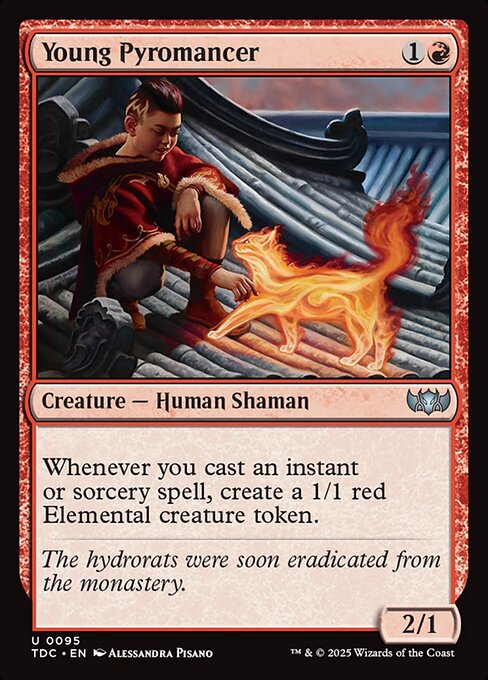
Young Pyromancer
Guttersnipe
Storm-Kiln Artist
You cast Opt, a simple one-mana instant.
You get to scry 1 and draw a card from Opt itself.
But you also create a 1/1 Elemental token, deal 2 damage to each opponent, and generate a Treasure token.
You put the three cast triggers on the stack above Opt in the order you choose. Without further responses, they resolve before Opt's scry and card draw.
That's quite a lot of value from a spell that originally cost one blue mana.
And now imagine casting another spell.
And another.
That's where Spellslinger becomes interesting. Each additional spell can contribute to several different parts of your strategy.
Of course, you need the right balance. Having three powerful payoff creatures but no spells to cast isn't particularly useful.
And having a hand full of cheap spells with nothing that rewards you for casting them isn't much better.
A good Spellslinger deck needs both.
Choosing Your Spellslinger Commander
I think the commander you choose has a huge influence on how your Spellslinger deck plays.
Some commanders reward casting lots of cheap spells. Others reduce their costs, copy them, or let you reuse cards from your graveyard.
And while blue and red are the most recognizable Spellslinger colors, you aren't limited to Izzet.
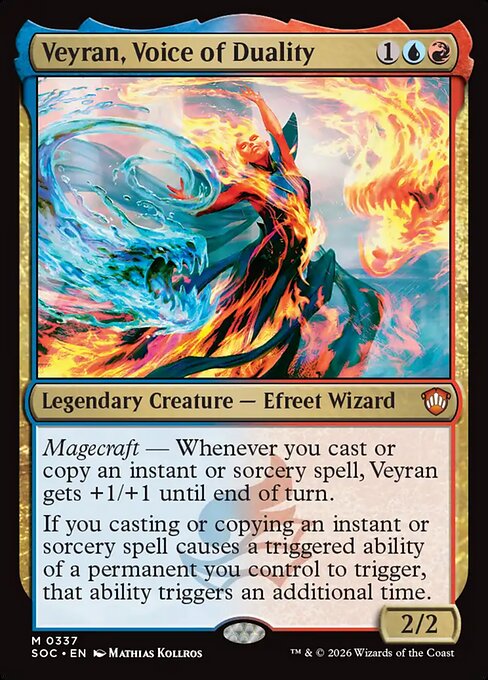
Veyran, Voice of Duality: Double the Triggers
Veyran, Voice of Duality is one of my favorite examples of what a Spellslinger commander can do.
Veyran gets stronger whenever you cast or copy an instant or sorcery, but the interesting part is the second ability.
If casting or copying one of those spells causes a triggered ability of a permanent you control to trigger, it triggers an additional time.
That can get out of hand very quickly.
Imagine controlling Veyran alongside Guttersnipe.
Normally, casting an instant or sorcery causes Guttersnipe to deal 2 damage to each opponent.
With Veyran on the battlefield, that ability triggers twice, dealing 4 damage to each opponent.
And you still get the effect of the spell you cast.
Now add a few more permanents with similar triggers, and every cheap spell starts doing an impressive amount of work.
What I like about Veyran is that you don't necessarily need expensive spells. Even a simple cantrip can generate several useful effects.
The downside is that you become quite dependent on keeping your payoff permanents alive.
If someone removes Veyran and your other engines, the deck can lose a lot of its explosive potential.
Mizzix of the Izmagnus: Expensive Spells Become Cheap
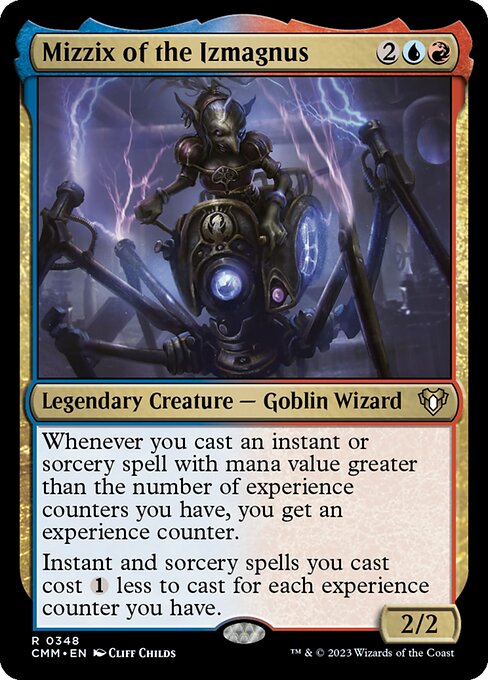
Mizzix of the Izmagnus takes a completely different approach.
Instead of doubling triggers, she makes your instants and sorceries cheaper as you accumulate experience counters.
Every time you cast an instant or sorcery with a mana value greater than your current number of experience counters, you gain another counter.
And each experience counter reduces the generic mana cost of your instants and sorceries by one.
That means expensive spells can eventually become surprisingly affordable.
What I particularly like about Mizzix is that experience counters stay with you, the player, even if your commander leaves the battlefield.
But you still need Mizzix on the battlefield to benefit from her cost reduction.
Mizzix can become extremely powerful when built around the right spells, especially those with large generic mana costs or X in their costs.
Just remember that her reduction doesn't eliminate colored mana requirements.
It changes what you pay, not a spell's mana value. An experience counter earned from casting a spell cannot retroactively make that same spell cheaper.
Kess, Dissident Mage: Your Graveyard Is Part of Your Hand
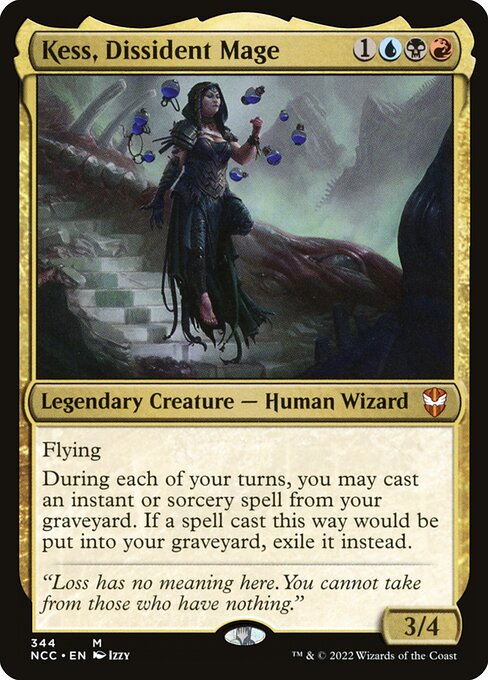
Kess, Dissident Mage is a great option if you enjoy reusing spells.
Once during each of your turns, she lets you cast an instant or sorcery spell from your graveyard. You still pay its costs and follow normal timing rules; if that spell would go to your graveyard, it is exiled instead.
That gives you access to cards you've already used.
Maybe you need another removal spell. Maybe you want to draw more cards. Or perhaps you want to cast an important spell that was countered earlier.
I like commanders that provide value without requiring you to assemble several specific pieces first.
Kess also gives you access to Grixis colors, opening up more options for removal, recursion, tutors, and win conditions.
Of course, graveyard hate can disrupt your plans, so I wouldn't build a deck that completely stops functioning without access to its graveyard.
Talrand, Sky Summoner: Every Spell Builds an Army
Not every Spellslinger deck needs complicated engines.
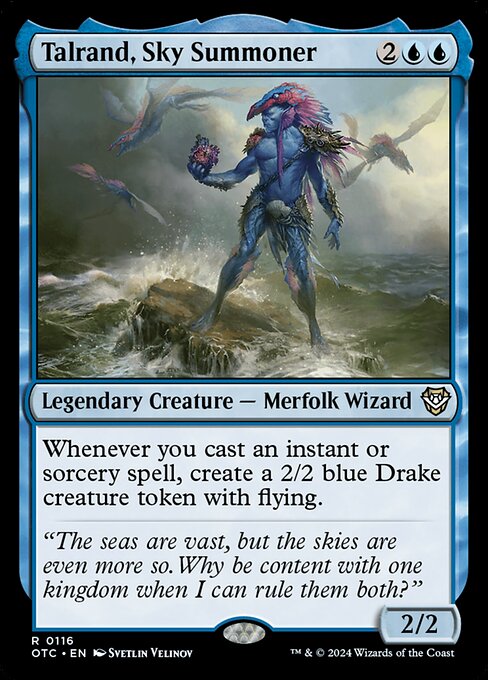
Talrand, Sky Summoner is a perfect example.
Whenever you cast an instant or sorcery, you create a 2/2 Drake with flying.
Simple.
You play your normal spells, interact with opponents, draw cards, and gradually build a flying army.
I like Talrand because the strategy is easy to understand, but there are still plenty of decisions to make.
Do you cast your spells now to create more Drakes, or hold them for the right moment?
Do you use your creatures defensively, or try to win through combat?
And because Talrand is mono-blue, your mana base can be much simpler than that of a three-color Spellslinger deck.
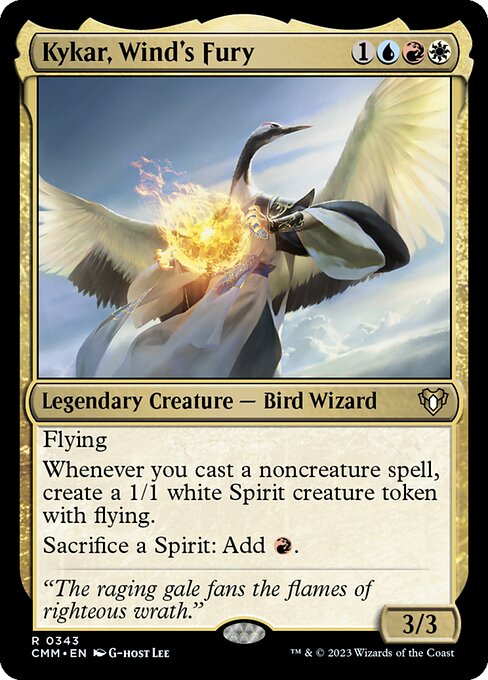
Kykar, Wind's Fury: Spells Become Creatures and Mana
Kykar, Wind's Fury creates a flying Spirit token whenever you cast a noncreature spell.
You can also sacrifice Spirits to generate red mana.
That gives you a very interesting combination.
Your spells create creatures, and those creatures can help pay for more spells.
Kykar also works with noncreature spells beyond instants and sorceries, which opens up additional deckbuilding possibilities.
I particularly like commanders that let you choose how to use your resources.
Sometimes you'll want to keep your Spirits for combat. Other times, sacrificing them for mana is exactly what you need to continue your turn.
Cheap Spells Are the Fuel of Your Deck
One of the first things I'd look at in a Spellslinger deck is the mana curve.
You don't necessarily need every spell to cost one or two mana, but cheap spells are especially valuable because they let you do several things in the same turn.
Cards like Opt, Consider, Ponder, and Preordain are useful examples of small spells that help you find what you need.
They're often called cantrips: inexpensive spells that replace themselves by drawing a card, sometimes while improving card selection.
A one-mana spell that draws a card might not look particularly impressive.
But when you have a Young Pyromancer, Guttersnipe, or Storm-Kiln Artist in play, that same spell can accomplish much more.
And because the spell replaces itself, you can keep moving through your deck.
That's something I really like about Spellslinger.
Some of the most important cards aren't necessarily the most expensive or spectacular ones.
Sometimes a simple one-mana instant is exactly what makes the entire engine work.
But don't fill your deck with cheap spells just because they're cheap.
They should still accomplish something useful.
If your entire deck consists of cantrips, you might spend several turns drawing cards without actually advancing toward a win.
Card Draw: You Need to Keep Casting
Spellslinger decks can burn through their hands very quickly.
Imagine starting your turn with five cards and casting four of them.
That might create tokens, generate Treasure, and deal some damage.
But if those spells don't replace themselves or produce enough resources, you're going to have a problem on your next turn.
That's why I consider card advantage one of the most important parts of the archetype.
Cards like Archmage Emeritus, Big Score, Expressive Iteration, and Treasure Cruise can be useful depending on your colors and strategy.
I particularly like Archmage Emeritus because it rewards you for casting or copying instants and sorceries.
But there's a balance to find.
You don't want every card in the deck to be another way to draw cards.
You also need threats, interaction, mana, and ways to finish the game.
And remember that drawing lots of cards isn't a win condition by itself.
Unless, of course, you're playing a deck specifically designed to win that way.
Otherwise, at some point you need to stop drawing and actually do something with those cards.
Generating Mana While Casting Spells
This is where Spellslinger can become explosive.
Normally, casting a spell costs you mana and reduces your available resources.
But some cards let you recover mana or generate additional mana as you play.
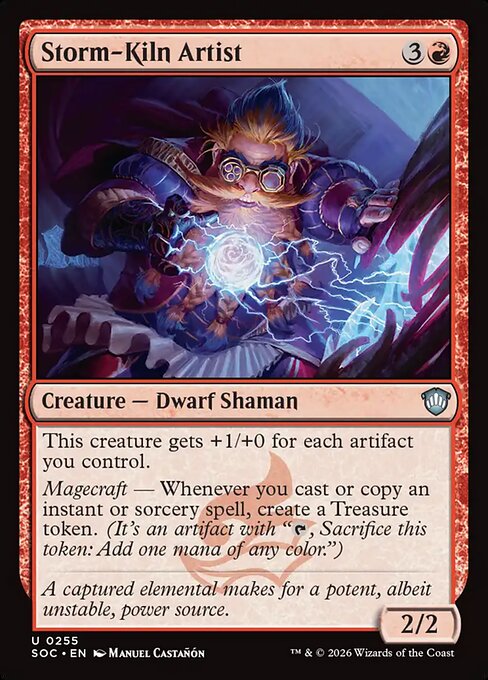
Storm-Kiln Artist is one of my favorite examples.
Whenever you cast or copy an instant or sorcery, it creates a Treasure token.
That Treasure can help pay for another spell.
And if that next spell generates another Treasure, you can continue the sequence.
Cards like Birgi, God of Storytelling, Mana Geyser, and Jeska's Will can also provide powerful mana generation in appropriate decks.
But they work differently.
Birgi rewards you for casting spells.
Mana Geyser depends on how many tapped lands your opponents control.
Jeska's Will can generate mana and potentially give you access to additional cards, with extra flexibility when you control your commander.
The important part is understanding what your deck actually needs.
A low-curve deck might prefer mana generation that supports casting lots of small spells.
A deck built around expensive X spells might want larger bursts of mana.
And I wouldn't remove conventional ramp just because the deck has a few spectacular mana-generating spells.
You still need to reach the point where those cards become useful.
Copying Spells: Sometimes One Isn't Enough
Copying spells is one of the most entertaining parts of Spellslinger.
You cast a spell that draws cards, removes a threat, or deals damage.
Then you copy it.
Maybe twice.
Maybe considerably more than twice.
Cards like Reverberate, Narset's Reversal, Twincast, and Bonus Round can create some very interesting situations.
But there are a few details worth understanding.
When you copy a spell directly on the stack, you're not normally casting that copy.
That means abilities that specifically trigger when you cast a spell won't automatically trigger from the copy.
For example, Young Pyromancer creates a token when you cast an instant or sorcery, not when you merely copy one.
On the other hand, Storm-Kiln Artist has magecraft, which triggers when you cast or copy an instant or sorcery.
So copying a spell can generate additional Treasure with Storm-Kiln Artist, even though it doesn't trigger Young Pyromancer.
These details matter a lot in Spellslinger.
It's worth learning them properly, especially if your commander has abilities that interact with spell copying.
And please, if you're playing a deck that copies spells repeatedly, keep track of the stack clearly.
Your opponents will appreciate it.
Interaction: Playing Spells Shouldn't Mean Ignoring the Table
One of the advantages of Spellslinger is that many of the cards your deck already wants to play can also interact with opponents.
Counterspells, bounce spells, and removal all contribute to your spell-based strategy.
Cards like Counterspell, Swan Song, Chaos Warp, Pongify, and Rapid Hybridization can provide useful interaction depending on your colors.
And if you have permanents that reward casting instants and sorceries, even a defensive spell can advance your game plan.
That's one of the things I enjoy about this archetype.
You're not necessarily choosing between developing your board and interacting with opponents.
Sometimes you can do both.
However, there's a trap here.
Just because casting spells triggers your engines doesn't mean you should cast interaction unnecessarily.
Countering a harmless spell to create a token might feel clever, but you'll probably regret it when somebody tries to win on the next turn.
In multiplayer Commander, knowing when not to cast a spell is just as important as knowing when to cast one.
How Does a Spellslinger Deck Actually Win?
This is probably the most important question to answer before finishing your deck.
Because Spellslinger can generate enormous amounts of value without necessarily winning.
You might draw twenty cards, create fifteen Treasures, and copy several spells.
Very impressive.
But what happens next?
There are several ways to finish games with Spellslinger, and they lead to quite different deckbuilding choices.
Win Through Damage Triggers
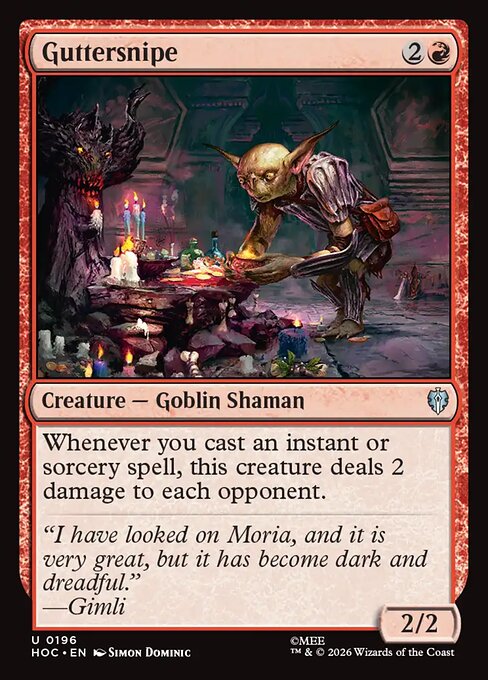
Cards like Guttersnipe, Electrostatic Field, and Firebrand Archer can turn repeated spellcasting into damage.
Guttersnipe is particularly interesting in multiplayer Commander because it damages every opponent.
Imagine having Guttersnipe on the battlefield and casting six instants or sorceries.
That's 12 damage to each opponent from Guttersnipe alone.
If you have multiple similar effects, the damage accumulates quickly.
This approach is great if you enjoy gradually wearing down the entire table before a big finishing turn.
But remember that not all these cards use identical trigger conditions. Firebrand Archer, for example, triggers on casting noncreature spells more broadly.
Win With Tokens
Cards like Young Pyromancer, Talrand, Sky Summoner, and Third Path Iconoclast can turn spellcasting into an army.
You cast spells to draw cards, remove threats, and generate resources.
Meanwhile, you're building a battlefield full of creatures.
Eventually, those creatures can win through combat, especially with some additional support.
I like this approach because it gives the deck another dimension.
You're not completely dependent on finding one giant finishing spell.
And your tokens can also block and protect you while you're setting up.
Win With a Big Spell
Sometimes you just want to generate a ridiculous amount of mana and cast something that ends the game.
Cards like Crackle with Power, Comet Storm, or other scalable damage spells can fill that role.
But I'd be careful about adding too many expensive finishers.
You don't want to open every game with three enormous X spells and no way to generate the mana needed to cast them.
A few reliable finishing options are usually more useful than filling the deck with flashy cards that sit in your hand.
Win With Storm or Combos
Some Spellslinger decks focus on casting large numbers of spells in a single turn, often using storm cards or repeatable loops.
Grapeshot, Aetherflux Reservoir, and various spell-recursion engines can become win conditions in the right builds.
But storm and Spellslinger aren't exactly the same thing.
A Spellslinger deck might cast several spells each turn and accumulate value gradually.
A dedicated Storm deck is usually trying to assemble one explosive turn where the number of spells cast becomes central to winning.
And some combo decks use cost reductions, recursion, and mana generation to create loops.
That's perfectly valid if it's the experience you want.
Personally, I don't think every Spellslinger deck needs to become a Storm combo deck.
There's plenty of room for spell-based control, token strategies, damage triggers, and other ways to win.
How Many Instants and Sorceries Should You Play?
There isn't one number that works for every Spellslinger deck.
A deck with Talrand, Sky Summoner might want a particularly high density of instants and sorceries.
A Kykar, Wind's Fury deck can benefit from a broader range of noncreature spells.
And a deck built around copying large spells has different needs from one focused on casting lots of cheap cantrips.
As a starting point, I'd look at roughly 25–35 instants and sorceries in a dedicated Spellslinger deck, sometimes more if the commander and strategy really reward it.
But I wouldn't chase a number just for the sake of it.
You still need lands, ramp, engines, protection, interaction, and ways to win.
Also, remember that many of your instants and sorceries can fill those roles.
A removal spell is still interaction.
A spell that draws cards is still card advantage.
And a spell that generates mana can be part of your acceleration package.
The important thing isn't how many instants and sorceries you have.
It's whether the deck can consistently cast them and benefit from doing so.
Don't Forget About the Permanents
It's easy to become so focused on instants and sorceries that you forget the permanents that make the strategy work.
Many of the strongest Spellslinger engines are creatures, enchantments, or artifacts.
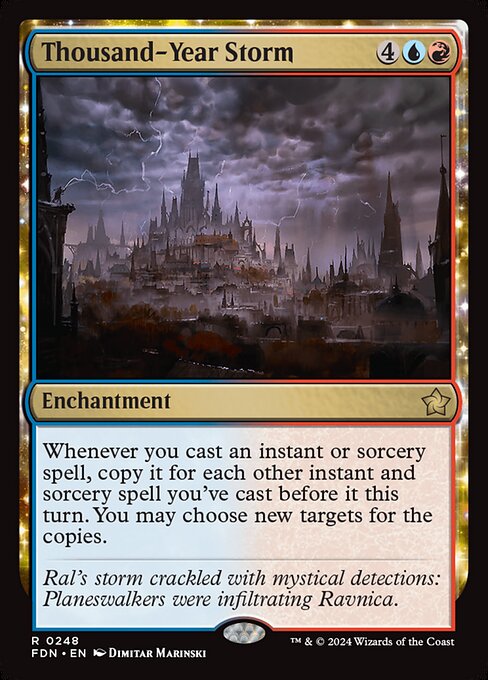
Archmage Emeritus, Storm-Kiln Artist, Young Pyromancer, Guttersnipe, and Thousand-Year Storm all provide ways to turn your spells into something more valuable.
The problem is that opponents can remove them.
And if your deck depends completely on having three specific permanents in play, one board wipe can leave you holding a collection of small spells that don't accomplish very much.
That's why I like having a mixture of engines.
Some generate card advantage, others create mana, and others provide actual win conditions.
And I try not to make the deck depend on one specific permanent.
You want your engines to work together, but you also want the deck to function when one of them disappears.
Protecting Your Big Turn
One of the most frustrating things in Spellslinger is spending several turns preparing for an explosive sequence, then having somebody counter the spell that was supposed to finish the game.
Sometimes there's nothing you can do.
That's Magic.
But you can build your deck to reduce that risk.
Cheap counterspells, protection effects, and careful sequencing can help you execute your plan.
I particularly like keeping some mana available when I'm about to cast an important finishing spell.
You don't always need to use every available resource immediately.
Sometimes it's better to wait a turn, develop another source of mana, or make sure you have a response ready.
And think about what your opponents can do.
If the blue player has seven untapped lands and six cards in hand, maybe that's not the best moment to commit everything to one spell.
On the other hand, waiting forever isn't a plan either.
Eventually, you'll need to take a risk.
Learning when to go for it is part of playing Spellslinger well.
Common Mistakes When Building Spellslinger
There are a few problems I'd watch out for.
Too many expensive spells. Big spells are exciting, but if your hand is full of six- and seven-mana cards, you might struggle to develop during the early game.
Not enough card draw. Casting lots of spells is great until you have none left.
Too many payoffs and not enough spells. A battlefield full of creatures that reward instants and sorceries isn't particularly useful if you're not casting any.
No real win condition. Generating 30 Treasures and drawing your entire deck is impressive, but you still need a way to win.
Ignoring protection. If your deck depends on a few important engines, expect opponents to remove them.
Overcomplicating the deck. Not every Spellslinger deck needs ten different copy effects, infinite loops, and a turn that takes fifteen minutes to resolve.
And one more thing.
Don't confuse casting lots of spells with playing efficiently.
Sometimes the correct play is to cast nothing.
Which can be surprisingly difficult when your deck rewards you for casting everything.
Making Your Turns Easier to Follow
There's something worth mentioning that isn't really about deck construction.
Spellslinger can create a lot of triggers.
And in a four-player Commander game, long turns can become exhausting if nobody understands what's happening.
I think it's worth making a little effort to keep everything clear.
Announce your spells, explain your triggers, and resolve things in the correct order.
If you have several effects that trigger from the same action, put them on the stack properly and make sure everyone understands what they're doing.
You don't need to give a lecture every time you cast Opt.
But if you're about to create eight Treasures, draw six cards, make four tokens, and deal twelve damage to everyone, it's worth explaining how you got there.
It's also a good idea to practice your deck a little.
Knowing your own interactions makes games much smoother.
And it prevents that awkward moment when you've spent five minutes explaining a combo only to discover it doesn't actually work.
We've all had a turn like that.
Test Your Spellslinger Deck Before Buying Everything
Spellslinger is one of those strategies where the deck can look fantastic on paper.
You have powerful payoffs, plenty of spells, some ways to generate mana, and a spectacular finisher.
But during real games, you might discover that your hand empties too quickly, your engines cost too much, or you don't have enough mana to cast multiple spells in the same turn.
That's why I like testing the deck before buying every card.
In MTG Master Deck Builder, you can build your Spellslinger Commander deck, explore cards, and use the Deck Analyzer to check your mana curve, consistency, interaction, resilience, and synergy.
I'd pay particular attention to the balance between cheap spells, mana generation, and card advantage.
The opening-hand simulator can also be useful.
Try several hands and see whether you have reasonable early plays.
A hand full of expensive payoff creatures and no cheap spells might look powerful, but it probably isn't going to do very much during the first few turns.
The combo detection tools are worth checking too, especially if your deck includes cost reductions, spell copying, recursion, and repeatable mana generation.
Sometimes a combination you included simply because the cards looked good together turns out to be considerably more powerful than expected.
Of course, no analyzer can tell you exactly how enjoyable a deck will be.
But it can help identify weaknesses before you spend money on cards that don't actually improve your strategy.
Is Spellslinger the Right Archetype for You?
I think Spellslinger is a great choice if you enjoy having lots of options, making decisions during other players' turns, and finding interesting interactions between spells.
It's particularly satisfying when a simple instant or sorcery triggers several useful abilities and turns into something much more powerful than the card itself.
You don't necessarily need a huge battlefield to become dangerous.
Sometimes all you need is a few well-chosen permanents, enough mana, and a hand full of spells.
But Spellslinger isn't for everyone.
If you prefer playing enormous creatures and attacking, constantly managing the stack and keeping track of triggers might feel like too much work.
And if your group prefers quick, straightforward turns, you might want to avoid building a deck that regularly spends ten minutes resolving a single sequence.
Personally, I think the most enjoyable Spellslinger decks are the ones where each spell has a purpose.
You're not casting spells just to increase a counter.
You're drawing cards, creating threats, interacting with opponents, building resources, and gradually getting closer to winning.
And sometimes, after all that preparation, you finally cast the spell that ends the game.
Assuming nobody has a counterspell.
Because, of course, there's always somebody with a counterspell.
Build your own Spellslinger engine
Choose your commander and balance cheap spells, mana engines, card advantage and a clear win condition in Deck Builder.