

Aminatou, Veil Piercer



 Commander
Aminatou, Veil Piercer is an Esper enchantment-focused commander that uses upkeep surveil and miracle-style discounts to turn well-timed draws into big tempo swings.
Public decks: 1Bracket: Varies

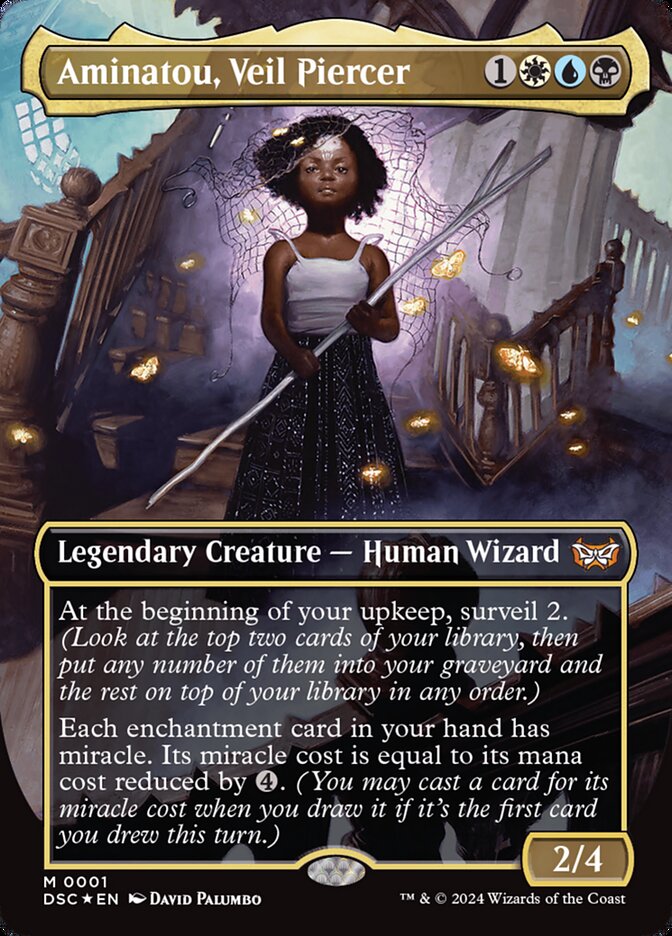
Card text
Legendary Creature — Human Wizard
At the beginning of your upkeep, surveil 2. (Look at the top two cards of your library, then put any number of them into your graveyard and the rest on top of your library in any order.)
Each enchantment card in your hand has miracle. Its miracle cost is equal to its mana cost reduced by  . (You may cast a card for its miracle cost when you draw it if it's the first card you drew this turn.)
Building around this commander?
Use MTG Master to build or analyze a Commander deck around this card, check consistency, and find weak spots before your next game.
Overview
- Use your upkeep surveil 2 to set up your next draw and filter into what you need.
- Leverage Aminatou giving enchantments in hand miracle with a large cost reduction to deploy powerful enchantments earlier than expected.
- Play a reactive, controlling game: develop mana, protect your window, then land an enchantment that stabilizes or snowballs value.
- Often prefers playing on your turn to take advantage of “first draw each turn” miracle timing.
- Can pivot between pillow-fort, soft-lock elements, and late-game inevitability depending on your enchantment suite.
Common lines
- Upkeep surveil to keep an enchantment on top, draw it for turn, then cast it for its miracle cost if it is your first draw.
- Use early interaction/counters to protect Aminatou and your key turns, then land an enchantment that slows the table.
- Build incremental advantage from repeated filtering, then close once opponents are constrained and you can safely commit more mana.
- After a wipe, rebuild by converting draw steps into discounted enchantments to re-establish control.
Strengths
- Strong card selection over time from repeatable surveil.
- Big mana efficiency spikes when miracle discounts line up with your draw steps.
- Naturally supports a controlling plan with enchantment-based disruption and protection.
- Good resilience in longer games where repeated filtering matters.
- Can create hard-to-answer board states if opponents lack enchantment interaction.
Weaknesses
- Heavily timing-dependent: miracle requires the first draw of the turn, so extra-draw effects can be awkward if sequenced poorly.
- Relies on Aminatou sticking around; repeated removal can slow your plan significantly.
- Can be clunky if you draw enchantments at the wrong time or can’t manipulate the top of your library.
- May attract early table attention if you include prison, taxes, or lock pieces (example cards exist in the snapshot).
- Vulnerable to concentrated enchantment removal and effects that pressure your life total while you set up.
Rule zero notes
- This commander can support prison/tax effects and slowed-gameplay enchantments; disclose if your list leans that direction (example cards include Archon of Emeria, Drannith Magistrate, Frozen Aether, Blind Obedience, Ghostly Prison, Grand Arbiter Augustin IV).
- If you run lock-style packages, mention them up front (example: Decree of Silence-style play patterns).
- If your build includes high-power tutors or fast win enablers, flag that (example tutors shown: Demonic Tutor, Enlightened Tutor).
- Let the table know how interactive your list is (countermagic and silence-style protection can change how opponents sequence).
- Clarify whether you’re aiming for a long control game or trying to assemble a quick finish (example finisher engines exist in the snapshot).
Matchups
Best into
- Creature-heavy midrange pods that struggle to push through pillow-fort or tapped-down boards.
- Slower, value-focused tables where repeated filtering and inevitability matter.
- Decks light on enchantment interaction.
Struggles against
- Fast combo pods that win before your control pieces and timing engine come online.
- Heavy enchantment-removal metas that can efficiently answer your key permanents.
- Aggressive burn/pressure strategies that punish slow, setup-oriented turns.

FAQ
How does Aminatou’s miracle ability work with enchantments?
Every enchantment in your hand gains miracle, with a miracle cost equal to its mana cost reduced by 4. You can cast it for that cost only when you draw it as the first card you drew that turn.
Why is the upkeep surveil important?
It helps set up your next draw step so you can draw the enchantment you want and potentially cast it for its miracle cost. It also smooths draws by binning unwanted cards.
Do I need lots of topdeck manipulation to make this work?
Aminatou already provides a baseline setup tool via surveil, but additional ways to control the top of your library can make your miracle turns more consistent.
Is this commander typically a stax/prison deck?
With very limited public data, builds can vary, but the snapshot includes several prison/tax-style examples. If you choose that route, expect longer games and more table scrutiny.
What kind of interaction should I plan to run?
You typically want a mix of protection for your key turns and answers to early threats. The snapshot shows examples of countermagic and broad removal, but your exact suite can vary.