
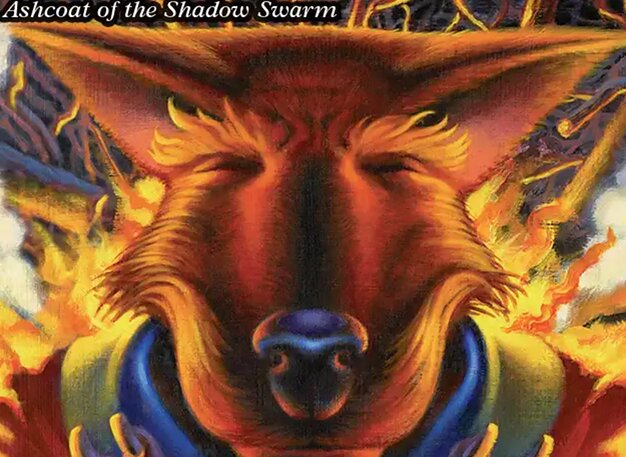
Ashcoat of the Shadow Swarm


Ashcoat of the Shadow Swarm is a mono-black Rat commander that turns a wide board into huge combat swings and refuels by milling and buying back Rats every end step.

Public decks: 2Bracket: 3
Overview
- Primary plan is to build a critical mass of Rats, then let Ashcoat turn attacks and blocks into massive temporary buffs.
- Ashcoat doubles as a grind engine: end step milling can stock the graveyard and return up to two Rat creature cards to hand.
- Games tend to pivot around combat math; even small Rats can suddenly trade up or threaten lethal when Ashcoat is involved.
- You can lean into a tribal anthem finish (e.g., cards like Coat of Arms or Banner of Kinship) or play a more attrition-heavy mono-black shell with sweepers and recursion.
- Because the deck is creature-count dependent, protecting Ashcoat and maintaining board presence are often the key decision points.
Common lines
- Develop early board with cheap Rats and mana acceleration (e.g., Arcane Signet), then land Ashcoat and start forcing awkward blocks.
- Use Ashcoat’s end step mill selectively: mill when you can reasonably expect to pick up Rats, skip it when you can’t afford to lose topdeck quality.
- After a wipe, rebuild by leveraging Ashcoat’s end step recursion to restock your hand with Rats and redeploy.
- Set up a “one big turn” where multiple Rats plus a payoff anthem (e.g., Coat of Arms) turns a single combat step into a table-shaping swing.
- Shift into drain/inevitability lines when combat stalls, using repeatable chip damage sources as backup (e.g., Ayara, First of Locthwain or Gray Merchant of Asphodel).
Strengths
- Explosive combat scaling that punishes opponents for letting you keep a wide board.
- Built-in card advantage over time via self-mill plus recursion to hand.
- Mono-black interaction can cover key problem permanents and creatures (e.g., Go for the Throat, Feed the Swarm, Deadly Rollick).
- Naturally resilient to spot removal on individual Rats since the plan is redundancy and volume.
- Can pivot between aggro pressure and grindy recovery depending on how the table interacts.
Weaknesses
- Highly dependent on having multiple Rats; repeated board wipes can reset your main damage engine.
- Ashcoat is a central multiplier—removal at the right time can defang a combat step and slow your clock.
- Temporary buffs mean you usually need to keep attacking to convert advantage into wins; stalled boards can be awkward without a finisher.
- Self-mill can be risky if key non-Rat pieces get binned without a way to reclaim them.
- Graveyard hate can blunt the end step recursion plan and reduce your ability to rebuild.
Rule zero notes
- Disclose if you’re running fast burst mana (e.g., Dark Ritual, Culling the Weak) that can power out early engines.
- Disclose if you’re on high-power tutors (e.g., Demonic Tutor) and what they typically find in your build.
- Mention if you include big snowball artifacts like Bolas's Citadel that can create explosive turns.
- Note whether your win plan is primarily combat (tribal swarm/anthem) or if you have drain-based inevitability finishes (e.g., Ayara, First of Locthwain, Gray Merchant of Asphodel).
- Flag any unusually punishing tribal scaling pieces (e.g., Coat of Arms) since they can dramatically change combat for the whole table.
Matchups
Best into
- Creature-heavy midrange pods where combat math and blocking matter.
- Removal-light tables that struggle to answer a growing board repeatedly.
- Slower value decks that give you time to amass a critical mass of Rats.
Struggles against
- Frequent sweepers and repeated mass-removal metas.
- Decks with reliable graveyard hate that shut off the recursion loop.
- Fast combo tables where combat pressure may not race without a quick start.
FAQ
Do I have to mill every end step?
No. It’s a may ability, and skipping mill is often correct when you can’t safely afford to lose cards off the top or when your graveyard setup isn’t ready.
Is Ashcoat more of an aggro or a grind commander?
It can play both roles: the combat trigger rewards going wide and turning sideways, while the end step recursion supports longer, attrition-based games.
What’s the most common way Ashcoat closes games?
Typically by stacking enough Rats that Ashcoat’s +X/+X swing makes blocks impossible, sometimes supported by a big tribal payoff like Coat of Arms or Banner of Kinship.
How do I recover after a board wipe?
You often rebuild by redeploying Rats and using Ashcoat’s end step ability to pick up more Rats from the graveyard, keeping your hand stocked for the next wave.
Do I need to protect Ashcoat?
Usually yes, because Ashcoat is your main combat multiplier and your steady refuel engine; examples like Lightning Greaves or Commander's Plate can help if your build supports them.