
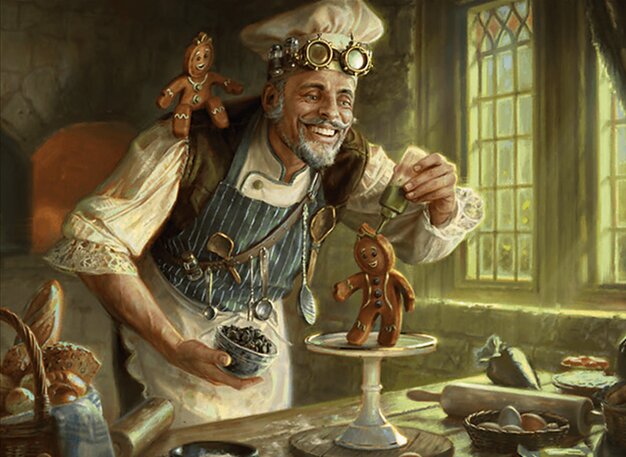
Brenard, Ginger Sculptor



 Commander
Brenard, Ginger Sculptor is a Bant value engine that turns your nontoken creatures into boosted Food Golem copies when they die, letting you grind through removal and win via repeated board presence.
Public decks: 3Bracket: Varies

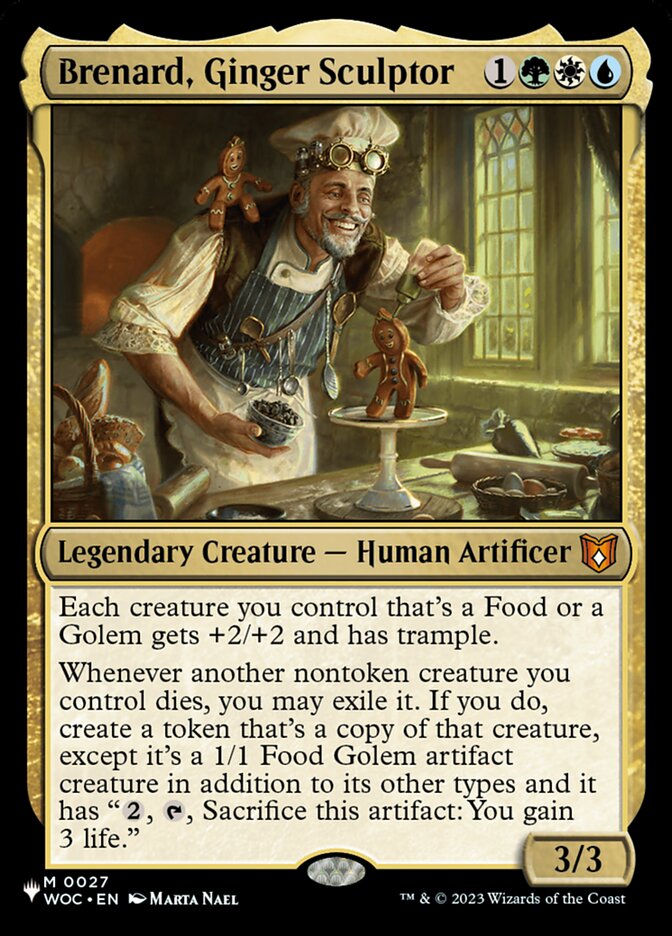
Card text
Legendary Creature — Human Artificer
Each creature you control that's a Food or a Golem gets +2/+2 and has trample.
Whenever another nontoken creature you control dies, you may exile it. If you do, create a token that's a copy of that creature, except it's a 1/1 Food Golem artifact creature in addition to its other types and it has " ,
,  , Sacrifice this token: You gain 3 life."
Building around this commander?
Use MTG Master to build or analyze a Commander deck around this card, check consistency, and find weak spots before your next game.
Overview
- Leans into nontoken creatures you can afford to trade off, then converts them into token copies to keep your board stocked.
- Your Food and Golem creatures naturally become real threats thanks to the built-in +2/+2 and trample anthem.
- Plays a resilient midrange game: block, trade, and rebuild while accumulating incremental advantages.
- Uses sacrifice and combat exchanges as a resource, often turning removal into upside by exiling the original and keeping a token version.
- Closes games by snowballing a wide board of trample attackers that are awkward to fully answer permanently.
Common lines
- Deploy a few impactful nontoken creatures, then invite trades in combat so their deaths convert into Food Golem token copies.
- Use sacrifice outlets or self-sacrificing creatures to proactively trigger Brenard and maintain pressure through board wipes and spot removal.
- Attack with a board of Food/Golems that are effectively larger than they look, leveraging trample to push damage through chump blocks.
- After interaction clears the table, rebuild quickly by turning each subsequent creature death into another body rather than losing material.
Strengths
- Strong attrition plan: creature removal and combat trades can turn into more bodies instead of fewer.
- Excellent at presenting a board that keeps coming back in a different form, making one-for-one answers less effective.
- Natural combat pressure from an anthem plus trample on key creature types.
- Incidental life gain from Food tokens can buy time in races and stabilize against chip damage.
Weaknesses
- Relies heavily on Brenard sticking; repeated commander removal can slow the engine dramatically.
- Exile-based removal and graveyard-independent sweepers can limit the value you get from death triggers.
- Token copies being 1/1 base bodies can be vulnerable to -X/-X effects and token-hate, even if they’re later pumped.
- May struggle to end games quickly without sustained board presence, especially into multiple sweepers.
Rule zero notes
- This commander tends to be a grindy value engine; mention if your list is tuned to loop death triggers aggressively.
- Call out if you’re running many sacrifice outlets, as they can make the deck feel much more combo-adjacent.
- If you include lock-style pieces that restrict combat or resources, disclose that upfront since Brenard already pressures attrition games.
Matchups
Best into
- Creature-heavy midrange pods where combat trades happen often.
- Spot-removal-heavy tables that try to grind with one-for-one interaction.
- Pods that win through damage races where incidental life gain matters.
Struggles against
- Exile-heavy interaction suites that prevent recursion-by-copying lines.
- Frequent board wipes that repeatedly reset your board before you can rebuild with Brenard online.
- Fast combo tables where incremental board value doesn’t have time to matter.
Recent public decks
Staples
Browse all public decksFAQ
What is Brenard actually trying to do each game?
Brenard typically wants to turn your nontoken creatures into repeatable material by converting their deaths into Food Golem token copies, then leverage the anthem and trample to pressure life totals.
Do the token copies keep the original creature’s abilities?
They’re copies of that creature, but they’re also 1/1 Food Golem artifact creatures and they gain a Food-style activated ability to sacrifice for life gain.
How does the deck usually win?
Most wins come from building a board of Food/Golems that are larger than their base stats thanks to Brenard and then attacking with trample to push through blocks.
Is this more of a combo commander or a fair combat commander?
From the card text, it leans naturally toward fair midrange and attrition, but it can feel more engine-driven if you add many ways to sacrifice creatures on demand.
What kind of interaction is most annoying for Brenard?
Exile effects and repeated commander removal tend to be the most disruptive, since they either prevent the death-to-token conversion or shut off the engine entirely.