

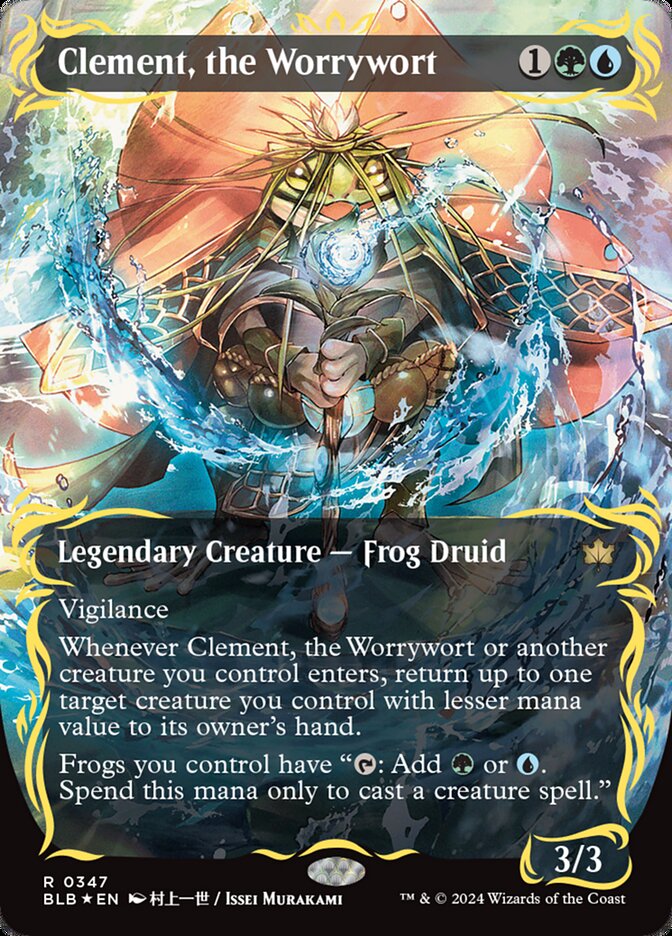
Clement, the Worrywort


 Commander
A Simic creature engine that turns every enter-the-battlefield into a self-bounce chain for value, protection, and potential creature-based loops.
Public decks: 2Bracket: Varies
Card text
Legendary Creature — Frog Druid
Vigilance
Whenever Clement or another creature you control enters, return up to one target creature you control with lesser mana value to its owner's hand.
Frogs you control have " : Add or . Spend this mana only to cast a creature spell."
Building around this commander?
Use MTG Master to build or analyze a Commander deck around this card, check consistency, and find weak spots before your next game.
Overview
- Build around creature ETB triggers: each creature you play can pick up a smaller creature to reuse later.
- Leans creature-dense, often curving up while recycling cheap ETB bodies for cards, mana, or tempo.
- Uses the bounce trigger defensively to save key pieces from removal and to dodge unfavorable blocks.
- Frog tribal is optional, but Frogs you control can function as creature-only mana dorks for chaining plays.
- Typically wins by snowballing repeated ETBs into overwhelming board presence or setting up a creature-loop finish.
Common lines
- Deploy a cheap creature, trigger Clement to pick up an even cheaper creature, then replay it to keep the ETB train going.
- Use the bounce trigger in response to removal to return the targeted creature to hand and recast it later.
- Sequence creatures from low to high mana value so each new ETB can rebuy a previous utility creature.
- Tap Frogs for creature-only mana to keep casting creatures through midgame turns where you want multiple spells.
Strengths
- Excellent grind potential from repeated ETB reuse without needing to overextend into the board.
- Built-in protection/tempo from bouncing your own creatures in response to interaction.
- Strong synergy with creature-based ramp and utility bodies, enabling multi-spell turns.
- Resilient to many sweepers compared to pure token decks, since key value pieces can be held in hand and replayed.
- Vigilance on the commander helps stabilize while still attacking or holding up blocks.
Weaknesses
- Can be mana-hungry: repeatedly recasting creatures is powerful but often slower than raw card-draw engines or fast combo.
- Relies on creature ETBs; effects that shut off ETB triggers or tax creature casting can stall the plan.
- Bounce clause depends on mana values lining up; awkward curves can make triggers less impactful.
- Commander-centric in practice: losing Clement repeatedly can reduce the deck to fair creature value.
- Graveyard-based value is minimal here; you’re mostly looping through hand, which can be disrupted by hand attack or repeated counterspells.
Rule zero notes
- This commander can enable repetitive bounce-and-recast patterns; clarify whether you’re aiming for fair value loops or a dedicated combo finish.
- Games can involve lots of triggers and sequencing; confirm your table is comfortable with a creature-engine playstyle.
- If you include many creature-based mana sources and cheap creatures, turns can become chain-heavy; set expectations for pace of play.
Matchups
Best into
- Midrange creature pods where repeated ETB value and tempo bounces matter
- Removal-heavy tables where saving creatures to hand creates card advantage over time
- Slower battlecruiser games where chaining creatures over several turns is rewarded
Struggles against
- Fast combo tables that end the game before your engine snowballs
- Stacks/tax effects that constrain creature casting or shut down ETB triggers
- Decks that punish returning creatures to hand or repeatedly counter creature spells
FAQ
Do I have to build Frog tribal?
No. Frogs mostly matter for the creature-only mana ability, so you can treat them as a theme or just a light support package.
What does the deck want more: cheap creatures or big creatures?
Typically more cheap creatures. The bounce trigger rewards having smaller bodies to pick up and replay, while your top end can be a smaller number of closers.
How do I avoid falling behind when I keep picking up my own creatures?
Prioritize creatures with impactful ETBs and sequence so you get value each time you replay them; the bounce is strongest when it functions like protection plus extra triggers.
Is Clement mostly a value commander or a combo commander?
It leans value by default, but the repeated bounce-and-recast pattern can be pushed toward loop finishes depending on how you build and what your group enjoys.
When should I cast Clement?
Often when you can follow up with a creature the same turn or already have a small creature to pick up, so you get immediate value rather than passing with a vulnerable engine piece.