

Emry, Lurker of the Loch

 Commander
Emry, Lurker of the Loch is a mono-blue artifact graveyard commander that turns cheap artifacts and self-mill into repeatable recasts and inevitability.
Public decks: 3Bracket: Varies

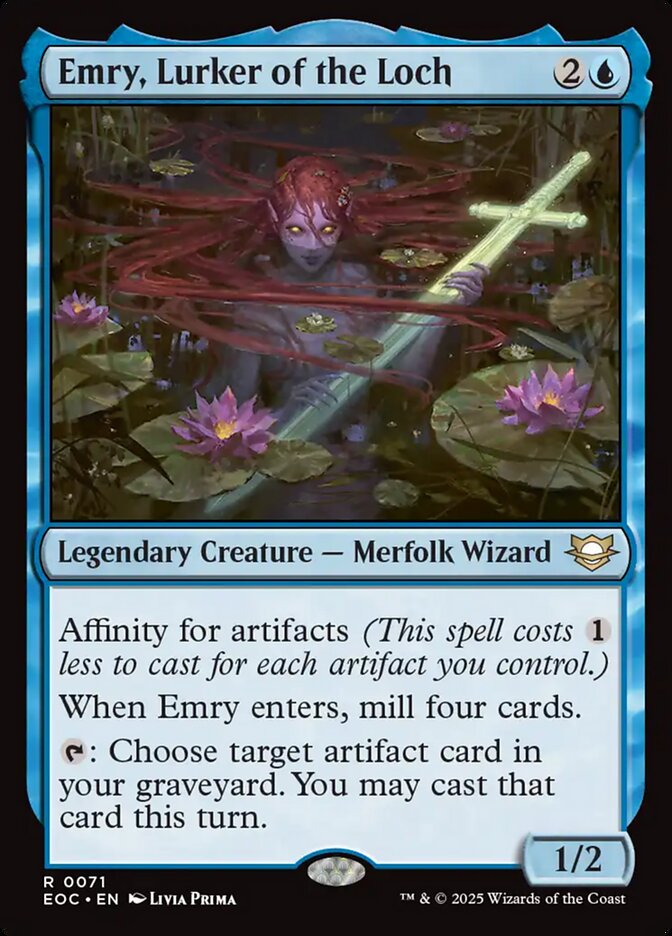
Card text
Legendary Creature — Merfolk Wizard
Affinity for artifacts (This spell costs  less to cast for each artifact you control.)
When Emry enters, mill four cards.
 : Choose target artifact card in your graveyard. You may cast that card this turn. (You still pay its costs. Timing rules still apply.)
Building around this commander?
Use MTG Master to build or analyze a Commander deck around this card, check consistency, and find weak spots before your next game.
Overview
- Leans on artifacts to cast Emry cheaply via affinity, then uses the ETB mill to stock the graveyard.
- Plays a grindy value game where Emry effectively turns your graveyard into a second hand for artifacts.
- Typically aims to keep mana open and interact, then use Emry activations to rebuild after trades or wipes.
- Can pivot between artifact-based pressure and a more controlling posture depending on what you recur each turn.
- Closing the game often comes from overwhelming long-game resource advantage and a few high-impact artifact payoffs.
Common lines
- Deploy a couple of cheap artifacts early, cast Emry for a reduced cost, and mill into artifacts worth replaying.
- Activate Emry each turn to recast a key artifact, forcing opponents to answer the same piece repeatedly.
- Hold up interaction, then on end step or your turn convert unused mana into an Emry recast to stay ahead.
- After removal, recast Emry and immediately resume value by replaying an artifact from the graveyard.
Strengths
- Excellent resilience in attrition games thanks to repeatable artifact recursion.
- Strong mana efficiency: affinity can make your commander come down earlier than expected.
- Naturally supports a reactive, instant-speed table presence with counterspells and bounce as needed.
- Good at turning incidental self-mill into real card advantage rather than a cost.
Weaknesses
- Graveyard hate can shut off Emry’s main engine and force you to play fair from hand.
- Artifact hate and repeated commander removal can slow you down if you can’t keep enough artifacts in play.
- Often relies on the commander being able to tap; effects that stop activations or keep Emry off the table are problematic.
- Mono-blue can struggle to permanently answer some resolved permanents without leaning on bounce or counterplay.
Rule zero notes
- Mention that the deck can be recursion-centric and may involve repeating the same artifact recast turn after turn.
- If you’re running high-end interaction (e.g., Force of Negation, Cyclonic Rift, Commandeer), flag that the deck can play a strong control game.
- If you include any dedicated mill plan (e.g., Court of Cunning, Fractured Sanity, Archive Trap as examples), confirm whether that’s a primary win condition or just a side theme.
- If you’re using any locky or loop-prone pieces (e.g., Isochron Scepter as an example), clarify whether the deck is aiming for deterministic combos or just value.
Matchups
Best into
- Midrange pods that plan to trade resources and win through incremental value
- Creature-heavy tables where bounce and tempo plays buy time to outgrind
- Slower metas that give you time to set up recurring artifact value
Struggles against
- Decks packing heavy graveyard interaction and incidental exile effects
- Fast combo tables that force you to always have immediate interaction
- Artifact-sweeper-heavy metas that repeatedly reset your board
Recent public decks

Staples
Browse all public decksFAQ
What does Emry actually provide that other artifact commanders don’t?
Emry gives you repeatable access to a specific artifact in your graveyard each turn, which turns self-mill and trades into long-game inevitability.
Do I need to be all-in on self-mill?
Not necessarily; Emry’s mill helps, but the core is having enough artifacts and ways to benefit from replaying them.
How does this deck usually win?
It often wins by accumulating more resources than the table can keep up with, then converting that advantage into a decisive artifact-based payoff or tempo swing.
Is this a combo commander?
Emry can enable combo lines in some builds, but she also plays well as a fair value engine; it depends on how many loop pieces and tutors you choose to run.
What’s the biggest thing to play around?
Graveyard hate and concentrated artifact removal are the main pressure points, since they attack both your mana efficiency and your recursion engine.