
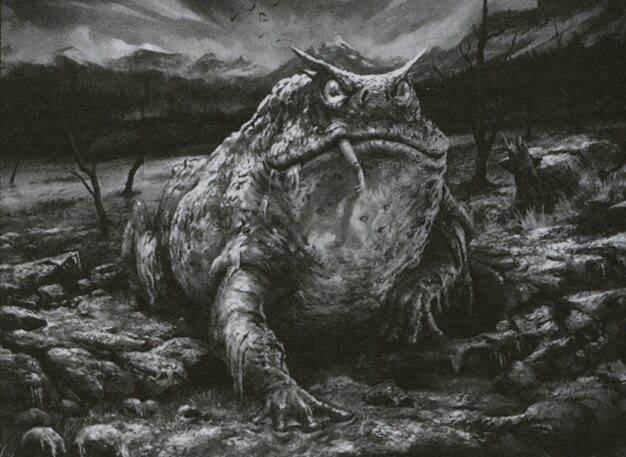
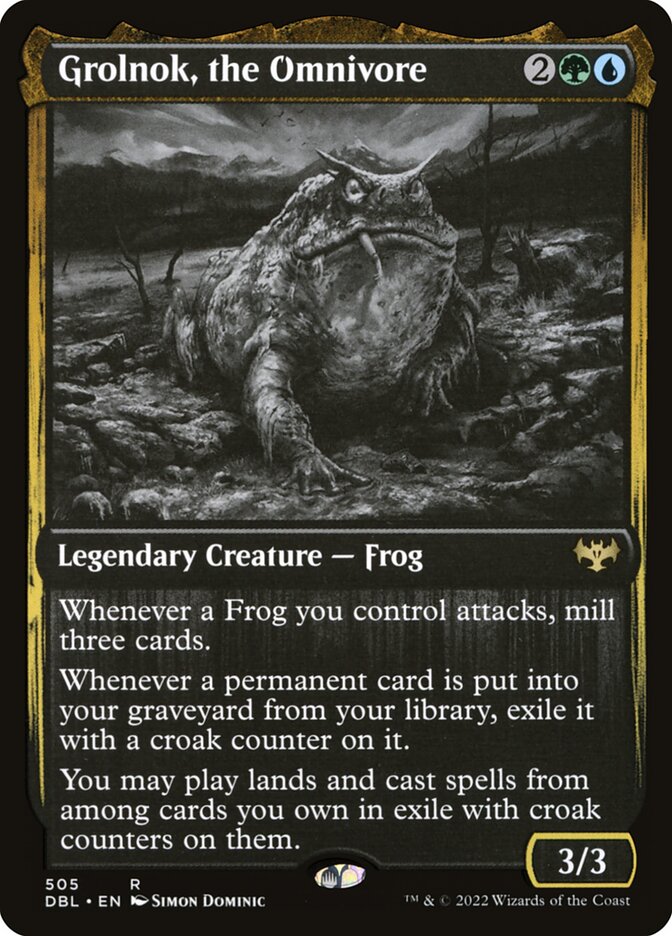
Grolnok, the Omnivore


 Commander
A Simic self-mill engine that turns attacking Frogs into a steady stream of exiled “hand” cards you can play from.
Public decks: 1Bracket: Varies
Card text
Legendary Creature — Frog
Whenever a Frog you control attacks, mill three cards.
Whenever a permanent card is put into your graveyard from your library, exile it with a croak counter on it.
You may play lands and cast spells from among cards you own in exile with croak counters on them.
Building around this commander?
Use MTG Master to build or analyze a Commander deck around this card, check consistency, and find weak spots before your next game.
Overview
- Develop mana and a small board, then start attacking with Frogs to mill and stockpile options in exile with croak counters.
- Leans on self-mill as card access: permanent cards milled from your library get “saved” to exile where you can play them.
- Often plays like a value deck that snowballs once Grolnok sticks and combat becomes safe.
- Can pivot between proactive board development and holding up interaction, depending on table speed.
- Typically closes by converting a huge exiled pool into overwhelming board presence, or by leveraging a deck-out style finisher if you go very deep on mill.
Common lines
- Ramp early, land Grolnok, then take low-risk attacks to start turning mill into playable resources.
- Keep attacks flowing to refill your “croak pile,” prioritizing keeping Grolnok and your Frog count on the table.
- Use interaction to protect the engine turn(s) where you plan to deploy multiple spells from exile.
- After a wipe or removal wave, recast Grolnok and rebuild quickly using the cards you’ve banked in exile.
Strengths
- Strong inevitability once combat triggers are online: self-mill becomes sustained card access rather than pure setup.
- Resilient to conventional discard and many wheel effects since key cards can end up in exile with croak counters.
- Naturally supports a flexible game plan (board development, tempo interaction, or deeper self-mill) based on draws.
- Simic colors give you the tools to ramp and protect a central commander-based engine.
Weaknesses
- Commander-dependent: if Grolnok can’t stick, milling yourself can become risky and low-impact.
- Combat-gated engine: fogs, pillow-fort effects, or clogged boards can slow your primary resource generation.
- Graveyard hate can matter in unexpected ways (e.g., stopping “from graveyard” plans you may include alongside Grolnok).
- Self-mill can backfire if your deck includes key nonpermanents you can’t recover, or if you push too close to empty-library lines without a payoff.
Rule zero notes
- Disclose whether you’re aiming for a dedicated self-mill win (for example, empty-library wins with Jace, Wielder of Mysteries) versus just value.
- Call out how interactive the list is (for example, if you’re on lots of cheap counters like An Offer You Can't Refuse, Arcane Denial, and Counterspell).
- Mention if you’re running big tempo resets (for example, Cyclonic Rift) and how often you expect to leverage them to close.
- Because there’s limited public build data here, it’s worth telling the table if the deck is tuned for speed (fast ramp like Birds of Paradise/Exploration-style starts) or built more casually around Frogs.
Matchups
Best into
- Creature-light pods where small attackers can reliably connect and keep the engine running
- Midrange tables that give you time to accrue incremental advantage and protect a big swing turn
- Decks that rely heavily on hand disruption (your resource pile can live in exile instead)
Struggles against
- Fast combo tables that pressure you before combat-based value matters
- Heavy board-control pods that repeatedly remove your commander or keep combat locked down
- Strategies that consistently punish self-mill or force you to race your own library
FAQ
Is this a graveyard deck or an exile deck?
It often plays closer to an exile-based value engine: Grolnok converts milled permanents into croak-counter cards you can play from exile.
Do I need to attack to get value?
Attacking with Frogs is the cleanest way to start milling, so the deck tends to care a lot about having safe attacks and multiple Frog bodies.
What actually wins the game?
Many builds can win by snowballing board presence off the extra cards you can play from exile; some lists also include a self-mill finisher like Jace, Wielder of Mysteries as an alternate endgame.
How do I avoid milling myself out by accident?
Track your library size and avoid taking unnecessary mill-heavy lines unless you have a clear payoff; having a reshuffle effect like Endurance (as an example) can act as a safety valve.
What kind of interaction fits here?
Cheap protection and tempo plays tend to line up well with an engine commander; examples from the snapshot include An Offer You Can't Refuse, Arcane Denial, and Counterspell.