

Kefnet the Mindful

 Commander
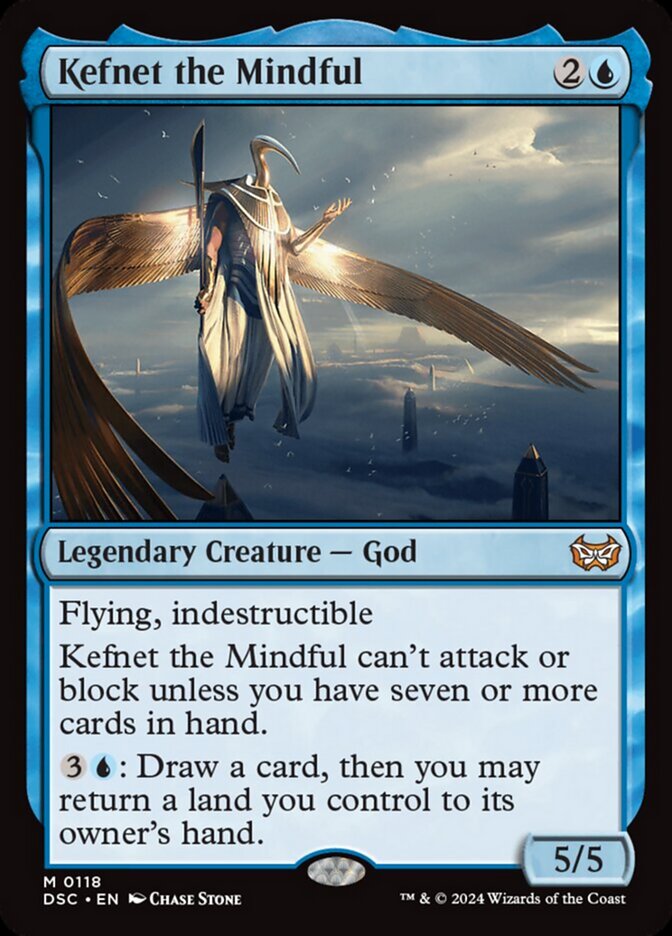
Kefnet the Mindful plays like mono-blue hand-size control, turning an indestructible flier into a real clock once you can consistently stay at seven cards.
Public decks: 1Bracket: 4
Card text
Legendary Creature — God
Flying, indestructible
Kefnet can't attack or block unless you have seven or more cards in hand.
 : Draw a card, then you may return a land you control to its owner's hand.
Overview
- Set up a game where you can keep a full grip while holding up interaction.
- Use Kefnet as a steady mana sink to draw cards, with the land-bounce acting as a built-in way to pace your land drops and protect key lands from sorcery-speed effects.
- Spend the early turns trading resources and sculpting, then turn the corner once Kefnet can attack and block.
- Close games through repeated evasive commander damage backed by countermagic and bounce/tempo plays.
- Often feels like draw-go: you pass with mana up, then convert unused mana into cards at the last safe moment.
Common lines
- Land, pass with mana open; if nothing demands an answer, activate Kefnet on the end step to draw and pick up a land.
- Deploy Kefnet early, then prioritize keeping your hand size high so it can both block and pressure planeswalkers or life totals.
- Stabilize a messy board with a reset effect or big tempo swing, then immediately start connecting in the air while opponents rebuild.
- In tighter games, treat Kefnet as a threat you can commit to the board without exposing yourself to most destroy-based removal.
Strengths
- Indestructible, evasive commander that can be difficult to remove cleanly.
- Built-in card draw gives you something productive to do with open mana.
- Plays strong at interactive tables where passing with mana up is rewarded.
- Naturally pivots from defense to offense once your hand is stocked.
- Commander comes down early and can matter without needing additional pieces.
Weaknesses
- The seven-cards requirement is a real constraint; discard pressure and forced resource exchanges can keep Kefnet offline.
- Exile, sacrifice, and bounce-based answers still line up well into Kefnet despite indestructible.
- The draw activation can be mana-hungry, and the land-bounce can cost tempo if you fall behind on development.
- Mono-blue can struggle to permanently answer resolved artifacts/enchantments without leaning on tempo plays.
- Fast combo pods can punish draw-go openings if you don’t have the right interaction at the right time.
Rule zero notes
- Call out how control-heavy the list is (lots of counterspells/instant-speed interaction vs. a lighter touch).
- If you run big, table-resetting bounce like Cyclonic Rift or Evacuation, mention it up front as it can drastically extend or swing games.
- If your build includes repeatable soft-lock play patterns (for example, recurring a buyback bounce spell like Capsize), make sure the table is okay with that texture of game.
- Clarify your intended win condition: commander-damage pressure vs. a more spell-based finisher.
- Because this commander can play very draw-go, set expectations on pacing (long turns are usually avoidable, but lots of end-step decisions happen).
Matchups
Best into
- Creature-heavy midrange pods that win through combat and board presence.
- Removal-dense metas that skew toward destroy effects over exile/sacrifice.
- Slower, grindy games where incremental cards and an evasive clock decide outcomes.
Struggles against
- Fast combo tables that demand multiple early answers in a row.
- Decks packed with exile, edicts, and other non-destruction removal patterns.
- Heavy discard/hand-attack strategies that keep you below seven cards.
FAQ
How do I reliably turn Kefnet on?
Your game usually revolves around maintaining seven cards by playing at instant speed, trading efficiently, and using Kefnet’s activation as a mana sink when you don’t need to interact.
Why would I ever return a land to my hand?
It’s often a feature, not a bug: you convert spare mana into cards while keeping future land drops flowing, and you can sometimes pick up a land you’d like to replay later.
Is Kefnet a control commander or an aggro commander?
Typically control first, finisher second; you spend the early game answering threats and drawing cards, then win by attacking with an indestructible flier once your grip is full.
What does winning usually look like?
Many builds can close by repeatedly connecting with Kefnet while protecting the lead with countermagic and tempo plays; some lists also lean on big draw spells like Finale of Revelation to bury the table.
What are the scariest answers to Kefnet?
Anything that ignores indestructible—exile, sacrifice effects, or repeated bounce—plus consistent pressure on your hand size that keeps Kefnet from attacking or blocking.