

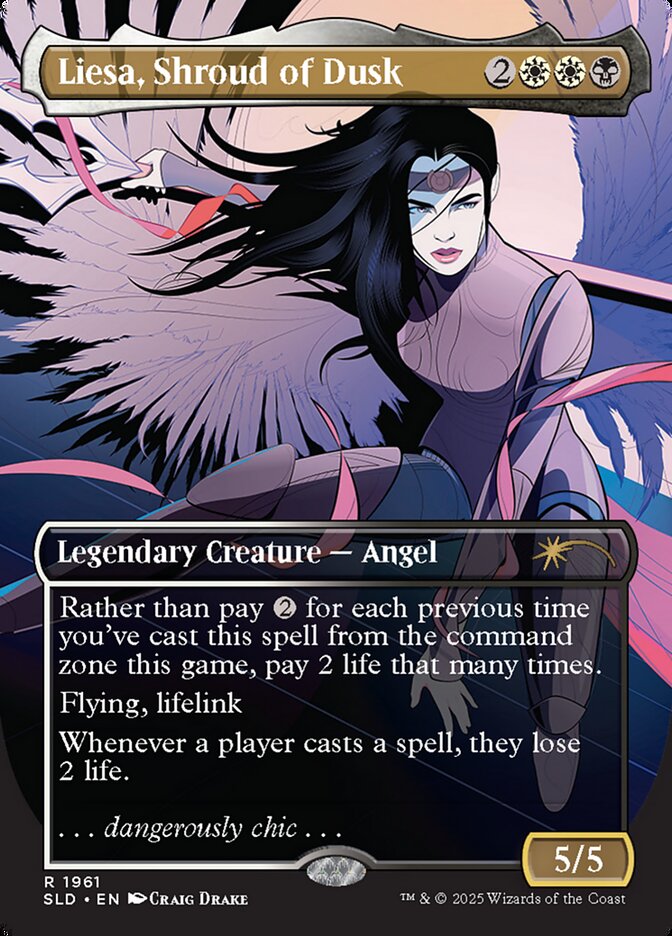
Liesa, Shroud of Dusk


 Commander
A lifelink flyer that punishes spellcasting and can be recast by paying life instead of extra commander tax.
Public decks: 3Bracket: 4
Card text
Legendary Creature — Angel
Rather than pay for each previous time you've cast this spell from the command zone this game, pay 2 life that many times.
Flying, lifelink
Whenever a player casts a spell, they lose 2 life.
Building around this commander?
Use MTG Master to build or analyze a Commander deck around this card, check consistency, and find weak spots before your next game.
Overview
- Punishes each spell cast by making the spell's controller lose life, turning spellcasting into a recurring cost for the table.
- Serves as an evasive lifelink threat that converts damage into life for you while pressuring opponents.
- Can be returned from the command zone multiple times by paying life in place of the escalating mana tax, letting you reuse its trigger and board presence.
- Plays as an attrition/tax-style commander that treats life as a resource to both threaten and sustain board presence.
Common lines
- Cast the commander early to start taxing the table, then follow up with removal or threats to exploit the incremental life loss.
- When you need the commander back, pay life instead of extra mana to recast it and reapply the taxing trigger.
- Use lifegain on damage dealt to offset life payments and maintain a positive life total while pressuring opponents.
Strengths
- Constant table-wide pressure on decks that cast multiple spells by converting spellcasts into life loss.
- Evasive lifelink body that helps you stabilize and benefit from damage dealt.
- Repeatable presence via life-based recasts from the command zone, enabling recurring advantage.
- Plays well with cards or lines that turn life loss or life gain into additional value.
Weaknesses
- Using life as a currency to recast the commander is risky and can accelerate your own defeat if unchecked.
- Vulnerable to removal and exile effects that prevent it from sticking and applying steady pressure.
- The global life-loss is symmetrical and can assist opponents who capitalize on life loss or gain.
- Less effective in pods that win quickly or that don't cast many spells during a game.
Rule zero notes
- Announce how aggressively you plan to use life payments to recast the commander, since paying life repeatedly speeds the game.
- Disclose if your list leans into heavy recursion or mass removal that changes the table's interaction expectations.
- Mention if you plan to include high-density taxing or punishment effects that make casting spells significantly more costly for everyone.
- Be clear whether your plan is to race life totals or to use lifegain defensively, since the global life-loss affects all players.
Matchups
Best into
- Spell-heavy, reactive decks that cast multiple spells each turn.
- Pods where slow attrition and incremental advantages decide games.
- Matchups where gaining steady life translates into longer-term wins.
Struggles against
- Fast combo decks that kill before the tax and attrition add up.
- Creature-stompy lists that win via overwhelming board presence rather than spell play.
- Decks that can cheaply remove or permanently exile the commander repeatedly.
Recent public decks

Staples
Browse all public decksFAQ
How does the commander’s replacement cost for recasting work?
Instead of paying the additional mana each time you recast it from the command zone, you may pay two life per previous recast to return it.
Who loses life from the triggered ability when a spell is cast?
The player who cast the spell loses the life specified by the trigger, so it affects each spell's controller.
Can the life-loss trigger hurt me as well?
Yes, if you cast spells you will be subject to the same life-loss trigger as everyone else.
Should I build around lifegain or life-pay synergies?
Building to offset life payments or to turn life loss into value complements the commander, but repeatedly spending life remains a real risk.
Is this commander effectively a lock or stax piece by itself?
It creates a taxing environment but is not an absolute lock; disclose if you plan to add heavy-stax elements because that changes game feel.