

Oloro, Ageless Ascetic



 Commander
Oloro rewards passive life gain from the command zone, turning steady upkeep triggers into cards and incremental drains when you have mana to spare.
Public decks: 6Bracket: 4

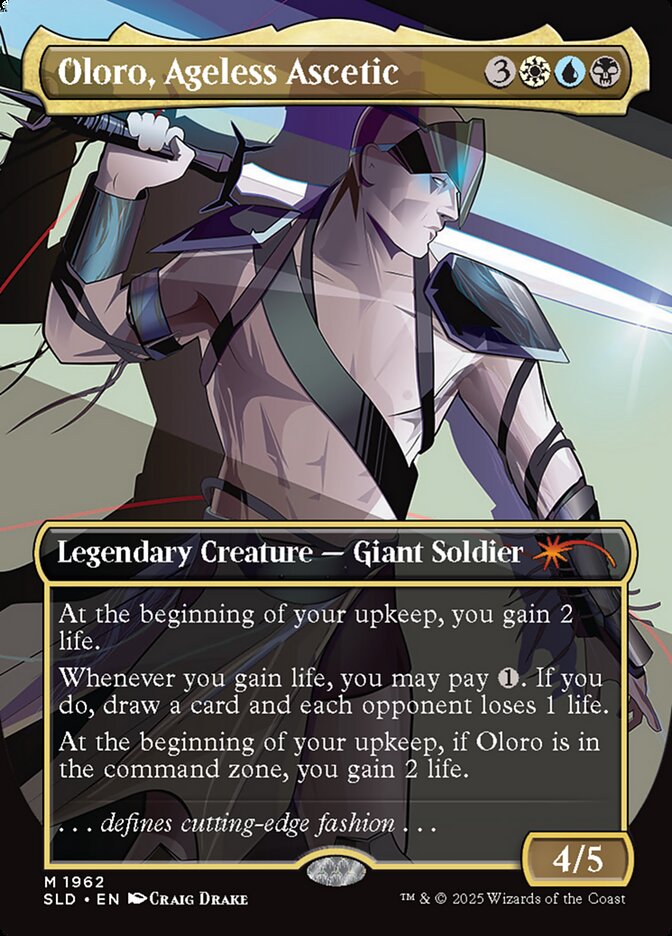
Card text
Legendary Creature — Giant Soldier
At the beginning of your upkeep, you gain 2 life.
Whenever you gain life, you may pay  . If you do, draw a card and each opponent loses 1 life.
At the beginning of your upkeep, if Oloro is in the command zone, you gain 2 life.
Building around this commander?
Use MTG Master to build or analyze a Commander deck around this card, check consistency, and find weak spots before your next game.
Overview
- Start accruing life immediately, even before casting your commander, and use the cushion to stabilize.
- Convert repeated life-gain triggers into value by paying extra mana to draw and drain.
- Play a controlling Esper game: answer key threats, sweep when needed, then take over with engines.
- Close games by scaling life-gain payoffs into a finisher, or by assembling a life-based win line (varies by build).
Common lines
- Use early turns to set up mana and defensive pieces, then spend spare mana on Oloro’s draw-and-drain trigger.
- Stabilize with spot removal and a reset button, then rebuild with persistent value sources.
- Turn a single life-gain event into multiple benefits (cards, drains, counters, or board presence), depending on your payoffs.
- When ahead on life, pivot from defense to a decisive finisher rather than grinding indefinitely.
Strengths
- Consistent baseline value from the command zone that doesn’t require casting Oloro.
- Strong in longer games thanks to repeatable life gain and card access.
- Naturally resilient to chip damage and many combat-focused openings.
- Access to broad Esper interaction (removal, sweepers, and countermagic).
Weaknesses
- Can be mana-hungry if you try to pay for the draw-and-drain trigger often.
- May struggle against fast, noncombat wins if you don’t line up early interaction.
- Life gain alone doesn’t end the game; you need dedicated payoffs to close.
- Graveyard, artifact/enchantment, or combo-centric pods can demand specific answers.
Rule zero notes
- Disclose whether your list includes instant-win combos (some builds use life-based combo pieces like Exquisite Blood).
- Mention if you run prison/tax elements (examples seen include Drannith Magistrate, Authority of the Consuls, and Blind Obedience).
- Call out tutor density if you’re using cards like Demonic Tutor or Enlightened Tutor to find finishers consistently.
- Clarify how controlling the deck is (board wipes like Farewell and free interaction like Deadly Rollick/Flawless Maneuver can raise perceived power).
Matchups
Best into
- Creature-heavy midrange pods that rely on combat damage over time
- Slow value decks where incremental advantage matters
- Removal-light tables that let engines stay in play
Struggles against
- Fast combo pods that try to win before your engines matter
- Heavy tax/land-denial strategies that constrain your spare mana
- Decks that repeatedly shut off life gain or punish card draw
Recent public decks
New Deck
Jun 21, 2026
P
Play2227...
Bracket 5
Life Gain
Apr 10, 2026
P
Play1506...
Bracket 3
Oloro 3
Mar 24, 2026
P
Play6453...
Bracket 3Deck Power 7
Oloro
Mar 23, 2026
P
Play6453...
Bracket 4Deck Power 7.5
Oloro, Life & Death
Oct 5, 2026

Edlimir
Bracket 4Deck Power 8
Oloro, Life & Death Duplicated from Edlimir
Dec 27, 2025

TheBest
Bracket 4Deck Power 7.4
1
Staples
Browse all public decksFAQ
Do I need to cast Oloro to get value?
Not always; you still gain 2 life each upkeep while Oloro is in the command zone. Casting Oloro mainly adds an on-board body and keeps your engine available through commander movement.
How does Oloro actually draw cards?
Whenever you gain life, you may pay 1; if you do, you draw a card and each opponent loses 1 life. The key is having repeatable life-gain triggers and enough spare mana.
Is Oloro a combo commander?
He can be, but it depends on build choices. Some lists include life-based finishers (for example Aetherflux Reservoir or Exquisite Blood), while others play a slower control-and-value plan.
What kinds of win conditions fit Oloro?
Typical directions are large life-drain finishes (for example Exsanguinate), life-to-damage payoffs, or inevitability through repeated draw-and-drain. Choose a plan that matches your table’s speed.
What should I prioritize in opening hands?
Keep hands that develop mana and interact early; Oloro will provide life over time, but you still need to hit land drops and answer fast starts. If your hand already gains life repeatedly, it can turn on your midgame engine sooner.