

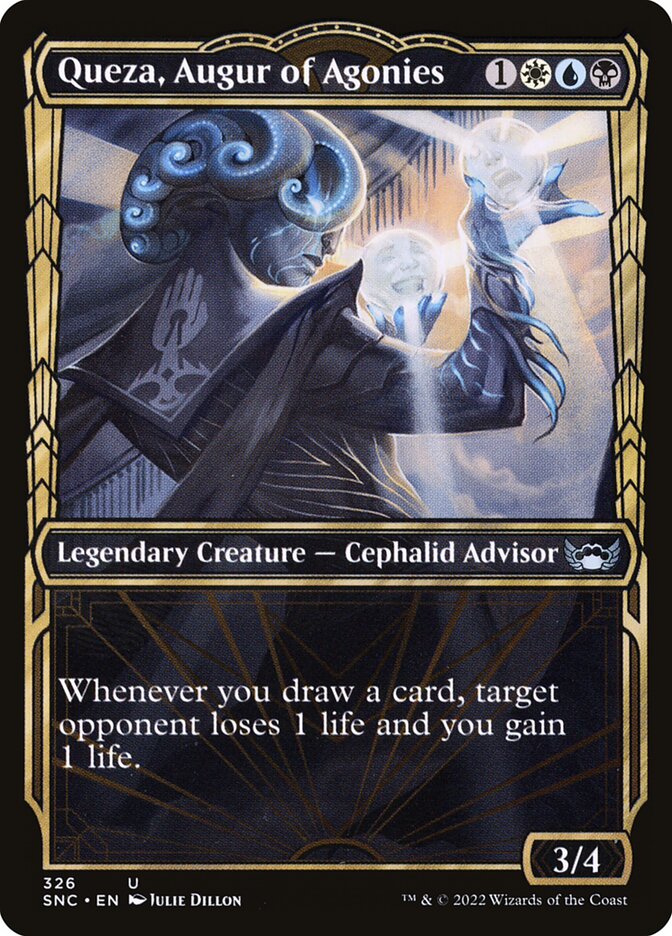
Queza, Augur of Agonies



 CommanderPauper Commander
Esper card-draw control that turns every draw into a small drain engine and eventually a life-total snowball.
Public decks: 3Bracket: 4
Card text
Legendary Creature — Octopus Advisor
Whenever you draw a card, target opponent loses 1 life and you gain 1 life.
Building around this commander?
Use MTG Master to build or analyze a Commander deck around this card, check consistency, and find weak spots before your next game.
Overview
- Queza rewards you for doing what Esper already wants to do: draw extra cards and play a long, interactive game.
- Early turns typically focus on fixing mana, sticking Queza, and keeping the table honest with removal/counters.
- Once Queza is online, incremental draw starts translating into real pressure as each draw becomes drain plus lifegain.
- The deck often pivots from attrition to closing the game via big life-swing turns, deterministic loops, or alternate wins.
- You usually choose targets politically; spreading drains can manage threat perception, while focusing one player can remove a key engine.
Common lines
- Deploy Queza, then chain multiple draw effects in a turn to convert cards into damage and pad your life total.
- Hold up interaction and use the life buffer from Queza triggers to comfortably trade resources in longer games.
- Use tutors to assemble a finisher or protection when you’ve stabilized and can force a win through.
- Leverage lifegain payoffs to turn the midgame into a single big closing turn rather than grinding forever.
Strengths
- Consistent incremental inevitability: normal gameplay (drawing cards) advances your win condition.
- Strong at stabilizing through interaction and lifegain, buying time against pressure.
- Flexible win conditions: can drain, go over the top with a life-based finisher, or use an alternate-win line.
- Good political agency from targeted drains and the ability to choose where pressure goes.
- Access to powerful tutoring and stack interaction (examples include Demonic Tutor, Enlightened Tutor, Mystical Tutor, Counterspell, Dovin's Veto).
Weaknesses
- Relies heavily on the commander; repeated removal or tax effects can slow your clock significantly.
- Can be slow to close if draw engines are disrupted or if you’re forced to play mostly at instant speed.
- Graveyard hate, discard, or hand disruption can blunt the “draw a lot” plan and strip key finishers.
- Life gain doesn’t stop combo kills; you still need to keep mana up and respect fast wins.
- Some builds can create deterministic loops; if your table dislikes that, expectations matter.
Rule zero notes
- Disclose whether you’re running deterministic draw/lifegain loops (for example, Queza with Lich's Mastery can create a repeating draw/drain loop).
- Mention your tutor density and how directly you tutor for win conditions (examples include Demonic Tutor, Enlightened Tutor, Mystical Tutor).
- Call out any alternate-win plans you intend to lean on (for example, Approach of the Second Sun).
- Be clear about how “locky” your slowdown pieces are if you run them (examples include Blind Obedience and Authority of the Consuls).
- Note if you’re packing high-end/free interaction (examples include Fierce Guardianship and Flawless Maneuver).
Matchups
Best into
- Creature-heavy midrange pods where lifegain plus sweepers and spot removal can stabilize.
- Fair, grindy tables where trading resources and incremental advantage matters.
- Boards that struggle to pressure life totals quickly or lack ways to repeatedly answer the commander.
Struggles against
- Fast combo pods that can win through a life buffer and punish tap-out turns.
- Decks with heavy commander suppression (repeat removal, commander tax pressure, or lock pieces).
- Strategies that deny cards (persistent discard/hand attack) or punish drawing.
Recent public decks
Staples
Browse all public decksFAQ
Do I need to build around wheels to make Queza work?
Not necessarily; Queza is happy with any plan that draws extra cards over the course of the game. Burst draw just accelerates the clock and makes your lifegain more relevant.
How does this deck usually win?
It often wins by converting sustained extra draws into enough drain to finish the table, or by setting up a big life-based closing turn. Some versions also lean on alternate-win or loop-based finishes.
Is there an infinite combo here?
It can exist depending on build choices; for example, Queza plus Lich's Mastery can create a repeating draw and drain pattern. If you include that, it’s worth discussing with your pod ahead of time.
How do I protect Queza?
You typically protect it with counterspells and protective effects, and sometimes with enchantment-style protection (examples include Diplomatic Immunity and Greater Auramancy). Timing matters: landing Queza with mana up is often safer than curving it out.
What’s the biggest mistake when piloting Queza?
Tapping out too often once you’re ahead; your life total can cushion mistakes, but it won’t save you from a clean combo kill. Also, over-targeting one opponent early can turn the table against you.