

Sauron, Lord of the Rings



 Commander
A big Grixis commander that rewards you for casting it with a huge tempo swing: build an Orc Army, stock the graveyard, and reanimate a creature immediately.
Public decks: 4Bracket: 3

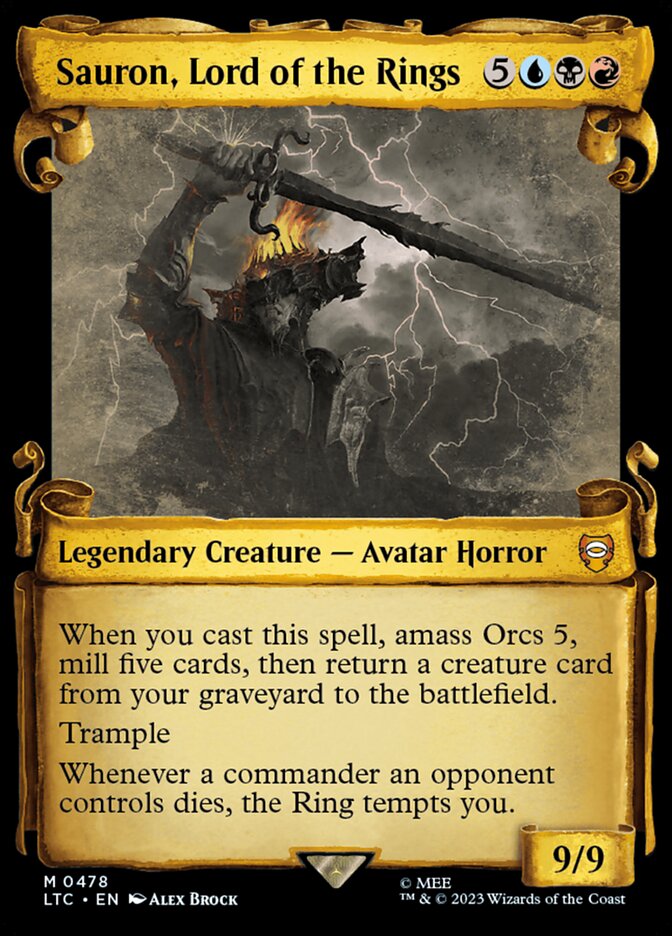
Card text
Legendary Creature — Avatar Horror
When you cast this spell, amass Orcs 5, mill five cards, then return a creature card from your graveyard to the battlefield.
Trample
Whenever a commander an opponent controls dies, the Ring tempts you.
Building around this commander?
Use MTG Master to build or analyze a Commander deck around this card, check consistency, and find weak spots before your next game.
Overview
- Plays like a top-end value engine: the cast trigger creates a board, fuels the graveyard, and reanimates in one package.
- Often aims to stabilize the midgame with removal and setup, then land Sauron as a turning point.
- The amass line naturally supports a single large threat plan (backed by trample) that can pressure life totals and planeswalkers.
- The mill plus reanimation pushes you toward a creature-centric build that can leverage ETB/death value.
- The Ring tempting triggers incidentally as opposing commanders die, giving you extra incentives to interact and trade.
Common lines
- Trade resources early, then cast Sauron to rebuild: make a sizable Army, fill the yard, and put a creature straight onto the battlefield.
- Use the reanimated creature to immediately generate value or stabilize the board, then pivot into attacking with a large trampling threat.
- Hold up interaction for opposing commanders; when one dies, you can get repeated Ring tempting triggers over the course of the game.
Strengths
- Huge on-cast swing that can recover from removal and board stalls.
- Naturally accrues multiple resources at once (board presence, graveyard setup, and reanimation).
- Creature-focused midrange plans get extra payoff from the built-in mill and reanimate.
- Can punish commander-centric tables by benefiting when opposing commanders die.
- Trample plus a tall Army threat can convert advantage into real damage.
Weaknesses
- Expensive mana cost means the deck can be slow to turn the corner without good setup.
- Highly sensitive to being countered or otherwise prevented from resolving the cast plan at key moments.
- Graveyard reliance can be disrupted by common graveyard hate, blanking part of the cast trigger.
- Often ends up committing a lot into one large creature, which can be vulnerable to exile or bounce.
- If you fall behind on mana development, recasting can be difficult.
Rule zero notes
- This commander tends to be a late-game haymaker; clarify whether your list is slower value or built to accelerate into it quickly.
- Mention how reliant your build is on graveyard reanimation so opponents know what kind of interaction matters.
- If your deck leans into frequent commander-killing and removal to farm Ring tempting triggers, flag that play pattern up front.
Matchups
Best into
- Grindy midrange pods where a single big cast trigger can swing the game back.
- Creature-heavy tables where combat and trading are frequent.
- Commander-centric metas where opposing commanders routinely die.
Struggles against
- Fast combo pods that can win before an eight-mana commander matters.
- Heavy countermagic/control tables that can stop your key cast turn.
- Pods packing lots of graveyard hate and exile-based interaction.
Recent public decks


Staples
Browse all public decksFAQ
What is Sauron, Lord of the Rings trying to do?
Typically it aims to make one big momentum play by casting Sauron: you get an Orc Army, stock the graveyard, and reanimate a creature in the same turn.
Does the first ability trigger if Sauron is countered?
Yes, it triggers when you cast the spell, so you still amass, mill, and reanimate even if Sauron doesn’t resolve.
How does the deck usually win?
It often wins by turning the cast-trigger advantage into repeated pressure: attacking with a large trampling threat and leveraging reanimated creatures to keep the board ahead.
What kind of cards tend to matter most with this commander?
Creature quality and graveyard synergy matter a lot, since you mill cards and immediately bring back a creature when you cast Sauron.
How important is killing opposing commanders?
It can be relevant over a long game, since each opposing commander death can trigger the Ring tempting you, but it’s usually a bonus rather than the whole plan.