

Sephiroth, Fabled SOLDIER // Sephiroth, One-Winged Angel

 Commander
A mono-black sacrifice-and-death-triggers commander that turns expendable creatures into cards, drains the table over time, and can snowball hard once it transforms.
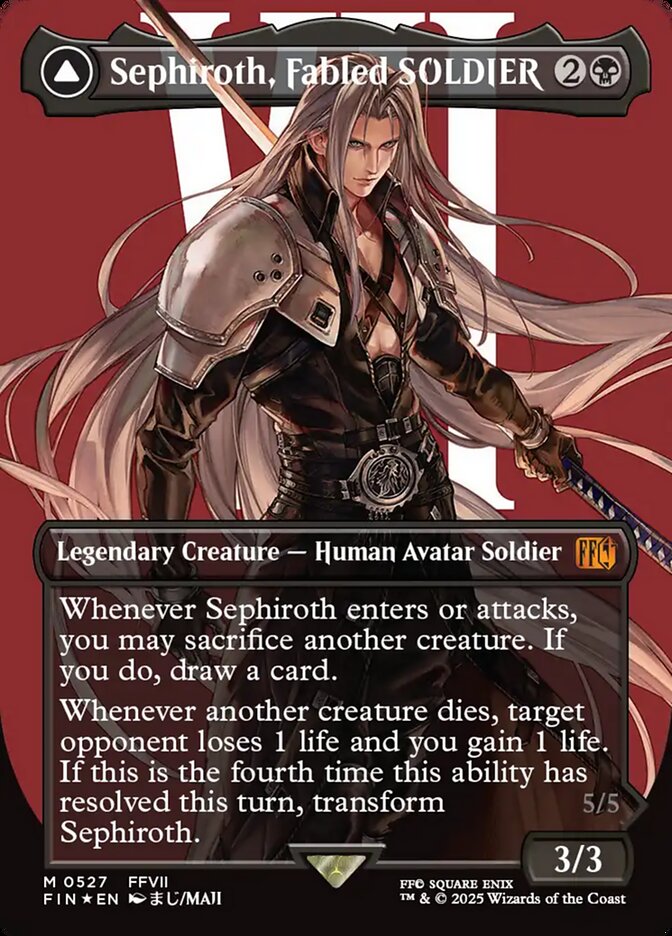
Card text
Whenever Sephiroth enters or attacks, you may sacrifice another creature. If you do, draw a card.
Whenever another creature dies, target opponent loses 1 life and you gain 1 life. If this is the fourth time this ability has resolved this turn, transform Sephiroth.
//
Flying
Super Nova — As this creature transforms into Sephiroth, One-Winged Angel, you get an emblem with "Whenever a creature dies, target opponent loses 1 life and you gain 1 life."
Whenever Sephiroth attacks, you may sacrifice any number of other creatures. If you do, draw that many cards.
Building around this commander?
Use MTG Master to build or analyze a Commander deck around this card, check consistency, and find weak spots before your next game.
Overview
- Wants a steady stream of disposable creatures to sacrifice on Sephiroth’s enter/attack trigger for incremental card advantage.
- Leans into constant creature death to drain opponents and pad your life total, setting up a midgame inevitability engine.
- Often plays like an attrition deck early: trade resources, keep boards small, and let death triggers do the work.
- Transforms after enough death-trigger resolutions in a single turn, then becomes a massive card-draw engine on attack by sacrificing any number of creatures.
- Typically closes by converting a big sacrifice turn into overwhelming life-drain, a huge hand, and/or a decisive combat step in the following turns.
Common lines
- Deploy fodder creatures and a sac outlet, then cast Sephiroth and immediately cash in a creature on ETB for a card.
- Attack with Sephiroth when you can safely connect; sacrifice a creature to draw while your death triggers chip away at life totals.
- Engineer a turn with multiple deaths to hit the transform threshold, then ride the emblem-style drain as ongoing reach.
- After transforming, set up a “big swing” turn: attack, sacrifice a pile of creatures to draw deep, then use the new hand to keep the engine going.
Strengths
- Built-in card advantage tied to attacking and sacrificing, which keeps you stocked through long games.
- Strong inevitability against creature decks thanks to repeatable death-trigger drain and the post-transform emblem effect.
- Life gain from the drain trigger can buy time and help you leverage life-as-a-resource lines.
- Scales well with token makers and recursive creatures, letting small bodies become real value.
Weaknesses
- Relies on having creatures to sacrifice; stumble on fodder and Sephiroth can feel like a fragile value piece rather than a plan.
- Commander-centric turns can be disrupted by removal or fog-style effects that stop attacks from mattering.
- Mono-black interaction can struggle with certain permanent types; you may have to lean on a narrow suite for problem enchantments.
- Graveyard hate and exile-based removal can blunt recursion lines and reduce your ability to chain deaths in one turn.
- Can draw a lot of attention once you’re close to transforming or once the emblem is online.
Rule zero notes
- This commander can generate large amounts of card draw and life-drain off creature deaths, especially after transforming.
- Some builds may include strong board-control pieces that punish opposing creatures dying or being sacrificed (for example, Grave Pact as a one-card direction).
- Depending on construction, the deck can include tutor density and combo-ish mana engines (for example, Diabolic Intent/Beseech the Queen and Ashnod's Altar).
- Games can slow down into an attrition loop if you repeatedly force sacrifices and keep boards low.
Matchups
Best into
- Creature-heavy midrange pods where lots of bodies die naturally and combat trades happen.
- Slower tables that give you time to assemble fodder, sac outlets, and a profitable transform turn.
- Decks that try to win through board presence rather than stack-based protection
Struggles against
- Fast combo tables that end the game before your death-engine matters.
- Heavy graveyard-hate pods that shut off recursive fodder and death-chaining.
- Control shells packed with instant-speed interaction that can pick off Sephiroth or key enablers at the critical moment