
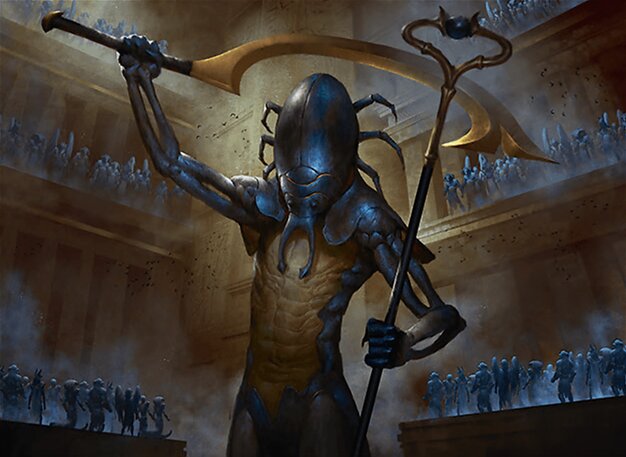
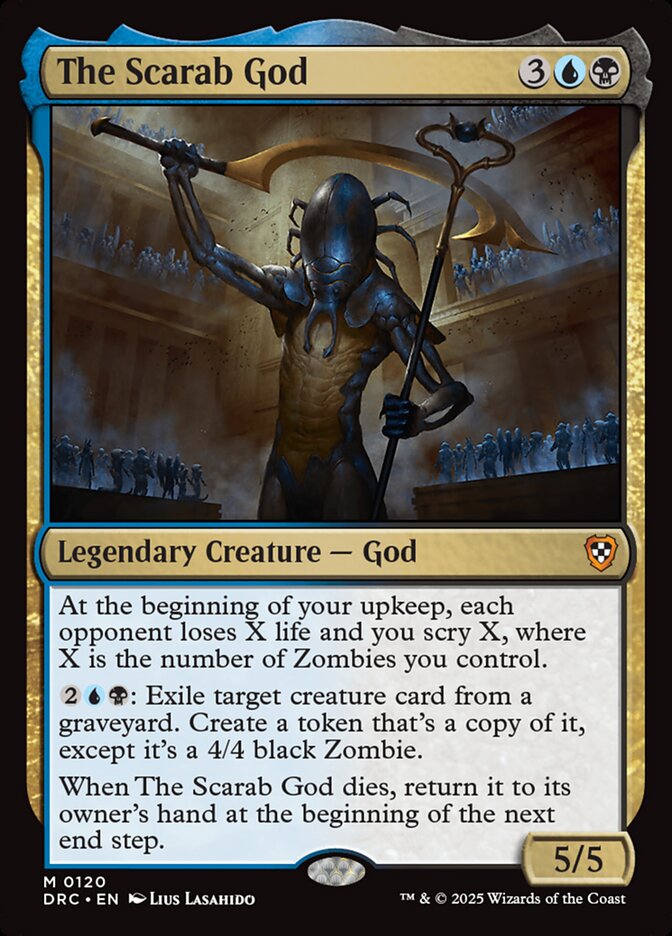
The Scarab God



A Dimir value engine that turns graveyards into a steady stream of 4/4 Zombies while draining the table over time.
Public decks: 1Bracket: 2
Overview
- Leans on repeatable reanimation from any graveyard to build a board without overcommitting cards from hand.
- Upkeep trigger rewards you for maintaining a Zombie count, converting tokens into life drain plus selection via scry.
- Often plays like a midrange-control deck: stabilize early, then take over with mana-efficient activations and resilient threats.
- Prefers longer games where graveyards fill up and you can keep mana open for interaction and end-step activations.
- Closes by snowballing Zombie count into unavoidable drains, or by copying high-impact creatures out of graveyards to win combat.
Common lines
- Develop mana, then land The Scarab God and start holding up {2}{U}{B} to threaten a 4/4 Zombie copy at instant speed.
- Trade resources early with removal/counters, then convert the best creature in any graveyard into your threat while denying opponents recursion.
- Build a small Zombie board, then let repeated upkeeps drain and scry you into more interaction or a finishing push.
- Use sacrifice and death-trigger payoffs to make chump blocks and token trades convert into extra reach.
Strengths
- Excellent inevitability in grindy pods: repeatable graveyard access plus an upkeep drain that scales.
- Resilient commander loop: dying returns it to hand, making it harder to permanently answer with spot removal.
- Plays well at instant speed, letting you represent both interaction and end-step board development.
- Naturally attacks opposing graveyard plans by exiling key creatures as part of your game plan.
- Flexible win patterns: combat pressure, incremental drain, and value reanimation all point toward closing games.
Weaknesses
- Graveyard hate and exile-based interaction can significantly reduce the commander’s ceiling.
- Mana-hungry engine: repeated {2}{U}{B} activations can be slow if your ramp gets checked.
- Can struggle to end games quickly without access to quality creature targets or a wide enough Zombie count.
- Table politics can turn against you once opponents realize you can steal the best creature out of any graveyard at instant speed.
- Token-based plans can be vulnerable to sweepers that reset your Zombie count before an upkeep.
Rule zero notes
- Disclose whether your list is primarily Zombie-tribal, aristocrats-leaning, or more control/value reanimator, since gameplay and speed can differ a lot.
- Call out any oppressive sacrifice-tax elements if you’re using cards like Dictate of Erebos (example from the snapshot), as it can lock creature decks out of developing.
- Be upfront that the commander can repeatedly exile creatures from any graveyard and make 4/4 Zombie copies, which can feel like “stealing” wins via opponents’ threats.
- Mention your interaction density if you’re packing multiple counterspells (examples shown include Counterspell and Force of Negation).
- If you have deterministic loops with sacrifice outlets and death-drain pieces (examples shown include Carrion Feeder and Blood Artist), clarify whether you’re aiming for combos or just value.
Matchups
Best into
- Creature-heavy midrange pods where graveyards naturally fill with good targets
- Removal-heavy games where a resilient commander and repeatable value matter
- Grindy battlecruiser tables that give you time to accumulate Zombies and scry into answers
Struggles against
- Pods with heavy graveyard hate or frequent exile effects
- Fast combo tables that end the game before your engine online
- Decks that repeatedly wipe tokens and keep the board empty
FAQ
How does The Scarab God usually win?
It typically wins by snowballing a Zombie count to amplify the upkeep drain and by repeatedly copying the best creatures in graveyards to take over combat.
Do I need to be all-in on Zombies?
Not necessarily; Zombies amplify the upkeep trigger, but the commander’s reanimation ability can carry games even if your creature suite is more value-oriented.
What should I copy with the activated ability?
Prioritize creatures that generate immediate value or swing combat, especially ones that are hard for opponents to answer profitably once they become 4/4 Zombies.
Is the deck more control or more graveyard midrange?
It can be either; the snapshot includes interaction like Arcane Denial and Counterspell alongside graveyard setup like Entomb and Buried Alive, which supports a midrange-control posture.
What’s the biggest thing to play around?
Graveyard hate and exile-based answers are the main pressure points, since they can cut off your best targets and keep your Zombie count from snowballing.