

The Ur-Dragon





 Commander
A five-color Dragon tribal commander that rewards you for casting Dragons and snowballing combat into cards and free permanents.
Public decks: 9Bracket: Varies

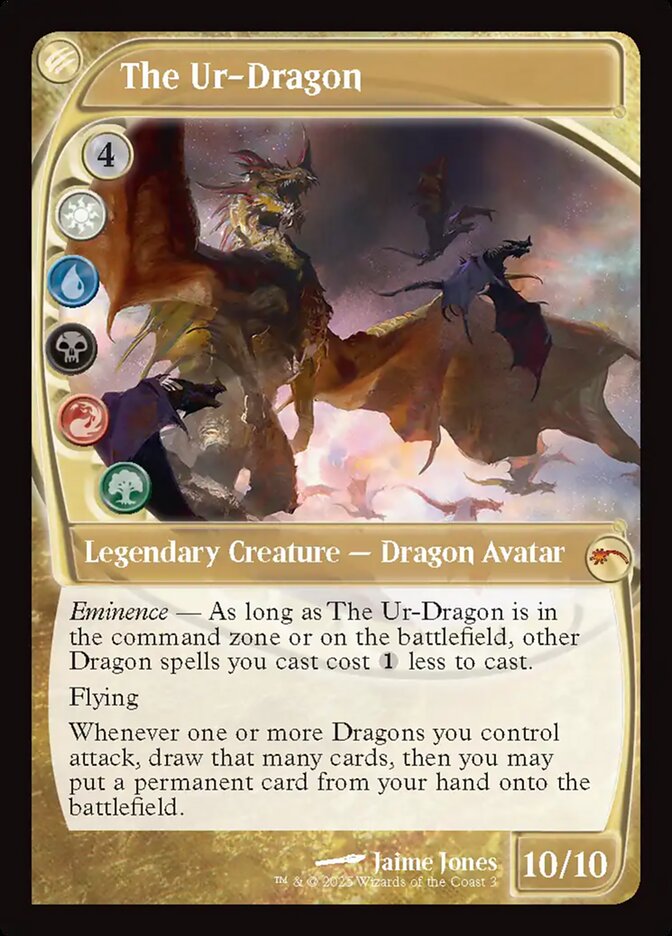
Card text
Legendary Creature — Dragon Avatar
Eminence — As long as The Ur-Dragon is in the command zone or on the battlefield, other Dragon spells you cast cost  less to cast.
Flying
Whenever one or more Dragons you control attack, draw that many cards, then you may put a permanent card from your hand onto the battlefield.
Building around this commander?
Use MTG Master to build or analyze a Commander deck around this card, check consistency, and find weak spots before your next game.
Overview
- Leans into a high Dragon count, with Eminence smoothing the curve by discounting your Dragon spells from the command zone.
- Typically plays a ramp-and-deploy game early, aiming to start attacking with multiple Dragons to turn combat into a huge card advantage engine.
- Attack triggers scale with the number of Dragons you swing with, so the deck often pivots from "stabilize" to "overwhelm" quickly once a board sticks.
- The attack trigger can convert the cards you draw into immediate board presence by dropping a permanent from hand mid-combat.
- The commander itself is expensive, so many games can function before it’s cast, with the commander arriving as a finisher and value multiplier.
Common lines
- Ramp and fix colors early, then start deploying Dragons at a discounted rate from Eminence.
- Build to a critical mass of Dragons, then turn a single attack into multiple cards and a burst of tempo by putting a permanent into play.
- Use your growing hand size to keep making land drops and redeploy after interaction, then re-establish attack pressure.
- Cast The Ur-Dragon once you can protect it or immediately benefit from combat, treating it as a payoff rather than a necessity.
Strengths
- Strong inevitability: repeated Dragon attacks can bury the table in cards and board advantage.
- Eminence makes your main creature type easier to deploy even when the commander is uncastable or answered.
- Threat density tends to be high, letting you pressure life totals while also accruing value.
- Can pivot between beating down and out-valuing slower tables once the attack engine is online.
Weaknesses
- Mana demands are real: five colors plus many expensive spells can lead to slow starts without solid fixing.
- Reliant on combat to fully turn on the commander’s payoff; fogs, pillow-fort effects, and clogged boards can blunt momentum.
- Wide board wipes and repeated removal can reset your Dragon count and reduce the impact of attack triggers.
- The commander’s high mana cost can make recasting difficult if it gets removed multiple times.
Rule zero notes
- Power level can swing widely depending on how much fast mana, tutoring, and combo finishing you include.
- The core plan is combat-driven and snowbally; disclose if you’re built to end games quickly versus play a longer battlecruiser style.
- Let the table know how interactive your list is (lots of removal/counters vs mostly big threats).
- Eminence provides value from the command zone; some tables may want a heads-up if they dislike command-zone advantages.
Matchups
Best into
- Slower midrange pods where combat connects and games go long enough for value engines to take over.
- Tables light on sweepers, where building a multi-Dragon board is more likely to stick.
- Matchups where opponents rely on incremental value rather than fast, deterministic wins.
Struggles against
- Fast combo pods that can win before you assemble attackers and start drawing a lot of cards.
- Heavy-control tables with frequent sweepers and spot removal that keep your Dragon count low.
- Pillow-fort or fog-heavy strategies that prevent profitable attacks and stall your primary engine.
Recent public decks
New Deck
Sep 8, 2026
S
Sombraca...
Bracket 3
New Deck
Aug 17, 2026
S
Spiessy
Bracket 3
New Deck
Aug 11, 2026

Gershu
Bracket 3
Ur Dragon
Jun 29, 2026

Lion
Bracket 4Deck Power 6.9
New Deck
Jun 9, 2026
P
Play6538...
Bracket 5
Ur-Dragon
May 14, 2026
A
Abomy
Bracket 5
Draconic Disaster
Apr 1, 2026
P
Play5085...
Bracket 1
The Ur-Dragon
Mar 22, 2026
P
Play5814...
Bracket 4
New Deck
Feb 11, 2026
Y
Yin
Bracket 3Deck Power 6.8
Staples
Browse all public decksFAQ
Do I need to cast The Ur-Dragon every game?
Often no; Eminence already discounts your Dragons, and the deck can function by curving out threats. Casting The Ur-Dragon tends to be best when you can convert an attack into immediate cards and a free permanent.
How does the attack trigger scale?
You draw a card for each Dragon that attacks, so going wide with multiple Dragons is usually more important than making one huge attacker. The more Dragons you swing with, the more the trigger takes over the game.
What kind of permanent should I put onto the battlefield with the trigger?
It depends on the spot, but you’ll typically want something that changes the board immediately—either more pressure, stabilization, or a key engine piece. Since it comes from hand, planning your combat with what you can drop matters.
What’s the deck’s main win condition?
Most builds win by overwhelming combat damage with Dragons while drawing enough cards to keep threats flowing. The commander’s triggers can also create a runaway advantage that makes it hard for opponents to catch up.
What’s the biggest risk to the game plan?
Getting set back by sweepers and not being able to rebuild a multi-Dragon board quickly. Anything that prevents attacks from connecting can also shut off your primary card-advantage engine.