
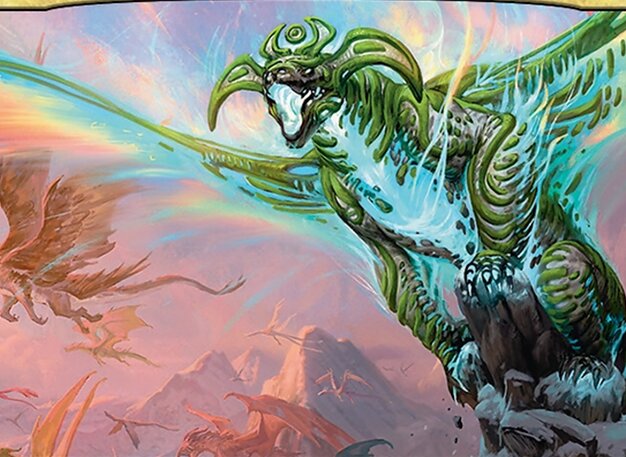
Ureni of the Unwritten



 Commander
A top-of-library toolbox commander that looks at the top eight cards to cheat Dragon creatures into play on entry or attack.
Public decks: 4Bracket: Varies

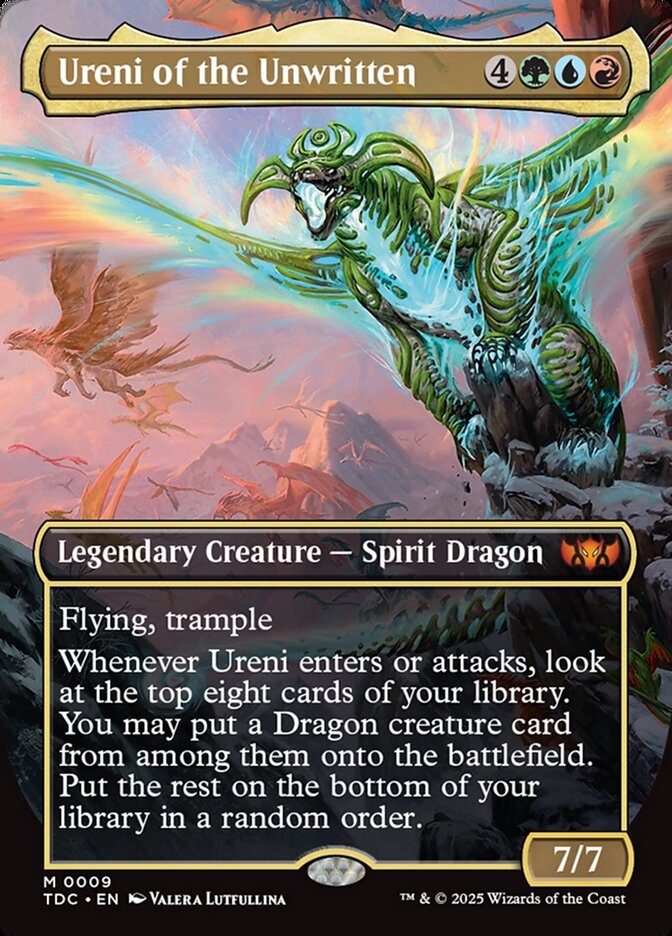
Card text
Legendary Creature — Spirit Dragon
Flying, trample
Whenever Ureni enters or attacks, look at the top eight cards of your library. You may put a Dragon creature card from among them onto the battlefield. Put the rest on the bottom of your library in a random order.
Building around this commander?
Use MTG Master to build or analyze a Commander deck around this card, check consistency, and find weak spots before your next game.
Overview
- Uses its enter and attack triggers to dig the top eight cards and put a Dragon creature from among them onto the battlefield.
- Plans usually revolve around assembling enough ramp and setup to cast the commander and maximize trigger frequency.
- Deck construction tends to prioritize Dragon creature density and ways to consistently see or manipulate the top of the library.
- Games can be swingy: big creatures appear suddenly and change board states quickly when triggers resolve.
Common lines
- Cast the commander, look at the top eight cards, and put a Dragon creature from among them onto the battlefield if available.
- Attack with the commander to repeat the top-eight check and potentially cheat another Dragon into play.
- Use ramp and top-deck manipulation to increase the chance of hitting Dragon creatures in the top eight.
- Follow up cheated Dragons with combat support or protection to convert board presence into damage.
Strengths
- Can generate sudden, high-impact board presence by cheating large Dragon creatures into play.
- Repeated attack triggers create ongoing threat generation rather than a single one-off effect.
- Top-eight selection offers a larger sample size than single-card digs, improving odds of finding Dragons.
- Flexible builds can lean into ramp, combat support, or supplemental value engines.
Weaknesses
- Performance depends on having enough Dragon creature targets in the deck and hitting them in the top eight.
- High commander casting cost can make initial setup slow and vulnerable to disruption.
- Opponents can focus removal on the commander or the cheated Dragons to interrupt the plan.
- Not inherently built for heavy interaction or prisoner-style stax without intentional card choices.
Rule zero notes
- This profile is based on a single public list; any named cards are examples only from that list.
- Disclose to the table that the deck tends to cheat large creatures into play and can produce sudden damage swings.
- Mention whether the build you bring is heavy on big creatures or includes significant interaction and removal.
- If your build includes protection or mass-damage effects, say so so opponents can assess answers and board impact.
Matchups
Best into
- Midrange or value decks that struggle to answer sudden large creatures quickly.
- Pods that lack consistent early removal or instant-speed ways to disrupt repeated enter/attack triggers.
Struggles against
- Fast combo decks that can end the game before the commander can be cast and trigger repeatedly.
- Heavy disruption or mass-removal decks that can repeatedly strip the cheated Dragons or lock the commander out of attacking.
Recent public decks
Staples
Browse all public decksFAQ
How does the commander find Dragons?
It looks at the top eight cards of your library on entry and attack and may put a Dragon creature from among them onto the battlefield.
Do I need a lot of Dragons in the deck?
You typically want a healthy density of Dragon creatures to improve your chances when the top-eight check happens.
Is the commander easy to kill or disrupt?
The commander can be a removal target because its attacks and entries drive the deck's main engine, so protection or alternate value is helpful.
What are good supporting card types to include?
Ramp to cast the commander reliably, top-deck manipulation or scry effects, and combat support or protection are common supportive roles.
Are the cards listed in the snapshot required?
No, the named cards are examples drawn from the single public list and are not required; build choices can vary.