
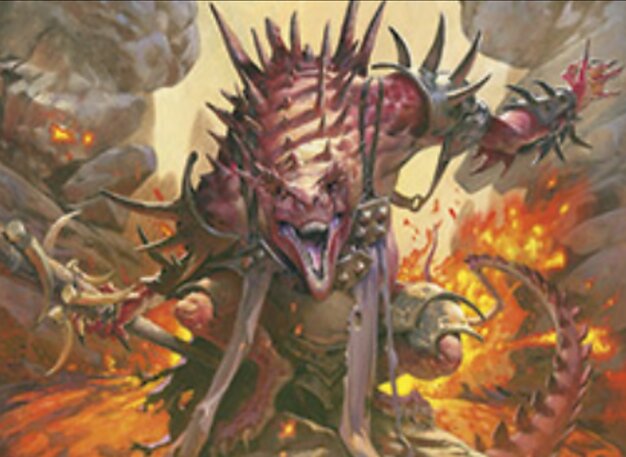
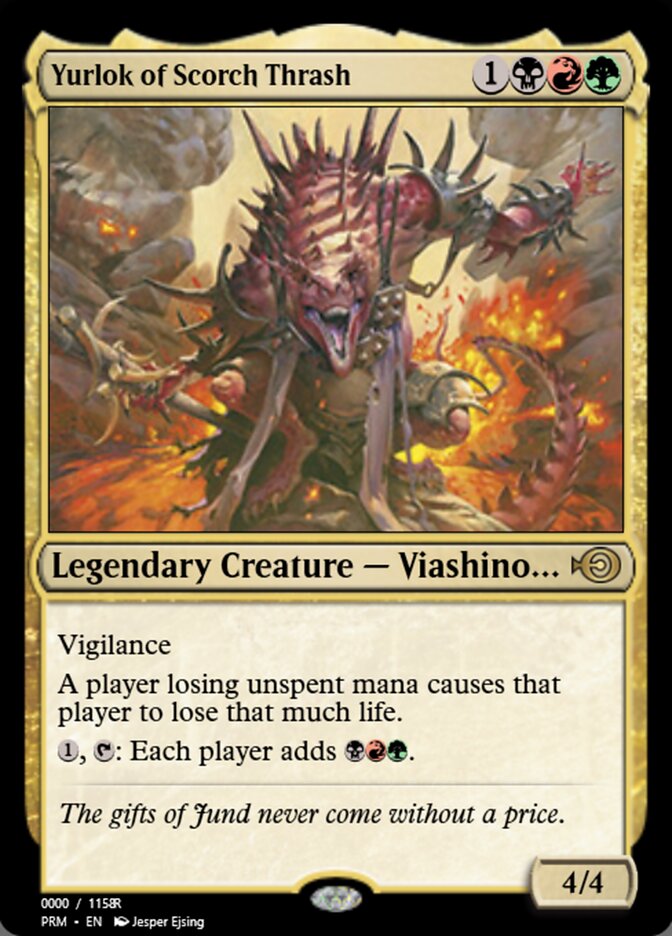
Yurlok of Scorch Thrash



 Commander
Yurlok of Scorch Thrash turns shared mana into a liability, pressuring the table with mana burn-style life loss and big-mana finishers.
Public decks: 1Bracket: 1
Card text
Legendary Creature — Lizard Shaman
Vigilance
A player losing unspent mana causes that player to lose that much life.
,  : Each player adds .
Building around this commander?
Use MTG Master to build or analyze a Commander deck around this card, check consistency, and find weak spots before your next game.
Overview
- Plays a political game early: you can give everyone {B}{R}{G}, then punish whoever can’t cleanly spend it.
- Leans into “too much mana” dynamics, where opponents are incentivized to cast into awkward windows or take damage for floating mana.
- Often pivots from table-warping resource acceleration into a direct kill via large X-spells and life-drain effects.
- Wants protection and untap access for Yurlok so the mana trigger is available at the moments that matter.
- Typically uses Jund interaction to keep scary engines off the table while your pressure accumulates.
Common lines
- Deploy Yurlok, then activate on end steps or in response to spells to force uncomfortable spending decisions.
- Pair global mana acceleration (example: Heartbeat of Spring, Dictate of Karametra, Eladamri's Vineyard) with mana-punishment (example: Citadel of Pain) to convert “help” into damage.
- Bank or convert excess mana when needed (example: Horizon Stone, Leyline Tyrant) while opponents still get punished for letting mana evaporate.
- Stabilize with sweepers and flexible removal (example: Blasphemous Act, Assassin's Trophy, Beast Within, Chaos Warp), then close with a single large payoff (example: Exsanguinate, Crackle with Power, Comet Storm, Lavalanche).
Strengths
- Unique pressure angle: life totals get taxed by resource management, not just combat.
- Strong political leverage: you can “help” the table while steering who gets burned and when.
- Scales well into multiplayer since the effect hits each player independently.
- Jund colors give broad answers to permanents and boards.
- Has clean big-mana outlets to end games once you’ve inflated resources.
Weaknesses
- Commander-dependent: removing or shutting off Yurlok can defang the deck’s main plan.
- Can feed opponents: extra mana may enable faster wins for other decks if you can’t capitalize immediately.
- Struggles against decks that consistently spend mana efficiently at instant speed or convert mana into non-loss resources.
- Life-total pressure can draw table attention quickly, especially after a few activations.
- Timing-sensitive: activating at the wrong time can give opponents perfect mana for interaction or combos.
Rule zero notes
- Call out that the deck can function like a group-slug/punisher list rather than pure ramp.
- Mention whether you run multiple global mana doublers (examples include Heartbeat of Spring or Dictate of Karametra), since that can accelerate the whole table.
- Be clear if you’re aiming for big X-spell finishes (examples include Exsanguinate or Crackle with Power).
- Discuss how oppressive you intend the “mana punishment” pieces to be (example: Citadel of Pain), especially for slower pods.
- Let the table know how interactive your build is, since extra mana can change threat assessment quickly.
Matchups
Best into
- Tap-out midrange pods that can’t reliably dump mana at instant speed
- Greedy curve decks that routinely leave mana open and pass
- Creature-heavy tables where sweepers plus mana pressure buy you time
Struggles against
- Decks with lots of instant-speed sinks and interaction that can always spend the mana
- Fast combo strategies that happily accept extra mana to win earlier
- Resource-conversion engines that negate the downside of floating mana

FAQ
Is this a group hug commander?
It can look like one because you give everyone mana, but the deck usually plays closer to group slug: the “gift” is designed to hurt if it isn’t spent cleanly.
How do Yurlok games usually end?
Many builds close by turning the inflated mana into one big finisher (for example, an X-burn or X-drain spell) once life totals are pressured.
When should I activate Yurlok?
Often on end steps or during tight stack fights, where players can’t efficiently spend three extra mana without making bad choices.
What happens if opponents just spend all the mana?
Then the incidental damage is lower, so you generally pivot to using the acceleration to power your own payoffs and interaction faster than the table.
Do I need ways to keep my own mana from burning me?
It helps; having ways to bank or convert extra mana can keep you from getting caught by your own effects while you set up a winning turn.