
How to Build an Artifacts Commander Deck: Synergies, Engines, and Ways to Win
By MTG Master EditorialPublished Updated 23 min read
There's something I really enjoy about artifact decks in Commander.
You start with a couple of mana rocks, maybe a small artifact creature, and something that creates a Thopter token.
Nothing particularly threatening.
Then you play another artifact, draw a card, generate some mana, create two more tokens, sacrifice one of them, and bring something back from your graveyard.
Suddenly, all those little pieces have turned into a machine that generates an enormous amount of value.
And your opponents are wondering when exactly things got so dangerous.
That's what makes artifact decks interesting to me. You're not necessarily relying on enormous creatures or spectacular spells. You're building a collection of cards that interact with each other, often in ways that aren't immediately obvious.
A simple one-mana artifact can become a mana source, a sacrifice target, a card-draw engine, or even part of your win condition.
But there's also a problem with artifact decks.
It's very easy to find fifty interesting artifacts and convince yourself that all of them belong in your deck.
I've done that with plenty of Commander strategies.
The difficult part isn't finding good cards. It's choosing the ones that actually work together.
Let's look at how I'd approach building an Artifacts Commander deck, which commanders are worth considering, and how to avoid spending fifteen minutes generating resources without having any idea how to win.
What Exactly Is an Artifacts Commander Deck?
An artifact deck is a strategy built around playing artifacts and taking advantage of their interactions.
That might sound extremely broad, and it is.
Artifacts are one of the most flexible card types in Magic.
Some produce mana. Others draw cards, create creatures, copy permanents, remove threats, or allow you to sacrifice and recover resources.
And because many artifacts are colorless, they can fit into different Commander decks.
But having ten mana rocks and a few powerful Equipment cards doesn't automatically make a deck an artifact strategy.
The difference is that in an artifact deck, the artifacts themselves are part of your main engine.
Imagine you control these three cards:
Sai, Master Thopterist
Reckless Fireweaver
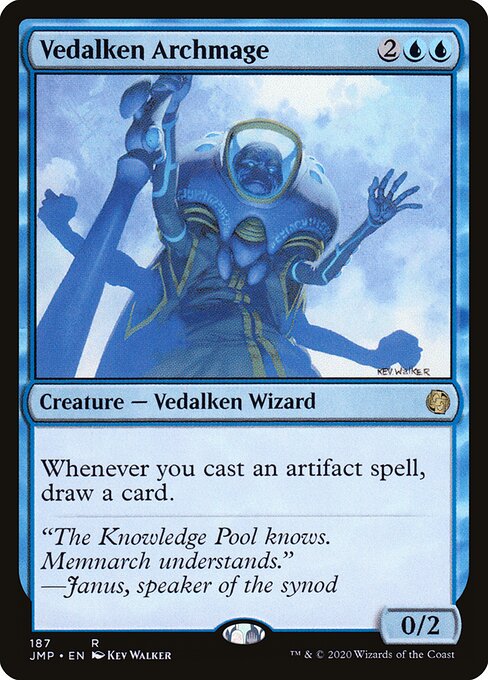
Vedalken Archmage
Now you cast a cheap artifact spell.
Sai creates a 1/1 Thopter artifact creature token with flying.
Reckless Fireweaver triggers when the artifact spell resolves and enters the battlefield, and also when the Thopter token enters, dealing a total of 2 damage to each opponent from those two entries.
And because you're increasing the number of artifacts you control, your future cards with affinity for artifacts can become cheaper.
Vedalken Archmage also triggers when you cast the artifact, drawing a card even if that artifact spell is later countered.
You've played a simple artifact, created a creature, drawn a card, dealt damage, and potentially made future spells more efficient.
That's what makes the strategy interesting.
One card can contribute to several parts of the deck.
Of course, there's an important distinction between casting an artifact and creating an artifact token. We'll get to that later.
Choosing Your Artifacts Commander
Your commander has a huge influence on how the deck plays.
Some commanders generate mana from artifacts. Others reward you for casting them, creating tokens, sacrificing artifacts, or recovering them from the graveyard.
And unlike some archetypes, artifact decks can work in many different color combinations.
Urza, Lord High Artificer: Turn Everything Into Mana
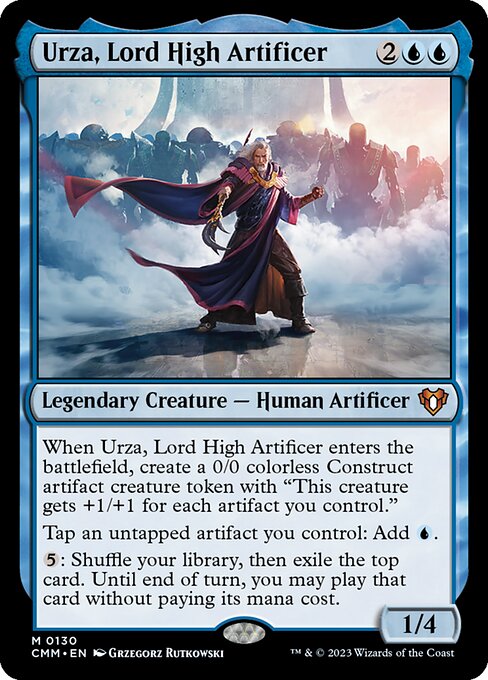
Urza, Lord High Artificer is one of the most powerful examples of an artifact commander.
When he enters the battlefield, he creates a Construct artifact creature token that gets +1/+1 for each artifact you control.
That Construct can become surprisingly large.
But Urza's most interesting ability is the one that lets you tap an untapped artifact you control to generate one blue mana.
Suddenly, artifacts that normally don't produce mana become mana sources.
A Treasure token can generate blue mana without being sacrificed.
An Equipment can help produce mana even when it isn't equipped.
And your artifact creature tokens can contribute to the engine too.
This tap cost belongs to Urza's ability and does not use the artifact's {T} symbol. Even a newly entered artifact creature can pay it.
That's incredibly useful.
Urza also has an activated ability that gives you access to additional cards, making him much more than a simple mana generator.
What I like about Urza is that almost every artifact you play can contribute to the strategy.
The downside is that he's powerful enough to attract attention immediately.
If your group plays more casual Commander, I'd think carefully about how optimized you want to make the deck.
Urza can become a very powerful combo commander.
Breya, Etherium Shaper: Artifacts as Resources
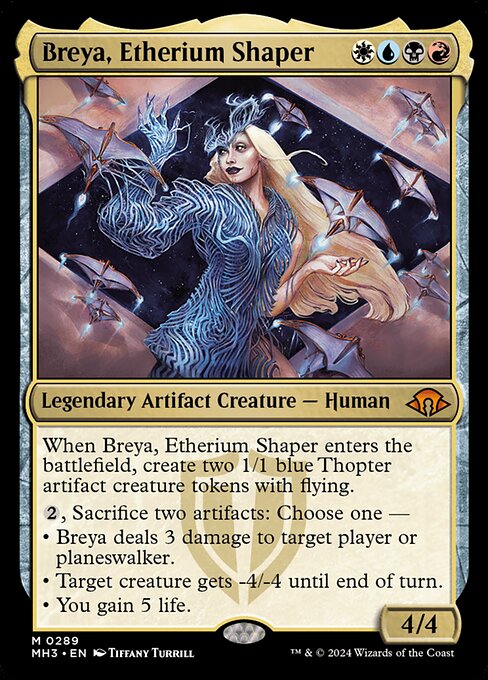
Breya, Etherium Shaper takes a different approach.
When she enters the battlefield, she creates two 1/1 Thopter artifact creature tokens with flying.
Then, by paying two mana and sacrificing two artifacts, she can deal damage, weaken a creature, or gain life.
What makes Breya interesting is that almost any artifact can become a resource for her ability.
You can sacrifice Thopters, Treasures, Clues, or other artifacts you no longer need.
And because she has a four-color identity, you have access to an enormous variety of artifact synergies.
I like Breya because she combines token generation, sacrifice, and interaction in one commander.
You don't necessarily need to build around one specific combo.
You can create artifacts, use them for value, recover them, and gradually gain control of the game.
The drawback is the mana base.
Four colors give you flexibility, but they also make the deck more complicated and potentially more expensive.
Osgir, the Reconstructor: Your Graveyard Is a Workshop
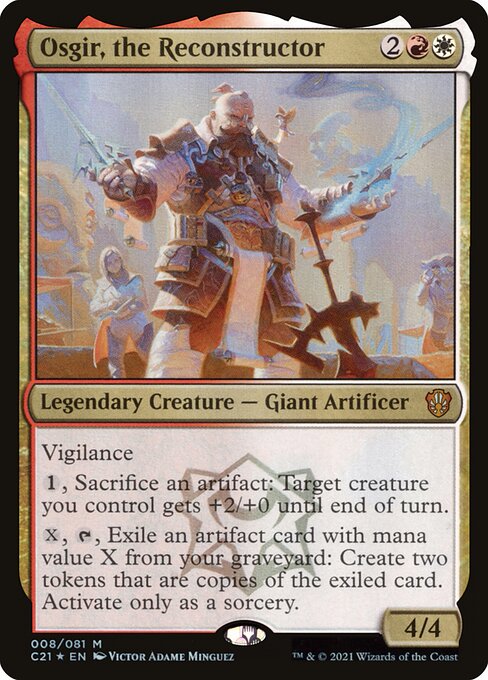
Osgir, the Reconstructor is one of my favorite examples of an artifact commander with a clear identity.
He lets you sacrifice artifacts for a temporary power boost, and his second ability can exile an artifact card from your graveyard to create two token copies of it.
That's a fantastic way to turn used artifacts into new resources.
Imagine you have Sol Ring in your graveyard.
With Osgir's second ability, you can pay one mana, tap Osgir, exile Sol Ring from your graveyard, and create two token copies of it.
You've turned a destroyed mana rock into two new ones.
Of course, Osgir can only activate that ability at sorcery speed, and the artifact card you exile needs to have a mana value matching the X you pay.
But the possibilities are enormous.
You can copy utility artifacts, mana rocks, or artifact creatures with useful abilities.
I particularly like this approach because sacrificing artifacts doesn't necessarily mean losing them forever.
Sometimes it's simply part of the plan.
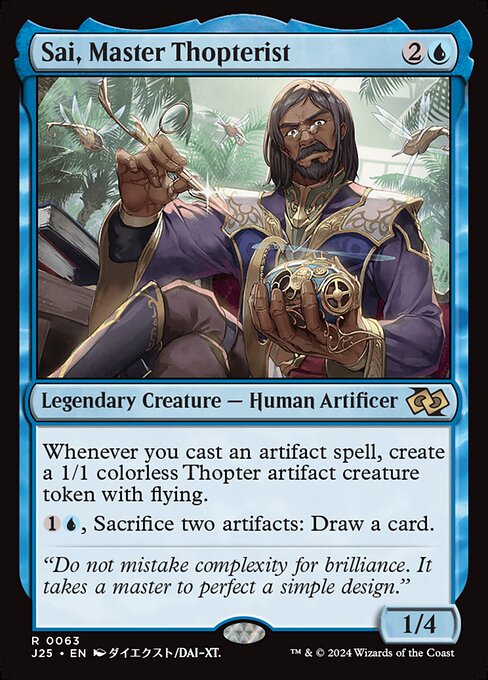
Sai, Master Thopterist: Artifacts Become an Army
Sai, Master Thopterist is an excellent choice if you enjoy artifact tokens.
Whenever you cast an artifact spell, Sai creates a 1/1 Thopter artifact creature token with flying.
He can also sacrifice two artifacts to draw a card, provided you pay the activation cost.
That gives you a very straightforward engine.
You cast artifacts, create Thopters, and use those artifacts for combat or card advantage.
I like Sai because the commander gives you both a way to develop your battlefield and a way to turn excess resources into cards.
And because he's mono-blue, your mana base can be relatively simple.
The important thing is keeping enough artifact spells available.
Sai rewards casting artifact spells, not simply creating artifact tokens.
If you're building around him, that distinction matters.
Emry, Lurker of the Loch: Artifacts That Keep Coming Back
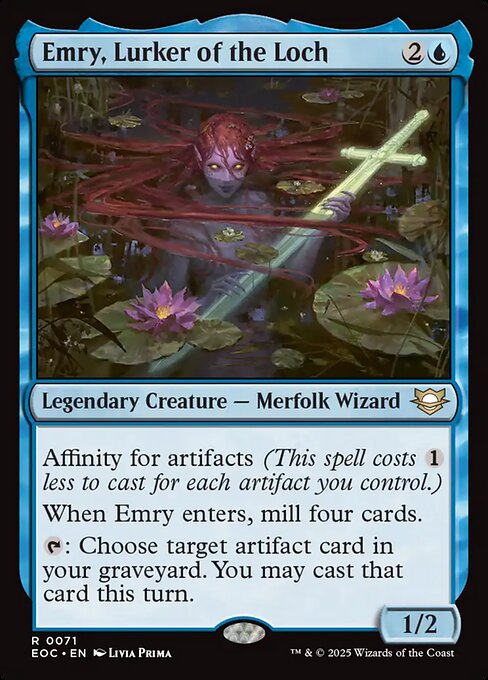
Emry, Lurker of the Loch is another excellent mono-blue option.
She becomes cheaper to cast depending on the number of artifacts you control.
When she enters the battlefield, you mill four cards.
And her activated ability lets you choose an artifact card in your graveyard and cast it that turn.
I particularly like Emry because she turns your graveyard into another resource.
An artifact that gets destroyed might still be useful later.
A cheap utility artifact can be cast again after it goes to the graveyard.
And cards that sacrifice themselves become especially interesting when you can reuse them.
But remember that Emry lets you cast the selected artifact card. She doesn't automatically put it onto the battlefield for free.
You still need to pay its costs unless another effect changes that.
Normal timing rules still apply, and artifact lands cannot be cast with this ability.
And, of course, graveyard hate can interfere with your plans.
Cheap Artifacts Are Often More Important Than Expensive Ones
One of the biggest mistakes I'd avoid when building an artifact deck is filling it with expensive, impressive cards.
There are plenty of spectacular artifacts in Magic.
Huge artifact creatures, powerful engines, legendary artifacts with complicated abilities...
And they're tempting.
But many artifact strategies become powerful because they can play several inexpensive artifacts during the same turn.
Cards like Sol Ring, Mind Stone, Ichor Wellspring, and Chromatic Star can contribute to different parts of your strategy.
Some generate mana.
Others draw cards, replace themselves, or become useful sacrifice targets.
And if your commander rewards you for casting artifacts, even a simple one-mana artifact can provide additional value.
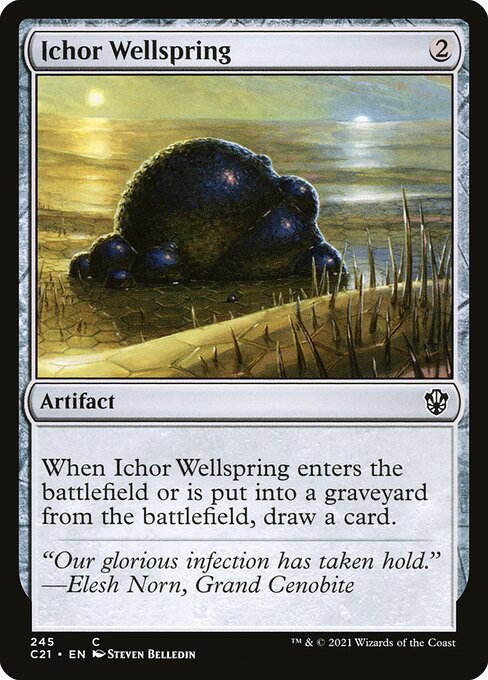
For example, Ichor Wellspring draws a card when it enters the battlefield and another when it goes from the battlefield to the graveyard.
In a deck with sacrifice effects and artifact recursion, that's much more interesting than it first appears.
I like artifacts that accomplish something useful immediately and can still contribute later.
But don't fill your deck with cheap artifacts simply because they're cheap.
They need a purpose.
An artifact that costs zero mana but doesn't contribute to your actual strategy is still using one of your 99 deck slots.
Artifact Tokens: Much More Than Little Creatures
When people think about artifact tokens, Thopters are probably one of the first things that come to mind.
And they're fantastic.
Small flying creatures that can attack, block, be sacrificed, or contribute to your artifact count.
But artifact tokens are much more than Thopters.
Treasures, Clues, Food, Blood tokens, and various artifact creature tokens can all support artifact strategies.
And depending on your commander, each type offers different possibilities.
Treasures: Mana Now or Resources Later
Treasure tokens are particularly useful because they can fix your mana and help pay for important spells.
But in an artifact deck, they can also contribute to effects that care about the number of artifacts you control.
For example, an artifact-counting creature may become larger while you have several Treasures on the battlefield.
And a card that rewards artifacts entering can trigger whenever you create a Treasure.
Sometimes keeping a Treasure instead of sacrificing it immediately is actually the better decision.
Of course, if you need the mana, use it.
A Treasure sitting on the battlefield isn't helping much if you're losing the game because you refused to spend it.
Clues and Food: Resources You Can Reuse
Clues let you spend mana and sacrifice them to draw cards.
Food tokens provide life gain.
Neither sounds particularly spectacular by itself.
But when your deck rewards artifacts entering, leaving the battlefield, or being sacrificed, those tokens can become part of larger engines.
You might create a Clue, trigger an artifact payoff, sacrifice it for a card, and then benefit from another effect that cares about artifacts going to the graveyard.
That's the sort of interaction I enjoy.
A simple utility token becomes part of several different systems.
Thopters, Constructs, and Other Artifact Creatures
Artifact creature tokens provide a different kind of value.
They count as both artifacts and creatures.
That means they can benefit from effects that care about either type.
A Thopter can help you attack through the air, increase your artifact count, and become a sacrifice target.
Construct tokens that grow according to the number of artifacts you control can become enormous.
And sometimes a battlefield full of little artifact creatures is enough to win through combat.
I particularly like token strategies that can do more than one thing.
You don't always have to choose between building an army and building an artifact engine.
Sometimes they're the same strategy.
Card Draw: Keep the Machine Running
Artifact decks can burn through their hands surprisingly quickly.
You play a mana rock, a cheap artifact, another artifact, and perhaps a creature that rewards those cards.
Suddenly, you've developed your battlefield but only have one card left.
And if your opponents remove your engine, rebuilding becomes difficult.
That's why card advantage matters so much.
Thoughtcast and Thought Monitor are excellent examples of cards that become more efficient when you control several artifacts.
Both have affinity for artifacts, reducing the generic mana required to cast them.
Thoughtcast draws two cards.
Thought Monitor is also an artifact creature with flying and draws two cards when it enters the battlefield.
Mystic Forge is another interesting option because it can let you cast artifact spells and colorless nonland cards from the top of your library.
And cards like Skullclamp can be particularly useful if you're generating lots of small artifact creature tokens.
I like having several independent sources of card advantage.
Not every draw engine needs to be an artifact, but in a dedicated artifact deck, it's nice when your card-draw effects also contribute to your main strategy.
Affinity, Improvise, and Cost Reduction
This is an area where artifact decks can become surprisingly explosive.
Some cards become cheaper based on the number of artifacts you control.
Others let you tap artifacts to help pay for spells.
And some reduce the costs of artifact spells directly.
But these effects aren't identical.
Affinity for Artifacts
Affinity for artifacts reduces the generic mana cost of a spell by one for each artifact you control.
For example, Thoughtcast normally costs four generic mana and one blue mana.
If you control four artifacts, affinity reduces the generic portion to zero.
You can cast Thoughtcast for one blue mana.
That's excellent.
But affinity doesn't remove colored mana requirements.
And simply having lots of artifacts doesn't mean every card in your deck becomes cheaper.
Only cards with the appropriate ability benefit.
Improvise
Improvise works differently.
It lets you tap untapped artifacts to help pay the generic mana portion of a spell's cost.
Cards like Whir of Invention use this mechanic.
It's particularly useful when you have artifact tokens or other artifacts that aren't doing much during the turn.
But remember that tapping an artifact with improvise isn't the same as generating mana.
You're using it to help pay the cost of that particular spell.
Even newly entered artifact creatures can help pay with improvise. But an artifact you already tapped for mana cannot also pay with improvise for that same spell.
Reducing Artifact Spell Costs
Cards like Etherium Sculptor and Foundry Inspector can reduce the generic mana cost of artifact spells.
These effects can make it much easier to cast several artifacts during the same turn.
And if your deck rewards you for casting artifacts, those reductions become even more valuable.
But I'd be careful.
Reducing costs is fantastic when you have cards to cast.
If your hand is empty, having three cost reducers on the battlefield doesn't accomplish very much.
That's why cost reduction and card draw work so well together.
Sacrificing Artifacts: Sometimes Breaking Things Is the Plan
One of the most interesting directions for artifact decks is sacrifice.
Normally, sacrificing a permanent means losing a resource.
But in the right artifact deck, sacrificing something can be exactly what you want.
Krark-Clan Ironworks lets you sacrifice artifacts to generate colorless mana.
Trading Post can sacrifice an artifact to draw a card, or sacrifice a creature to return an artifact card from your graveyard to your hand, using its separate activated abilities.
And Goblin Welder can exchange an artifact on the battlefield with an artifact card in a graveyard, provided the targets and other requirements are satisfied.
These cards can create very powerful engines.
Imagine you have Ichor Wellspring on the battlefield and a way to sacrifice it.
You draw a card when Wellspring enters.
Then you sacrifice it and draw another card.
If you have a way to return it to the battlefield or cast it again, you can repeat the process.
And if your deck also rewards artifacts going to the graveyard, the interaction becomes even more useful.
This is why I think artifact sacrifice decks are particularly interesting.
You aren't simply trying to keep every permanent alive.
Sometimes destroying or sacrificing your own artifacts is how you make progress.
Artifact Recursion: Your Graveyard Is Full of Spare Parts
Artifact decks have access to some excellent ways to recover resources.
Emry, Lurker of the Loch, Goblin Engineer, Myr Retriever, and Scrap Trawler are good examples.
They work differently, but all can help you make use of artifact cards in your graveyard.
Myr Retriever returns another artifact card from your graveyard to your hand when it dies.
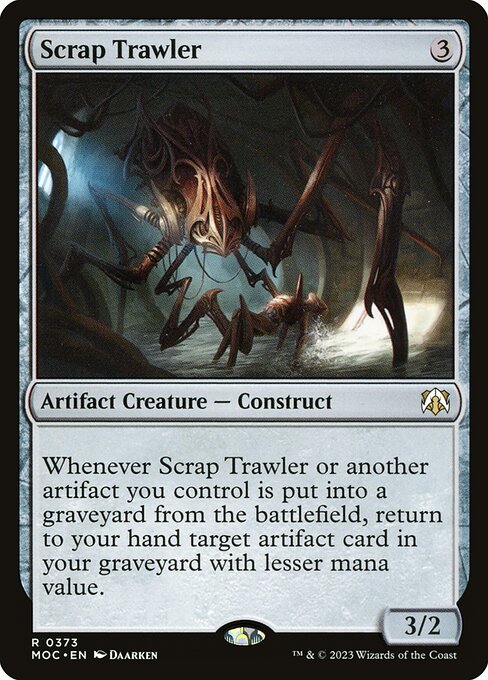
Scrap Trawler can return an artifact card with a lower mana value from your graveyard to your hand when an artifact you control goes to the graveyard from the battlefield.
And Goblin Engineer can help put an artifact into your graveyard and later exchange a small artifact on the battlefield for an artifact card with mana value three or less.
These effects make artifact strategies more resilient.
If somebody destroys one of your important artifacts, you may be able to recover it.
And if you're deliberately sacrificing artifacts, those recursion effects can become part of your main engine.
But there's a risk.
Graveyard hate can interrupt the entire system.
A card like Rest in Peace can make artifact recursion much more difficult.
That's why I wouldn't build every artifact deck around the assumption that the graveyard will always be available.
Some decks should be able to win through combat, tokens, or other engines even when their recursion is disrupted.
Protecting Your Artifacts
Here's the unpleasant part.
Artifact decks can be extremely vulnerable to certain removal spells.
You spend several turns building a beautiful machine.
Mana rocks, utility artifacts, token generators, card-draw engines...
Everything is working.
Then somebody casts an overloaded Vandalblast.
And all your artifacts disappear.
That's a painful experience.
Cards like Bane of Progress can be even worse in the right circumstances, especially if your deck also uses enchantments.
And effects such as Farewell can exile artifacts entirely, preventing normal graveyard recursion.
So I'd think about protection before filling every slot with artifact synergies.
Padeem, Consul of Innovation can give your artifacts hexproof.
Darksteel Forge makes your artifacts indestructible.
And depending on your colors, cards like Heroic Intervention or Teferi's Protection can help protect your battlefield.
But none of those cards solves every problem.
Indestructible doesn't stop exile.
Hexproof doesn't prevent a board wipe that doesn't target.
And expensive protection pieces can be awkward to draw when you're already behind.
Personally, I like combining some protection with the ability to recover after losing important artifacts.
Sometimes you won't be able to save everything.
Being able to rebuild is just as important.
How Many Artifacts Should You Play?
This depends heavily on your commander.
A Sai deck that rewards casting artifact spells needs a different structure from an Osgir deck focused on recursion.
And a Breya deck that creates and sacrifices artifacts has different priorities from a Urza deck that turns artifacts into mana.
But in a dedicated artifact deck, I'd generally want a fairly high artifact count.
Something around 25–35 artifact cards among the 99 can be a useful starting point, and some strategies will want considerably more.
That includes artifact creatures, mana rocks, Equipment, and other artifact types.
Artifact lands also count as artifacts while on the battlefield, although including them can expose part of your mana base to artifact removal.
Token generators can increase your artifact count during games without requiring every card in your deck to be an artifact.
But I wouldn't chase a number just for the sake of it.
A card still needs to accomplish something useful.
You also need lands, interaction, protection, card advantage, and ways to win.
The advantage is that artifacts can perform many of those jobs.
A mana rock contributes to ramp and artifact synergies.
An artifact creature can help with combat and card advantage.
And an artifact token can become mana, a blocker, or sacrifice material.
I prefer cards that perform several useful roles over cards that simply increase the artifact count.
How Does an Artifacts Commander Deck Actually Win?
This is probably the most important question to answer before finishing the deck.
Because artifact decks are very good at creating engines.
Sometimes too good.
You can generate enormous amounts of mana, create artifacts, sacrifice them, recover them, and repeat the process.
But eventually you need to convert all that value into a victory.
Fortunately, artifacts offer several different ways to do that.
Win With Artifact Creatures
This is one of the most straightforward approaches.
You create artifact creature tokens, build a powerful battlefield, and eventually attack.
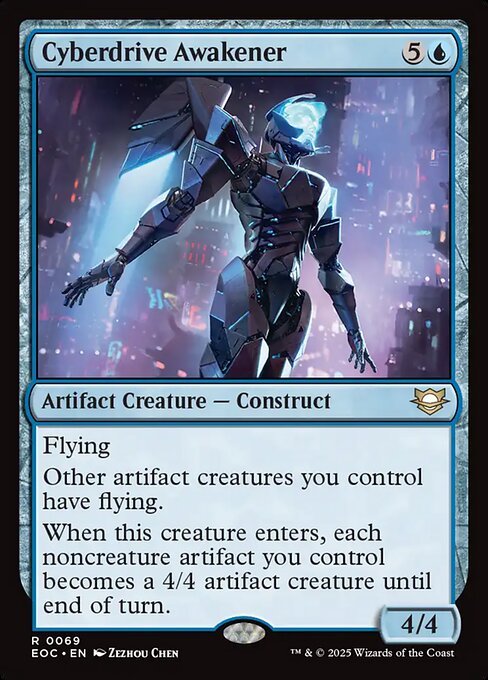
Cards like Cyberdrive Awakener can turn your noncreature artifacts into flying 4/4 artifact creatures for a turn, creating the potential for a very dangerous attack.
Urza, Lord High Artificer can create enormous Constructs as your artifact count grows.
And Nettlecyst can give a creature a huge power and toughness boost based on how many artifacts and enchantments you control.
I like this approach because your artifacts already contribute to the strategy before becoming attackers.
Those mana rocks and utility artifacts can suddenly become part of your finishing plan.
Win Through Artifacts Entering the Battlefield
Reckless Fireweaver is one of the simplest examples.
Whenever an artifact enters the battlefield under your control, Fireweaver deals 1 damage to each opponent.
Imagine creating ten artifact tokens.
That's ten damage to each opponent from Reckless Fireweaver alone.
And if you can repeat the process, the damage accumulates quickly.
This approach works particularly well with commanders that create artifact tokens or decks that repeatedly cast and reuse cheap artifacts.
You don't necessarily need to attack.
You're turning artifact entries into pressure on the entire table.
Win Through Sacrificing Artifacts
Some artifact decks prefer to destroy their own resources.
Cards like Marionette Master, Disciple of the Vault, and other artifact-death payoffs can convert artifacts going to the graveyard into life loss.
That becomes particularly interesting with Treasures and other disposable artifacts.
You can generate mana, sacrifice artifacts, and damage your opponents as part of the same general strategy.
I like this approach because sacrificing an artifact doesn't necessarily mean losing value.
Sometimes it's exactly how you win.
Win Through Combos
Artifact decks also have access to some very powerful combos.
Cost reductions, sacrifice outlets, recursion, and repeatable mana generation can create infinite loops.
One classic example involves Basalt Monolith and Rings of Brighthearth, which can generate unlimited colorless mana through repeated untap interactions.
The loop needs two extra mana to start, and Rings copies the paid untap ability, not Basalt Monolith's mana ability.
Other combinations use Thopter Foundry and Sword of the Meek to repeatedly generate Thopters and gain life, spending mana for each activation unless another engine supplies the resources.
There are plenty of possibilities.
But I wouldn't automatically include every infinite combo available.
Artifact decks can become extremely powerful, and some combinations may push them well beyond the type of Commander your group enjoys.
Personally, I like artifact decks that have several useful engines and can win through normal gameplay.
If a combo naturally fits the strategy, that's fine.
But I don't think every artifact deck needs to become a combo machine.
A Few Artifact Rules Worth Knowing
Artifacts have some interactions that are easy to misunderstand.
Creating an artifact token isn't casting an artifact spell. Sai, Master Thopterist triggers when you cast an artifact spell, not when you create a Treasure or Thopter token.
Artifact tokens can go to the graveyard. If a Treasure is sacrificed, it goes to the graveyard before ceasing to exist, so appropriate abilities that care about artifacts going to the graveyard can trigger.
Not every artifact is a creature. A Treasure doesn't count as a creature simply because it's an artifact.
Artifact creatures count as both types. A Thopter artifact creature can trigger effects that care about creatures and effects that care about artifacts.
Artifact lands are still lands. They count toward effects that care about artifacts, but you still play them under the normal rules for lands.
Cost reduction doesn't remove colored mana automatically. Affinity and many other reductions affect generic costs, not colored requirements.
These details become particularly important when you're generating lots of artifacts and triggering several abilities at once.
Common Mistakes When Building Artifacts
There are a few things I'd watch out for.
Too many expensive artifacts. Powerful artifacts are tempting, but you still need a reasonable mana curve and early plays.
Not enough card draw. Artifact decks can empty their hands very quickly.
Too many engines and no way to win. Generating infinite mana is impressive, but you need something useful to do with it.
Ignoring artifact removal. A single board wipe can destroy several turns of development.
Depending entirely on the commander. If your commander gets removed repeatedly, the deck should still be able to function.
Too many cards that need other cards. Synergy is important, but drawing four pieces that accomplish nothing individually can be frustrating.
Confusing casting artifacts with creating tokens. Not every artifact-related ability triggers from the same event.
And one more thing: don't include an artifact simply because it's famous or powerful.
A card can be excellent in one artifact strategy and completely unnecessary in another.
Choose cards that actually support your plan.
Test Your Artifacts Deck Before Buying Everything
Artifact decks are particularly interesting to build because there are so many possible combinations.
You can start with a commander, add a few mana rocks, find some artifact creatures, discover recursion engines, and suddenly your list has 140 cards.
And almost all of them look useful.
But during real games, you might discover that the deck doesn't work as smoothly as expected.
Perhaps you have too many expensive artifacts.
Maybe you can generate lots of mana but not enough card advantage.
Or perhaps your entire strategy collapses when somebody destroys one important permanent.
That's why I'd test the deck before buying all the cards.
In MTG Master Deck Builder, you can build your Artifacts Commander deck, explore card synergies, and use the Deck Analyzer to review consistency, mana curve, interaction, resilience, and other aspects of the deck.
I'd pay particular attention to the balance between mana generation, artifact payoffs, recursion, and ways to win.
The opening-hand simulator can also help identify slow starts.
And because artifact decks can contain complicated interactions between cost reduction, sacrifice, recursion, and mana generation, the combo detection tools are particularly useful.
Sometimes a few cards that look like ordinary value pieces create a powerful loop when combined.
That can be something you want to keep.
Or something you'd rather avoid, depending on the kind of Commander you enjoy.
No analyzer replaces real games, but it can help identify problems before you spend money on a deck that doesn't quite work the way you imagined.
Is Artifacts the Right Archetype for You?
I think Artifacts is a fantastic choice if you enjoy finding interactions, building engines, and turning small resources into something much more powerful.
It's also one of the most flexible strategies in Commander.
You can create enormous armies of artifact creatures.
You can sacrifice artifacts for value.
You can recover them from the graveyard.
You can build powerful mana engines, control the battlefield, or combine several approaches.
And because artifacts exist in every color, you have plenty of freedom when choosing your commander.
But Artifacts isn't for everyone.
If you prefer straightforward combat and simple turns, constantly managing artifact triggers, sacrifice abilities, and recursion might feel a little complicated.
And if your group plays a lot of artifact removal, you'll need to be comfortable rebuilding.
Personally, I think the most satisfying artifact decks are those where every piece has a purpose.
Your cheap artifacts help you develop.
Your engines turn those artifacts into additional resources.
And your finishers make use of everything you've built.
You don't necessarily need the most expensive artifacts or the most complicated infinite combo.
Sometimes a battlefield full of little machines is all you need.
And when your opponents ask what that harmless one-mana artifact actually does, and you need a moment to explain the five different interactions it enables...
Well, that's usually a good sign that your artifact deck is working.
Build an artifact engine with a winning plan
Balance cheap artifacts, mana, card draw, recursion and a clear win condition in Deck Builder.