
Commander Deck Matchup Analyzer
By MTG Master EditorialPublished Updated 5 min read
Some Commander matchups feel bad because the decks line up badly, not because one list is automatically broken.
A Commander deck can look strong on paper and still struggle against a specific commander, archetype, or table plan.
The Commander Deck Matchup Analyzer compares two legal Commander decks and explains how they line up: estimated edge, pressure points, game phase advantage, key cards, mulligan advice, and practical upgrades.
It is not a deterministic simulator. It is a structural profile designed to help you understand what actually matters before the game starts.
The report compares your deck against one opponent deck instead of rating either list in isolation.
Percentages are structural matchup estimates, not exact win probabilities.
The report highlights what to mulligan for, what to answer, and what categories of upgrades matter.
Want to understand a real matchup?
Compare two Commander decks and see pressure points, structural advantages, weaknesses, and practical improvement ideas.
Why I built this tool
Most Commander players know the feeling: your deck is good, but this matchup feels terrible.
A normal deck rating can show ramp, draw, interaction, mana, and overall consistency. But it does not always answer the practical question: does this deck have the right tools for that opponent?
How does my deck actually match up against that deck?
What the Matchup Analyzer looks at
MTG Master reads both decks together. The payload includes commanders, card roles, ramp, lands, curve, draw, tutors, removal, board wipes, protection, opening-hand indicators, early-turn indicators, Oracle text, and matchup-specific pressure points.
- Which deck is faster in this specific matchup
- Whether removal lines up with the threats that matter
- Which game phase favors each deck
- How commander dependency changes the risk profile
- Which card types, engines, or defenses decide the matchup
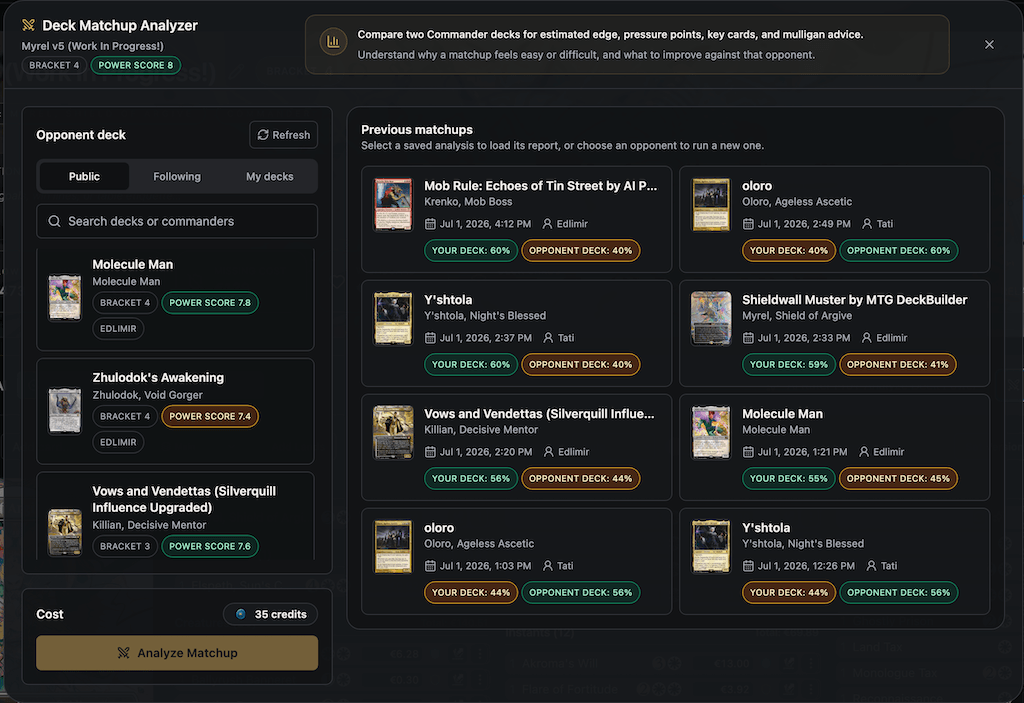
Estimated matchup advantage
The report includes an estimated matchup advantage split, such as 44% for one deck and 56% for the other.
Commander has too much variance for exact prediction. Opening hands, mulligans, sequencing, table politics, threat perception, and the other players all matter.
The percentage is better read as MTG Master's structural estimate: based on the decklists, stats, roles, and pressure points, one deck looks slightly more favored across repeated games.
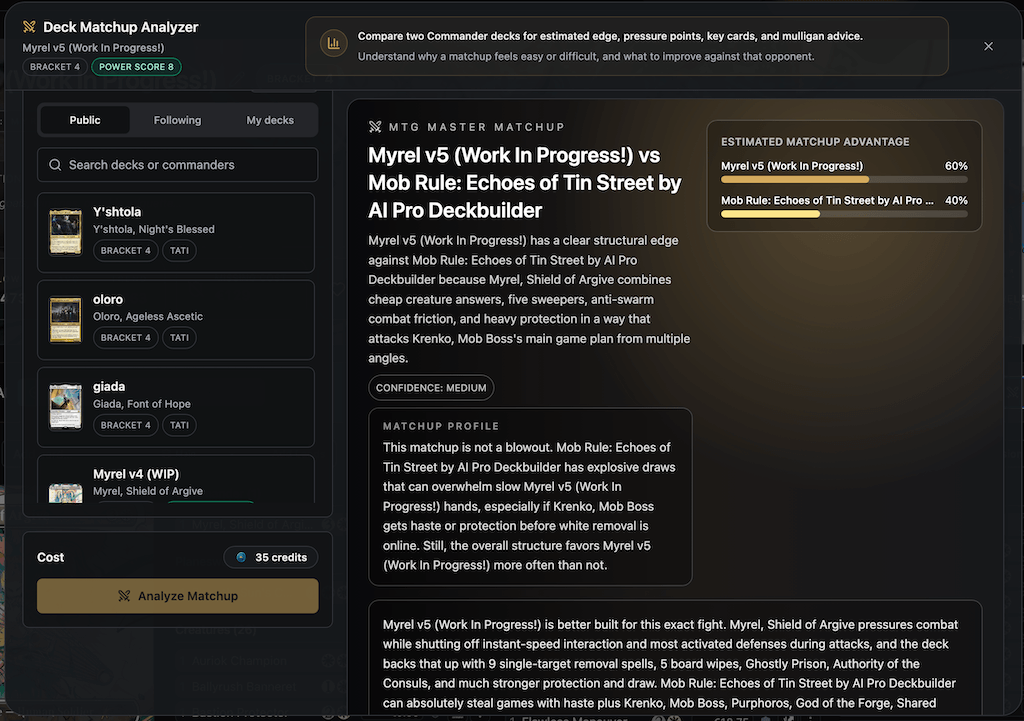
The matchup verdict
The verdict is the quick answer: which deck is favored, how close the matchup is, why that edge exists, and how much variance is involved.
The useful output is not generic text like "this deck has good ramp." It should explain the actual tension, such as a combat deck running into pillow-fort effects, or a commander-dependent strategy facing cheap exile removal.
Start from one of your saved decks
Open your deck library, choose a deck, and run a matchup report against another Commander list.
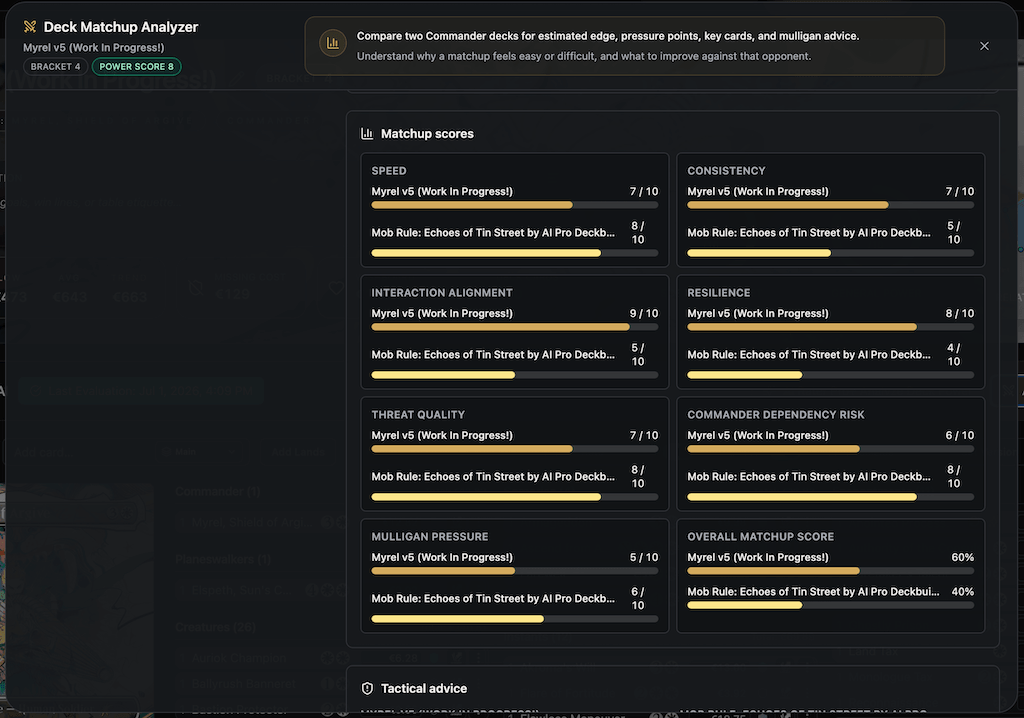
Game phase advantage
Commander matchups often change by phase. Some decks must pressure early. Some stabilize in the mid game. Some are quiet until the late game and then take over.
- Early game: who develops first and what hands matter
- Mid game: which engines, answers, and commanders decide momentum
- Late game: which deck has inevitability or better recovery
Pressure points
A pressure point is something that can decide the matchup: a card, a mechanic, a weakness, or a game state.
- Your commander must survive until the first attack
- The opponent cannot keep a draw engine
- You need exile removal because destroy effects are not enough
- Your combat deck must answer pillow-fort effects before going wide
- You need to avoid overcommitting into sweepers
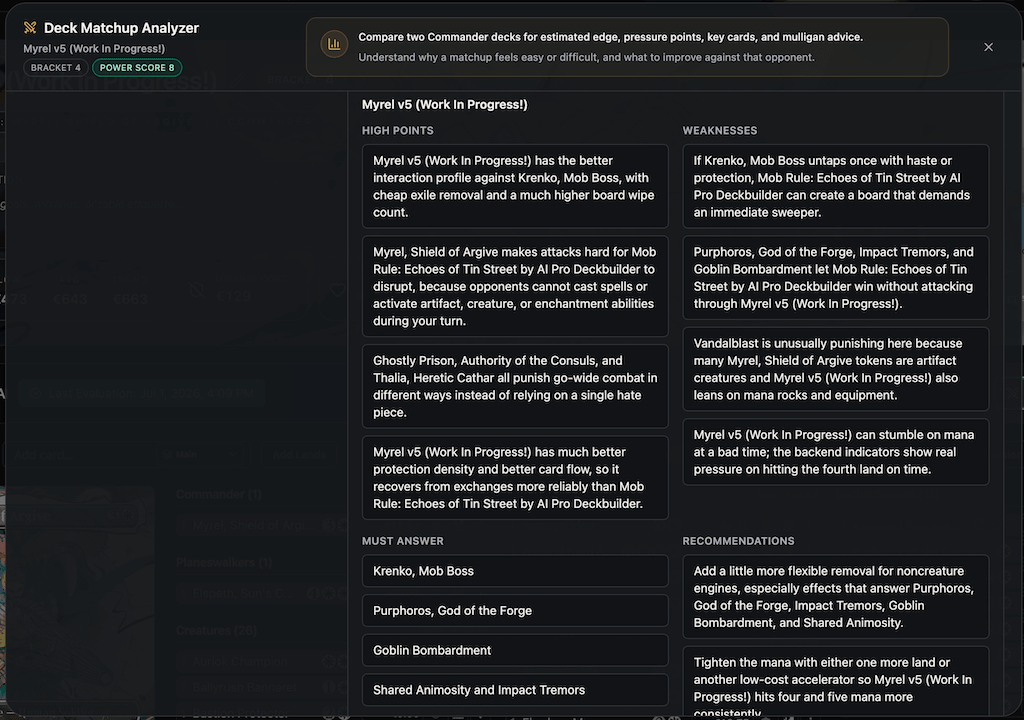
Cards that matter
Not every card matters equally in every matchup. The report highlights the cards that define the game: key threats, answers, protection, board wipes, tutors, draw engines, combo pieces, pillow-fort cards, graveyard hate, and finishers.
That helps you decide whether to remove the commander immediately, save removal for a payoff, destroy the draw engine, hold protection for a wipe, or answer a lock piece before building a board.
Mulligan advice
A good opening hand is not good in every matchup. The analyzer gives matchup-specific mulligan advice for both decks.
- Look for early ramp and enough lands
- Prioritize cheap interaction against fast decks
- Find commander protection against control
- Keep graveyard hate against graveyard engines
- Value early blockers or sweepers against combat pressure
Upgrade recommendations
The upgrade advice is category-first. If the problem is enchantments, the answer is not a random powerful creature. If the commander always dies, the answer may be protection, haste, recursion, or a backup plan.
- Add more exile removal
- Add flexible artifact and enchantment removal
- Add more commander protection
- Add board wipe recovery
- Add graveyard hate
- Add noncombat win conditions
Different from normal deck analysis
A normal deck analysis looks at your list by itself. Matchup analysis asks whether your deck has the right tools for a specific opponent.
That changes everything. A deck with eight removal spells can still be weak if none answer the important permanents. A strong combat plan can still struggle if the opponent taxes attacks. A higher-power deck can still fold to the exact hate piece it cannot remove.
Built for real playgroups
Use the tool to compare your deck against a friend's deck, understand why one pod matchup feels bad, test whether your new build has the right answers, or compare two of your own decks into the same strategy.
Sometimes the issue is not that a deck is too strong. Sometimes it is just a bad matchup. Understanding that can make table conversations better.
The Commander Deck Matchup Analyzer is built to help Commander players understand how two decks actually play into each other, not just how strong each list looks in isolation.