
How to Build a Landfall Commander Deck: More Lands, More Triggers, More Problems
By MTG Master EditorialPublished Updated 21 min read
Normally, playing a land isn't the most exciting thing you do during a Magic game.
You put it on the battlefield, maybe tap it for mana, and move on to something more interesting.
But in a Landfall deck, playing a land can be the most important part of your turn.
You play a Forest, create a creature, draw a card, generate some mana, and put counters on something.
Then you play another land.
And everything happens again.
Suddenly, that simple Forest has done more work than some of the expensive spells in your opponents' hands.
That's what I like about Landfall. You're turning one of the most basic mechanics in Magic into an engine that can generate enormous amounts of value.
And the best part is that you don't necessarily need expensive cards to make it work. Even basic lands can become surprisingly powerful when your deck rewards you for playing them.
But there's a difference between playing lots of lands and building a good Landfall deck.
You need reliable ways to put lands onto the battlefield, enough cards that reward you for doing so, and a plan for turning all that extra value into a win.
Because having fifteen lands and twenty Treasures is impressive.
But eventually, you'll need to do something with them.
What Exactly Is Landfall in Commander?
Landfall is an ability word used on cards that reward you when a land enters the battlefield under your control.
The important part is that the land doesn't necessarily have to be played from your hand.
It can enter through your normal land drop, a ramp spell, an activated ability, or another effect.
For example, imagine you control these three cards:
Tatyova, Benthic Druid
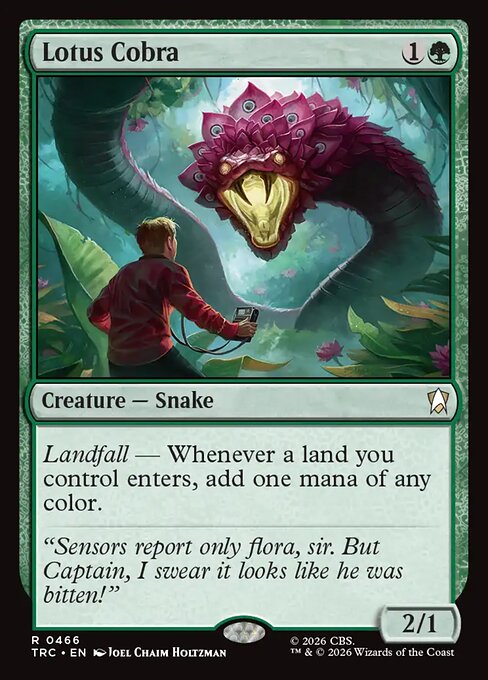
Lotus Cobra
Tireless Provisioner
You play a Forest.
Tatyova lets you gain 1 life and draw a card.
Lotus Cobra adds one mana of any color.
Tireless Provisioner creates either a Treasure or Food token.
That's already a pretty good result from simply playing a land.
Now imagine casting Harrow, which sacrifices a land as an additional cost and puts two basic lands onto the battlefield.
Both lands enter, so each of those abilities triggers twice.
You draw two cards, gain two life, get two mana from Lotus Cobra, and create two tokens with Tireless Provisioner.
And you still have the two new lands available to tap for mana.
That's where Landfall starts becoming really interesting.
You're not only accelerating your mana. You're turning land-based effects into card draw, resources, creatures, and potentially damage.
One important detail: Landfall doesn't care whether the entering land is basic or nonbasic, unless the particular card says otherwise. And lands entering tapped still trigger it.
Choosing the Right Landfall Commander
Your commander has a big influence on how the deck plays.
Some commanders reward you directly whenever lands enter.
Others let you play additional lands, recover them from the graveyard, or turn land drops into creatures and damage.
I like commanders that provide something the deck needs, rather than simply being another expensive Landfall payoff.
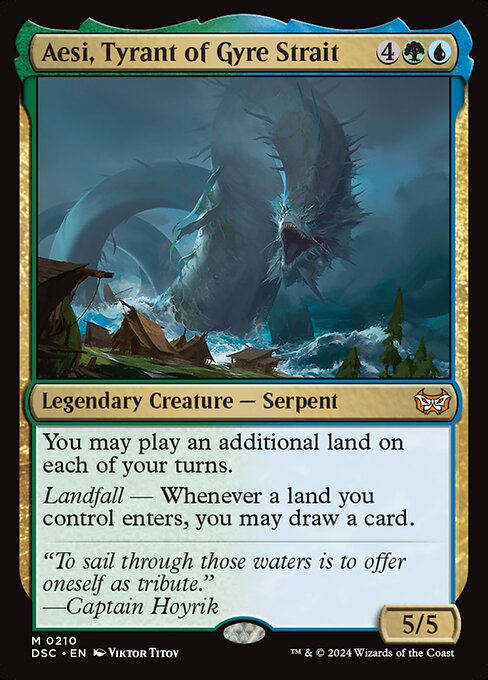
Aesi, Tyrant of Gyre Strait: Lands Become Cards
Aesi, Tyrant of Gyre Strait is one of the most recognizable Landfall commanders.
He lets you play an additional land during each of your turns, and whenever a land enters under your control, you may draw a card.
That's a fantastic combination.
You're able to play more lands, and those lands help you find even more cards.
Once Aesi is on the battlefield, it can become surprisingly difficult to run out of resources.
What I like about Aesi is that the strategy is extremely clear.
You want to play lands, draw cards, and use that advantage to develop your battlefield.
The main drawback is that Aesi costs six mana.
If he gets removed several times, the commander tax can become painful.
And because so much of your card advantage comes from him, I'd still include independent sources of draw.
Tatyova, Benthic Druid: A Little Cheaper, Still Dangerous
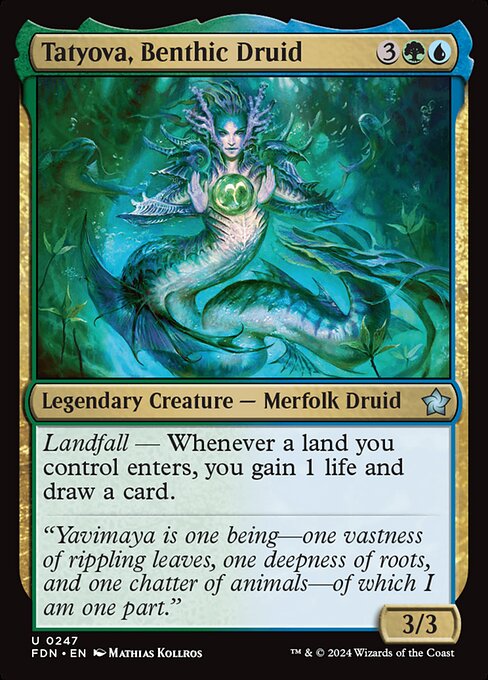
Tatyova, Benthic Druid is another excellent option in Simic colors.
Whenever a land enters under your control, you gain 1 life and draw a card.
Unlike Aesi, Tatyova doesn't let you play additional lands, but she costs one mana less.
I like Tatyova because she provides reliable value without requiring complicated interactions.
You play lands, draw cards, gain some life, and gradually build an advantage.
The life gain might seem relatively small, but over a long Commander game, those extra points can become quite useful.
Especially if your deck has ways to put several lands onto the battlefield during the same turn.
Omnath, Locus of Creation: Landfall With Several Rewards
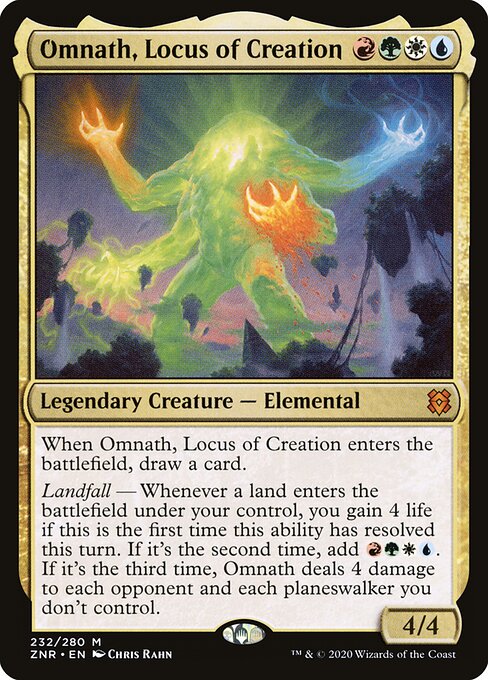
Omnath, Locus of Creation takes Landfall in a different direction.
His Landfall ability changes depending on how many times it has resolved that turn.
The first time, you gain 4 life.
The second time, you generate four mana, one of each of Omnath's colors.
The third time, Omnath deals 4 damage to each opponent and each planeswalker you don't control.
That's a lot of value from three land entries.
I like this approach because your land drops contribute to several different parts of your strategy.
You gain life, generate mana, and eventually deal damage.
The disadvantage is that Omnath has a four-color identity.
That gives you access to many powerful cards, but your mana base becomes more complicated.
And if you're building on a budget, I'd consider whether you really need all four colors before choosing him.
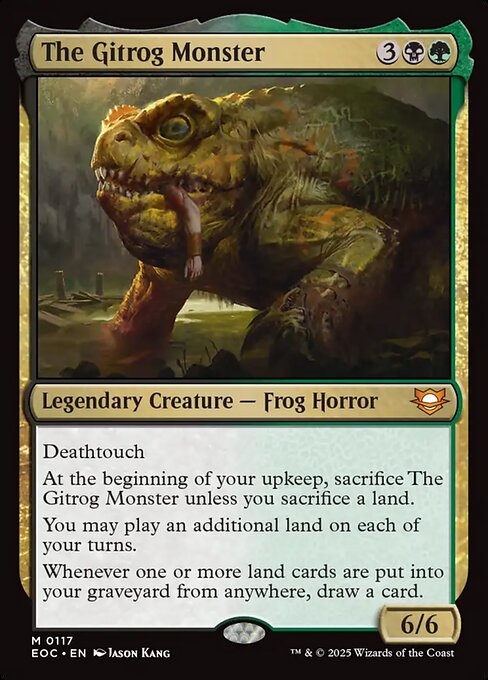
The Gitrog Monster: Lands and Graveyards
The Gitrog Monster doesn't have an ability labeled Landfall, but it's an excellent example of a commander that works with land-based strategies.
It lets you play an additional land during each of your turns. At the beginning of your upkeep, you must sacrifice The Gitrog Monster unless you sacrifice a land. When one or more land cards go to your graveyard from anywhere, you draw a card.
If several lands reach your graveyard at once, you get one draw trigger for that event, not one per land.
That creates some very interesting possibilities.
You can sacrifice lands, recover them, discard them, or put them into your graveyard through other effects.
And instead of treating those lands as lost resources, you're turning them into part of your engine.
I particularly like the idea of combining land strategies with graveyard recursion.
The Gitrog Monster can become extremely powerful, and some builds focus heavily on combos.
But you can also build it as a slower lands-and-graveyard deck if that's the kind of experience you're looking for.
Phylath, World Sculptor: Landfall and an Army of Plants
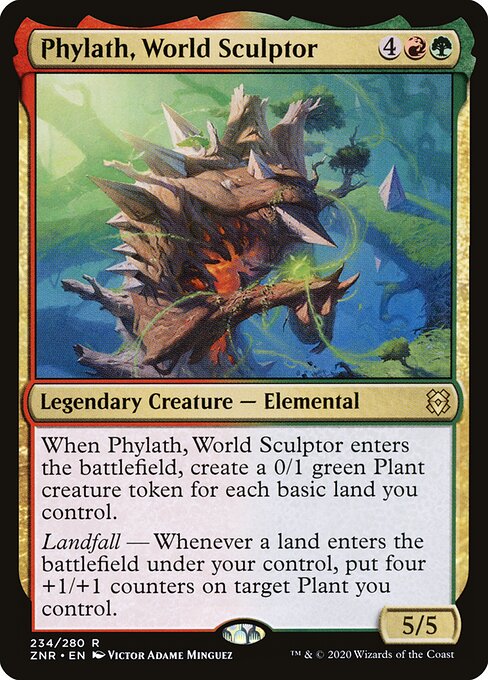
Phylath, World Sculptor is a good option if you want Landfall to become a creature strategy.
When Phylath enters, you create a number of 0/1 Plant tokens equal to the number of basic lands you control.
Then, whenever a land enters under your control, Phylath can put four +1/+1 counters on a Plant you control.
That means your lands aren't just producing mana.
They're helping you turn tiny Plants into enormous threats.
I like Phylath because it gives you a clear way to win through combat.
And having access to red and green makes the deck feel quite different from a Simic Landfall strategy.
Playing More Lands Is the Foundation
One of the first things I'd look at when building Landfall is how consistently the deck can put lands onto the battlefield.
Not just during the first few turns.
Throughout the game.
Because if you're only making your normal land drop each turn, you're probably not getting the most out of the strategy.
There are several ways to improve that.
Additional Land Drops
Cards like Exploration, Azusa, Lost but Seeking, Wayward Swordtooth, and Dryad of the Ilysian Grove allow you to play additional lands.
That's extremely valuable when you have several Landfall payoffs on the battlefield.
Normally, you can play one land during each of your turns.
If an effect lets you play another, that's another opportunity to trigger all your Landfall abilities.
And if you have several effects that allow additional land plays, those permissions can accumulate.
But there's an important problem.
Being allowed to play more lands doesn't mean you actually have more lands to play.
If your hand is empty, Exploration isn't accomplishing much.
That's why additional land-drop effects work particularly well with card draw and ways to recover lands from the graveyard.
I wouldn't fill a deck with extra-land effects without making sure it can keep finding lands.
Ramp That Puts Lands Onto the Battlefield
This is where Landfall differs from many other Commander strategies.
Normally, ramp is about getting access to more mana.
In Landfall, the way you ramp matters.
Cards like Rampant Growth, Nature's Lore, Cultivate, Kodama's Reach, and Harrow can help develop your mana while also contributing to your Landfall strategy.
A mana rock like Arcane Signet is still useful.
But it doesn't trigger Landfall when you play it.
A spell that puts a land onto the battlefield does.
And sometimes that's the difference between simply accelerating your mana and generating several additional resources.
Of course, not every ramp spell works the same way.
Cultivate puts one basic land onto the battlefield tapped and another into your hand. It doesn't trigger Landfall twice immediately.
Harrow, on the other hand, puts two lands onto the battlefield, giving you two Landfall triggers.
Those details matter when choosing your ramp package.
I wouldn't remove every mana rock from a Landfall deck, but I'd generally give more attention to land-based ramp.
Fetchlands: One Land Can Trigger Landfall Twice
This is one of the most useful interactions in the archetype.
A fetchland is a land that can be sacrificed to search for another land.
For example, Evolving Wilds enters the battlefield as a land.
That triggers your Landfall abilities.
Then you can sacrifice it, search your library for a basic land, and put that land onto the battlefield tapped.
That triggers Landfall again.
So one card can produce two separate land entries.
And that can be extremely useful.
The same idea works with Terramorphic Expanse, Fabled Passage, and other lands that sacrifice themselves to search for replacements.
You don't necessarily need expensive fetchlands to benefit from this strategy.
Budget options can still generate extra Landfall triggers while helping fix your mana.
I also like lands such as Myriad Landscape, which can eventually search for up to two basic lands that share a land type and put them onto the battlefield tapped.
That's two Landfall triggers from one activation.
The drawback is that these lands can be slower than more expensive alternatives.
But not every Commander deck needs to be optimized for maximum speed.
If you're building a casual Landfall deck, there are plenty of useful budget options.
Landfall Payoffs: What Happens When a Land Enters?
This is where your deck starts developing its own personality.
Some Landfall cards create creatures.
Others draw cards, generate mana, deal damage, or make your existing creatures more powerful.
And you don't necessarily want all of them.
I'd choose payoffs based on how you intend to win.
Creating Creatures With Landfall
Rampaging Baloths is a classic example.
Whenever a land enters under your control, you create a 4/4 green Beast token. Rampaging Baloths has trample, but the tokens do not get that ability by themselves.
That's already pretty good.
But if you're putting two or three lands onto the battlefield during a turn, you can create an entire army.
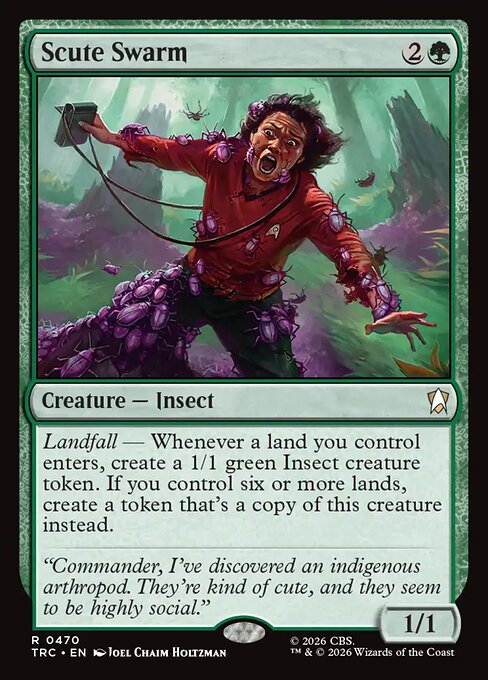
Scute Swarm is another famous Landfall card.
Normally, it creates a 1/1 Insect token whenever a land enters.
But if you control six or more lands when the ability resolves, it creates a token copy of Scute Swarm instead.
And those copies have the same Landfall ability.
You can probably imagine what happens after several more land drops.
Suddenly you have four Scute Swarms.
Then eight.
Then sixteen.
And eventually you're wondering whether you brought enough dice.
I love how ridiculous this card can become, although it's also worth remembering that a single board wipe can remove the entire insect population.
Turning Land Drops Into Damage
Not every Landfall deck needs to win through combat.
Omnath, Locus of the Roil deals damage when it enters, based on your Elemental count. Its Landfall ability puts a +1/+1 counter on an Elemental and draws a card if you control eight or more lands. Valakut Exploration is the example here that can turn unused exiled cards into damage at your end step.
Valakut Exploration is particularly interesting because it provides access to additional cards when lands enter, then can damage your opponents with cards left exiled by it at your end step.
That means your land drops can contribute to both card advantage and a win condition.
I like payoffs that accomplish more than one thing.
They make the deck less dependent on finding a separate finisher after generating lots of resources.
Growing Your Creatures
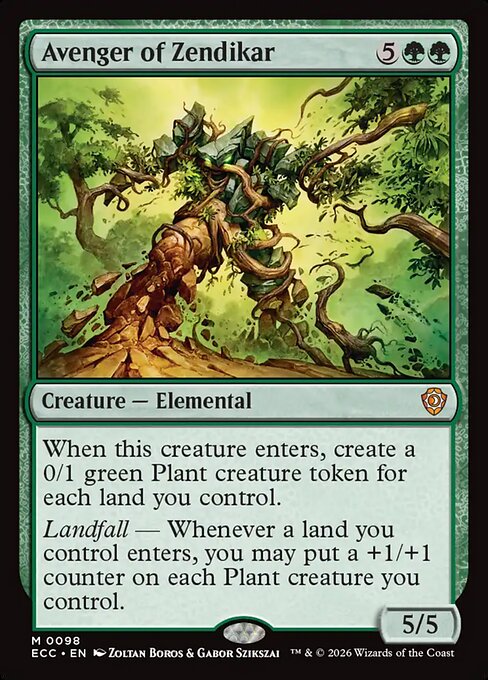
Avenger of Zendikar is one of the most recognizable cards for this.
When it enters the battlefield, it creates a number of Plant tokens equal to the number of lands you control.
Then its Landfall ability puts a +1/+1 counter on each Plant you control whenever a land enters.
A few land drops can turn those harmless Plants into a surprisingly dangerous army.
Felidar Retreat is another interesting card.
Whenever a land enters, you can create a 2/2 Cat Beast token, or put a +1/+1 counter on each creature you control and give them vigilance until end of turn.
That flexibility is excellent.
You can create more creatures when you need them, then start making your entire board stronger.
I like cards that give you those kinds of decisions instead of always producing the same effect.
Returning Lands From the Graveyard
This is one of my favorite parts of building Landfall.
Your lands don't necessarily need to be used only once.
Cards like Ramunap Excavator and Crucible of Worlds allow you to play lands from your graveyard.
That becomes particularly interesting with lands that sacrifice themselves.
Imagine you have Ramunap Excavator on the battlefield and Evolving Wilds in your graveyard.
You can play Evolving Wilds from your graveyard, provided you have a land play available.
It enters and triggers Landfall.
You sacrifice it, search for a basic land, and trigger Landfall again.
And Evolving Wilds goes back to your graveyard, ready to be played again on a future turn.
That's a very useful engine.
Life from the Loam is another excellent tool because it can return up to three lands from your graveyard to your hand.
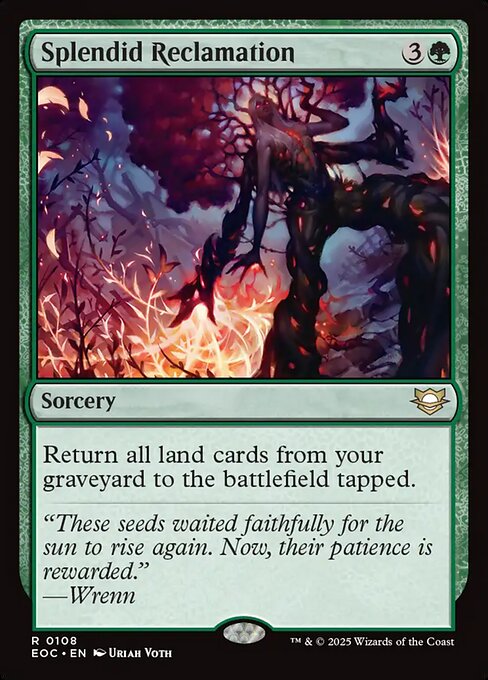
And Splendid Reclamation can return all land cards from your graveyard to the battlefield tapped.
Imagine resolving Splendid Reclamation with eight lands in your graveyard and several Landfall payoffs in play.
Those eight lands enter, and each of your Landfall abilities can trigger eight times.
That's the sort of turn that makes everybody at the table start paying attention.
But remember that playing lands from the graveyard still respects your normal land-play limits unless another effect allows additional plays.
Ramunap Excavator doesn't automatically give you unlimited land drops.
Card Draw: Don't Run Out of Lands
One of the biggest mistakes I'd watch out for is including lots of effects that let you play additional lands without enough ways to find more lands.
You play two or three lands in one turn.
Great.
But what happens next?
If you've emptied your hand, your Landfall engines might stop working.
That's why I like commanders such as Aesi and Tatyova.
They turn land entries into card draw, helping you find more resources.
Cards like Tireless Tracker can also provide card advantage through Clue tokens.
And more conventional draw spells still have a place in the deck.
I wouldn't rely entirely on one creature staying alive.
If your commander gets removed repeatedly, you still need ways to continue developing.
I'd also consider cards that help you play lands from the top of your library.
Oracle of Mul Daya is a classic example.
It lets you play an additional land each turn and allows you to play lands from the top of your library.
That can help keep your Landfall strategy moving without relying exclusively on the lands in your hand.
But remember that you still need actual land cards available.
No amount of extra-land permissions helps if you can't find any more lands.
How Many Lands Should a Landfall Commander Deck Play?
Landfall is one of the archetypes where I'd normally consider playing more lands than usual.
But that doesn't mean every Landfall deck needs fifty lands.
It depends on the commander, the mana curve, how much card draw you have, and whether you're using lands as part of your engine.
For a typical Landfall deck, I'd start by looking somewhere around 38–42 lands and adjust from there.
Some decks will want more.
Others can function with fewer if they're built around efficient ramp, card selection, and recurring lands.
But I'd be careful about reducing the land count simply to fit more exciting spells.
In Landfall, lands are not just mana sources.
They're also the cards that activate much of your strategy.
That makes them more valuable than they would be in many other decks.
I also wouldn't assume that more expensive lands automatically make a better deck.
Basic lands can work perfectly well.
And cheap utility lands that sacrifice themselves can sometimes be more useful than expensive dual lands that don't contribute additional Landfall triggers.
The important thing is having a mana base that supports both your colors and your strategy.
How Does a Landfall Deck Actually Win?
This is something I always like to decide before finishing a deck.
Because Landfall can generate enormous amounts of value without necessarily winning.
You might have twelve lands, fifteen Treasures, and a hand full of cards.
But eventually, you need to finish the game.
There are several ways to do that.
Win With a Huge Army
This is one of the most straightforward approaches.
Cards like Scute Swarm, Rampaging Baloths, and Avenger of Zendikar can generate lots of creatures.
Then you use a card like Overwhelming Stampede or another combat finisher to turn that army into lethal damage.
This works especially well if your deck already has several ways to put additional lands onto the battlefield.
But I'd also include some protection or ways to recover from board wipes.
Creating fifty creatures is impressive.
Losing all fifty to one spell is considerably less impressive.
Win Through Landfall Damage
Some decks can win by repeatedly triggering effects that damage opponents.
This approach can be particularly effective with commanders like Omnath or other land-based damage engines.
You don't necessarily need to attack.
Instead, you focus on generating enough land entries to create a decisive amount of damage.
I like having this option in a deck that otherwise focuses on creatures.
It means you're not completely dependent on combat.
Win With Combos
Landfall can also produce some powerful combos.
Cards like Retreat to Coralhelm, Sakura-Tribe Scout, and lands that return other lands to your hand can form interesting repeatable engines when combined with the right additional pieces.
Other combinations involve Kodama of the East Tree, token generation, and lands that return to your hand.
Depending on the exact cards, these interactions can generate repeated Landfall triggers, tokens, mana, or even infinite loops.
But I wouldn't automatically include every combo available.
If you're building a high-power deck, those interactions might fit perfectly.
If you're aiming for casual Commander, repeatedly playing lands and growing a huge army can be just as satisfying.
Personally, I enjoy Landfall most when the deck develops naturally and becomes increasingly dangerous as more lands enter.
I don't need every game to end with the same combo.
Don't Forget Interaction and Protection
It's easy to fill a Landfall deck with extra-land effects, token generators, recursion, and expensive payoffs.
There's always another interesting land interaction to discover.
But your opponents are also playing Magic.
You still need removal, protection, and some ways to deal with problematic permanents.
In green, cards like Beast Within and Nature's Claim can help.
Blue gives you access to counterspells and other useful interaction.
White and red provide additional options depending on your commander.
I also like having ways to protect important creatures and enchantments.
If your entire strategy depends on keeping one Landfall payoff alive, opponents will eventually identify it as a threat.
And don't forget that board wipes can be especially painful if your Landfall deck creates lots of tokens.
The advantage is that your lands normally survive creature board wipes.
So even if you lose your creatures, you may still have enough mana to rebuild quickly.
That's one of the strengths of land-based strategies.
Common Mistakes When Building Landfall
There are several things I'd watch out for.
Too many extra-land effects, not enough card draw. Being allowed to play three lands is pointless if you have none in your hand or otherwise available.
Too few lands. Your lands are part of your engine, not just your mana base.
Too many expensive payoffs. Having powerful six- and seven-mana creatures is great, but you still need to survive the early game.
No way to finish. Generating mana and drawing cards is useful, but you need to convert those resources into a victory.
Ignoring graveyard interaction. If your deck depends on reusing lands from the graveyard, expect opponents to interfere.
Overcommitting to tokens. A huge army is vulnerable to board wipes, even if you created it through Landfall.
Assuming every land-related card belongs in the deck. Some cards are excellent in lands-matter strategies but don't actually help your particular Landfall plan.
And one more thing: actually playing a land is limited to your own main phase while the stack is empty, and uses a land play. A spell or ability that puts a land onto the battlefield is doing something different and does not use that allowance.
Having several extra-land effects doesn't let you play a land whenever you want.
Test Your Landfall Deck Before Buying Everything
Landfall is one of those strategies that can look fantastic when you're browsing cards.
You find powerful Landfall creatures, cards that let you play extra lands, ways to recover lands from the graveyard, and a few spectacular finishers.
And suddenly your decklist is full of cards that all seem to work perfectly together.
But actual games can reveal problems.
Maybe you draw several expensive payoffs but not enough ramp.
Maybe you can play additional lands but keep running out of them.
Or perhaps you generate plenty of mana without finding a way to win.
That's why I'd test the deck before buying every card.
In MTG Master Deck Builder, you can build your Landfall Commander deck, explore card synergies, and use the Deck Analyzer to review consistency, mana curve, interaction, resilience, and other aspects of the deck.
I'd pay particular attention to the land count, ramp package, and how well the deck can generate card advantage.
The opening-hand simulator is useful too.
Try several hands and see whether you can reliably develop your mana during the first few turns.
And if your deck includes repeatable land recursion, bounce lands, or token-producing engines, the combo detection tools are worth reviewing.
Sometimes a combination of cards you've included for ordinary value turns out to create a much more powerful loop.
No analyzer replaces real games, of course.
But it can help identify structural weaknesses before you spend money on a deck that doesn't quite work the way you imagined.
Is Landfall the Right Archetype for You?
I think Landfall is a fantastic choice if you enjoy building engines, generating resources, and watching your battlefield become increasingly powerful.
It's also interesting because the deck can play in several different ways.
You can build an enormous army.
You can draw lots of cards and control the game.
You can recur lands from the graveyard.
Or you can focus on triggering damage abilities until your opponents run out of life.
And unlike some strategies that depend on casting lots of expensive spells, Landfall turns something you're already supposed to do into part of your win condition.
You're going to play lands anyway.
You might as well get something extra from them.
But Landfall isn't for everyone.
If you prefer straightforward combat or don't enjoy managing lots of triggers, some Landfall decks can become surprisingly complicated.
And if you play cards like Scute Swarm, you might eventually spend more time counting tokens than actually playing Magic.
Personally, I think the most enjoyable Landfall decks are those where every land drop feels useful, but the deck doesn't collapse when one important payoff disappears.
You play a land, generate some value, develop your board, and gradually build toward a victory.
And when you finally announce that you're playing your fourth land of the turn, only to see your opponents checking how many Landfall triggers you have...
Well, that's usually when you know the deck is working.
Build a Landfall deck where every land matters
Balance lands, ramp, card advantage and Landfall payoffs around your commander in Deck Builder.